

Key Takeaways
- A standard carry-on can hold seven days of clothes when you choose items that mix and match.
- Rolling clothes instead of folding reduces wrinkles and saves measurable space.
- Wearing your bulkiest outfit on travel day keeps bag weight and volume lower.
- Limiting yourself to one color palette makes it easier to reuse pieces across multiple outfits.
- Packing cubes compress contents and keep categories separated so repacking is faster each day.
What you will need
Why seven days fits in one bag
The assumption that a week of travel requires a checked bag is built on two common habits: packing one outfit per day and treating each outfit as a distinct set of clothes. Neither habit holds up when you plan around reuse and mix-and-match flexibility.
Seven days of clothing does not mean seven complete outfit changes. It means enough pieces to produce seven presentable looks from a smaller set of items. Most adults already do this at home without thinking about it. The difference is that at home, a full closet provides options automatically. A travel bag requires you to create those options deliberately before you leave.
For a broader foundation on packing systems that work across trip types, the end-to-end packing resource covers bag selection and organizational strategy in depth. If you are newer to packing efficiently, the introduction to packing well explains the basics clearly before you tackle a week-long bag.
What you will need
How to pack for a week
Follow these steps in order. Each one builds on the last, so skipping ahead typically results in a bag that does not close or an outfit gap you only discover on day four.
Carry-on bag
The primary container for all clothing; choose a soft-sided bag that flexes to fit overhead bins.
Packing cubes
Compress and categorize clothing so items stay organized and the bag closes easily.
Compression sacks
Remove air from bulky items like sweaters or a light jacket to reduce their packed volume.
Dry-cleaning or mesh laundry bag
Separate worn clothing from clean items throughout the trip.
Audit your trip's actual activities
Write down every type of activity you have planned: flights, city walking, a formal dinner, beach time, hiking, or any combination. Then count how many of each you have. Most travelers pack for imagined scenarios rather than confirmed plans, which is the single biggest cause of overpacking.
For a seven-day trip, a realistic activity audit usually reveals two or three distinct clothing contexts, not seven separate ones. That changes how many items you actually need to bring.
Build a single cohesive color palette
Choose two neutral base colors (such as navy and khaki, or black and grey) and one accent color. Every item you pack should work with at least two other items in the bag. This constraint forces mix-and-match versatility and eliminates single-use pieces.
A typical seven-day palette might include: three tops, two bottoms, one dress or one pair of versatile pants that work across contexts, one lightweight layer, and one set of shoes beyond what you wear on the plane. Accessories in the accent color can shift the same outfit between casual and dressed-up contexts.
Apply the roll-and-fill method
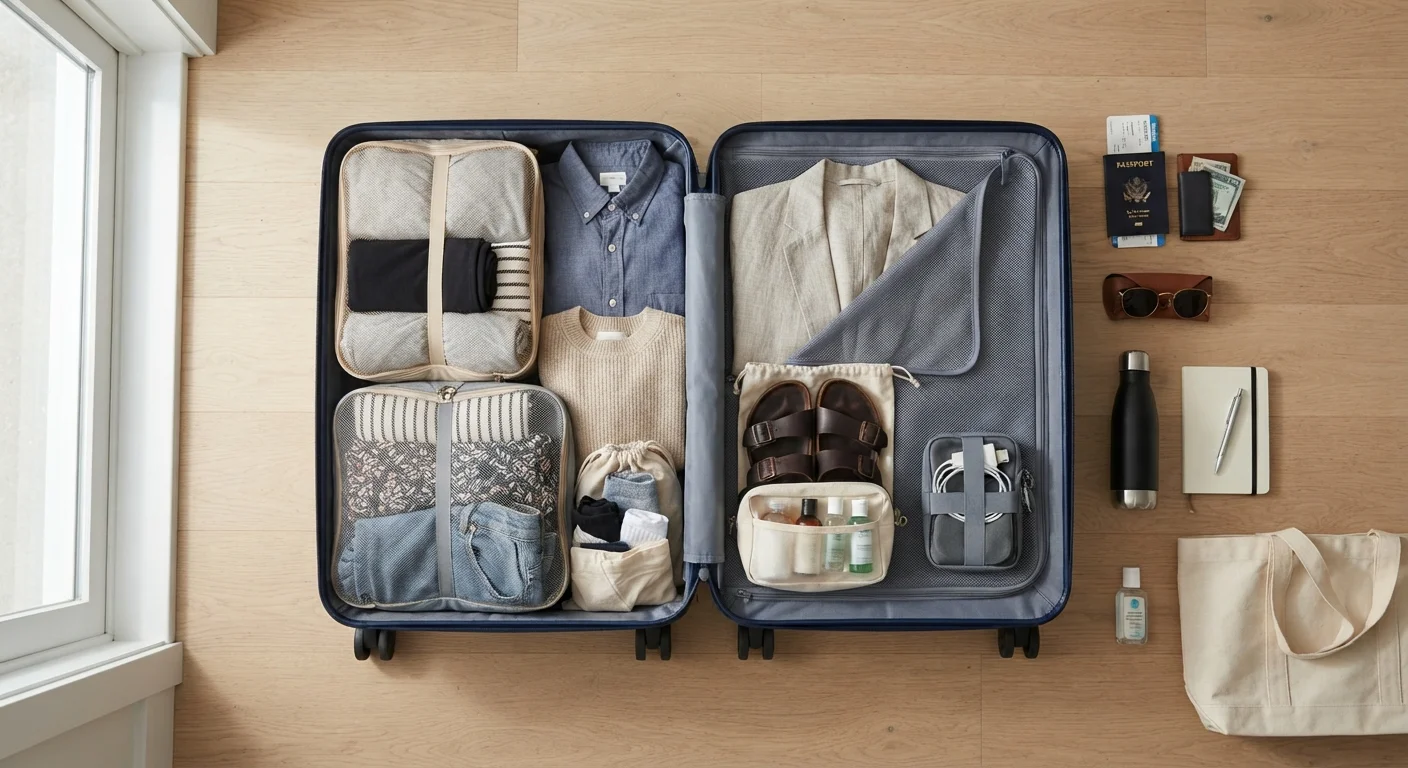
Roll each garment tightly rather than folding it flat. Start with the heaviest items: jeans, trousers, and structured tops. Place these along the bottom and sides of the bag where the frame is. Rolled t-shirts and underwear fill gaps and corners.
If you are using packing cubes, assign one cube per category: tops in one, bottoms in another, underwear and socks in a third. Compress each cube before zipping. The full breakdown of packing cube tradeoffs covers when they help most and when they add more bulk than they remove.
Handle shoes and bulky items last
Shoes go sole-down along one side of the bag. Stuff socks inside each shoe to preserve shape and reclaim dead space. A light jacket or sweater can wrap around the interior perimeter of the bag rather than sitting in a folded pile in the center.
If cold weather is part of your trip, the guide to packing light for cold weather goes deeper on layering strategies that reduce bulk without sacrificing warmth.
Do a trial close before travel day
Pack everything and close the bag completely at least one day before you leave. If it does not close without forcing, remove items until it closes easily. A bag packed to its absolute limit is hard to repack mid-trip and risks seam damage or a gate-check fee.
Stand the packed bag upright and lift it as if putting it in an overhead bin. If you cannot do this with one arm, the bag is too heavy for most airline carry-on policies, regardless of its dimensions. Remove items until the lift is manageable.
Wear your biggest items on travel day
Put on your heaviest shoes, thickest pants, and bulkiest jacket before you leave home. These items take up the most space in a bag, and wearing them costs you nothing at the gate. Your bag will be noticeably lighter and easier to close.
Airline size limits vary, so verify before you go
Carry-on dimensions differ between carriers and even between fare classes on the same airline. A bag that fits on one carrier may be gate-checked on another. Always confirm your specific airline's current carry-on size and weight limits before your travel date, and measure your packed bag, not just the empty one.
Do not rely on laundry access without confirming it first
This packing method assumes you can wash at least a few items mid-trip. Coin laundry, in-room laundry bags, and sink-washing all work, but none are guaranteed. Before committing to a minimal wardrobe, confirm what laundry options exist at your specific accommodation. If none are available, add one or two garment days to your count.
Adapting this approach to different trip types
A week-long leisure trip is the easiest context for this method. Business trips add constraints: a suit, dress shoes, and presentation-ready garments take up more volume and resist the rolling technique. The guide to business trip packing covers how to balance professional wardrobe requirements with carry-on limits.
Family travel is a different problem. When you are packing for children as well as yourself, the one-bag approach applies per person but requires coordination across the group to avoid redundancy in shared items like sunscreen, first aid, or snacks. The family travel packing guide goes into how to distribute the load.
For any trip, the bag you choose matters as much as how you pack it. A structured hard shell may protect fragile items but does not compress to fit tight overhead bins. The comparison of soft-sided and hard-shell bags explains which suits carry-on travel better and why.