

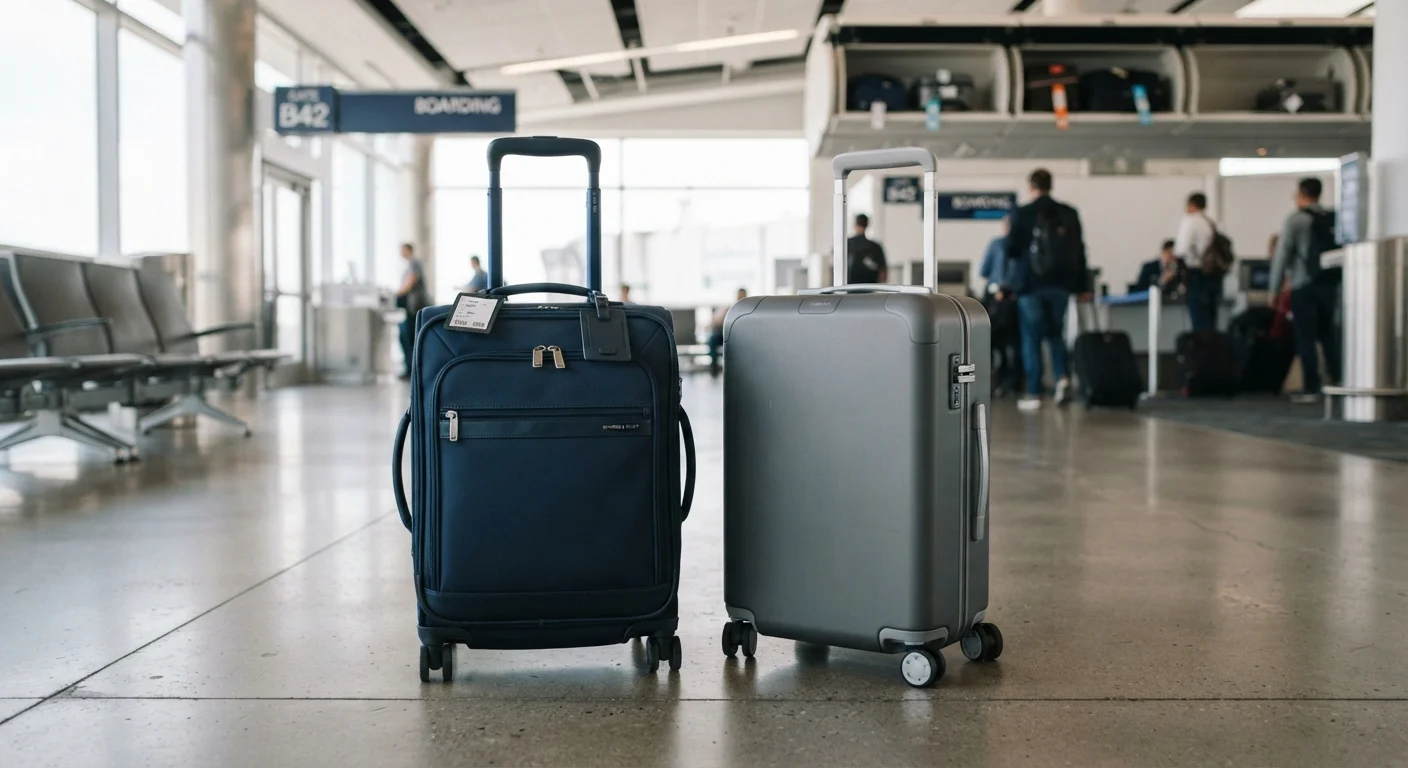
Key Takeaways
- Soft-sided bags flex to fit irregular overhead bin space; hard shells do not compress at all.
- Hard shells protect fragile contents better and resist moisture if the zippers seal fully.
- Soft-sided bags typically weigh less empty, giving you more of your weight allowance for contents.
- For a one- or two-night trip, bag structure matters less than knowing your airline's size rules.
- Both types are available as carry-on dimensions; the choice is about contents and travel style, not trip length alone.
Option A
Soft-sided luggage
The flexible, packable option for tight spaces and variable loads.
Best for: Travelers who need to squeeze into overhead bins, use personal item allowances, or pack inconsistent volumes across trips.
Option B
Hard-shell luggage
The rigid, protective structure for fragile or moisture-sensitive contents.
Best for: Travelers carrying breakables, electronics, or anything that cannot handle compression or a wet baggage carousel.
If you overpack or pack differently every trip
Soft-sided luggage
The flexible walls give a few extra inches of give when you've stuffed in one item too many, and exterior pockets let you adjust load distribution on the fly.
If you carry a camera, glass bottles, or fragile souvenirs
Hard-shell luggage
Rigid walls absorb direct impacts that would crush soft fabric, and the sealed interior keeps contents dry if the bag gets wet on the tarmac.
If you travel on budget carriers with strict size enforcement
Soft-sided luggage
Soft bags are easier to compress slightly when a gate agent checks fit in a sizing box, and many fold flat for storage under the seat.
If you check luggage and worry about rough handling
Hard-shell luggage
Hard shells resist punctures and crushing during baggage handling in a way soft fabric simply cannot match.
How the two structures actually differ
Soft-sided luggage uses woven fabric, nylon, or polyester stretched over an internal frame or no frame at all. The shell gives when pressed, which lets the bag squeeze into an overhead bin that a rigid case would block. Most soft bags also have exterior pockets, so you can access a phone charger or boarding pass without opening the main compartment.
Hard-shell luggage is molded from polycarbonate, ABS plastic, or aluminum. The walls hold their shape regardless of what surrounds the bag, which means a full bin may not accept a large hard shell at all. What that rigidity buys you is impact resistance: the case takes the blow instead of passing it to your contents.
| Criterion | Soft-sided luggage | Hard-shell luggage |
|---|---|---|
| Overhead bin flexibility | Compresses slightly to fit | Fixed shape, may not fit |
| Typical empty carry-on weight | 5 to 7 lbs | 7 to 10 lbs |
| Impact protection | Low, fabric absorbs little force | High, shell deflects direct blows |
| Moisture resistance | Low unless treated or lined | High if zipper seals fully |
| Exterior pockets | Usually 2 to 3 zip pockets | None |
| Overfill tolerance | Walls flex to accommodate | Interior depth is fixed |
| Repairability | Zippers and fabric replaceable | Cracks are hard to repair |
Weight is a practical factor worth checking before you buy. Soft-sided carry-ons often weigh between 5 and 7 pounds empty. Hard shells in the same carry-on dimension commonly run 7 to 10 pounds. On airlines that enforce a 15- or 22-pound carry-on limit, that difference affects how much you can actually pack. See how weight limits work across carriers before you commit to a bag.
Weekend trips: where structure changes the math
A weekend trip typically means one or two nights and a single carry-on or personal item. At that scale, the bag's structure interacts with two decisions: whether you're flying carry-on only, and what you're bringing.
If you're flying carry-on only on a domestic route, a soft-sided bag has a practical edge. Gate agents on full flights sometimes ask passengers to check bags that don't fit the sizing box. A soft bag compresses enough to pass that test more often than a hard shell of nominally identical dimensions. Deciding between a checked bag and a carry-on involves more variables than just size, but structure is one of them.
If you're bringing a bottle of wine, a camera lens, or any item that breaks under pressure, the calculus shifts. Hard shells absorb lateral compression that fabric bags pass straight through. A soft bag packed tightly into an overhead bin with bags stacked on top of it will transmit that weight to whatever is inside.
Airline sizing boxes vary
Airlines publish carry-on size limits, but the physical sizing boxes at gates are not always built to the same dimensions. Soft bags pass the box test more consistently because they compress. If you travel frequently on budget carriers, check whether your bag's published dimensions include wheels and handles, since many hard shells exceed the stated limit once those are counted.
For family travel, the decision multiplies. Each person's bag choice affects how the group moves through a terminal. Distributing loads across a family group is easier when at least one adult carries a soft bag with accessible exterior pockets for documents and snacks.
Packing efficiency by bag type
Soft-sided bags accept irregular shapes better. A pair of shoes, a book, and a folded jacket pack into a soft bag without visible gaps because the walls adjust slightly. Hard shells work best with flat, layered packing: clothes in the main clamshell, small items in the mesh divider. That structure suits methodical packers who fold everything flat.
Exterior pockets are exclusive to soft bags. Depending on the design, you might have two or three zip compartments for small items. Hard shells have none: everything goes inside the main body. If you reach for items frequently during travel, that difference is noticeable.
Compression straps inside the main compartment exist on both types, but on a hard shell they matter more because you can't compress the shell itself. Overfilling a hard shell past its interior depth means the zipper either strains or won't close. Soft bags tolerate modest overfilling without that risk. For a practical approach to fitting everything into one bag, this guide to fitting a week's worth of clothes into one bag covers folding and layering methods that apply to both structures.
Durability and what actually wears out
Hard shells crack at the corners after repeated rough handling. Polycarbonate flexes and resists cracking better than ABS, but neither is immune to a direct drop on a hard floor. Once a hard shell cracks, repair is difficult and cosmetic damage is permanent.
Soft bags wear through fabric abrasion and zipper failure. The zipper pulls on frequently opened exterior pockets tend to fail first. Fabric tears near zipper teeth are common after two or three years of regular use. Neither type is definitively more durable: they fail in different ways depending on how you use them.
For a broader foundation on building a packing system that holds up across many trip types, this end-to-end packing resource covers bag selection alongside the organizational habits that reduce wear on any luggage.