

Key Takeaways
- Packing cubes compress clothing and reduce suitcase chaos, but they add weight and bulk of their own.
- They work best for trips where you keep items separated by category or person.
- Cubes are less useful for ultralight travel or bags with irregular interior shapes.
- A partial cube setup often works better than committing every item to a cube.
Separates clothing by category without extra compartments
You assign each cube a purpose (tops, bottoms, workout gear) and locate items without digging. This is most useful when a bag has a single main cavity.
Speeds up unpacking at each destination
Cubes move directly from bag to drawer, so settling into a hotel room takes minutes rather than a full unpack. On a multi-stop trip, this adds up.
Compression versions recover usable space
Double-zip compression cubes can reduce the thickness of a folded clothing stack by 20 to 30 percent, which matters when fitting a week of clothes into a carry-on.
Keeps a shared bag organized between travelers
Assigning one cube per person in a family bag makes it easy to identify and hand off each person's items without unpacking everything.
Enforces packing limits through physical constraint
If a category does not fit in its assigned cube, items must be left behind. That built-in limit can reduce the tendency to overpack.
Each cube adds weight before you pack a single item
A typical fabric cube weighs 1 to 3 ounces. A set of five adds up to nearly a pound, which matters on airlines with strict carry-on weight policies.
Cube walls reduce net usable bag volume
The fabric and structure of each cube occupy space on their own, so your effective packing capacity is slightly less than the bag's listed liter volume.
Rigid structure makes in-trip additions harder
If you buy clothing or pick up items during your trip, fitting them into a full cube requires reorganizing the whole system.
Less efficient in bags with irregular shapes
Rectangular cubes leave dead space in tapered or curved bags. A loose packer can fill those odd corners naturally; a cube packer cannot.
Unnecessary for disciplined rollers or minimalist packers
Travelers who already roll clothing tightly and pack only what they need may find that cubes add process without adding benefit.
Our Verdict
Packing cubes genuinely improve organization and speed up unpacking for most travelers, particularly on multi-stop or family trips. The tradeoff is added weight and a small reduction in usable bag volume. They are a tool worth using selectively, not a system that every packer needs.
Travelers who move between multiple destinations, share bags with family members, or struggle to find items quickly in a full suitcase.
What packing cubes actually do
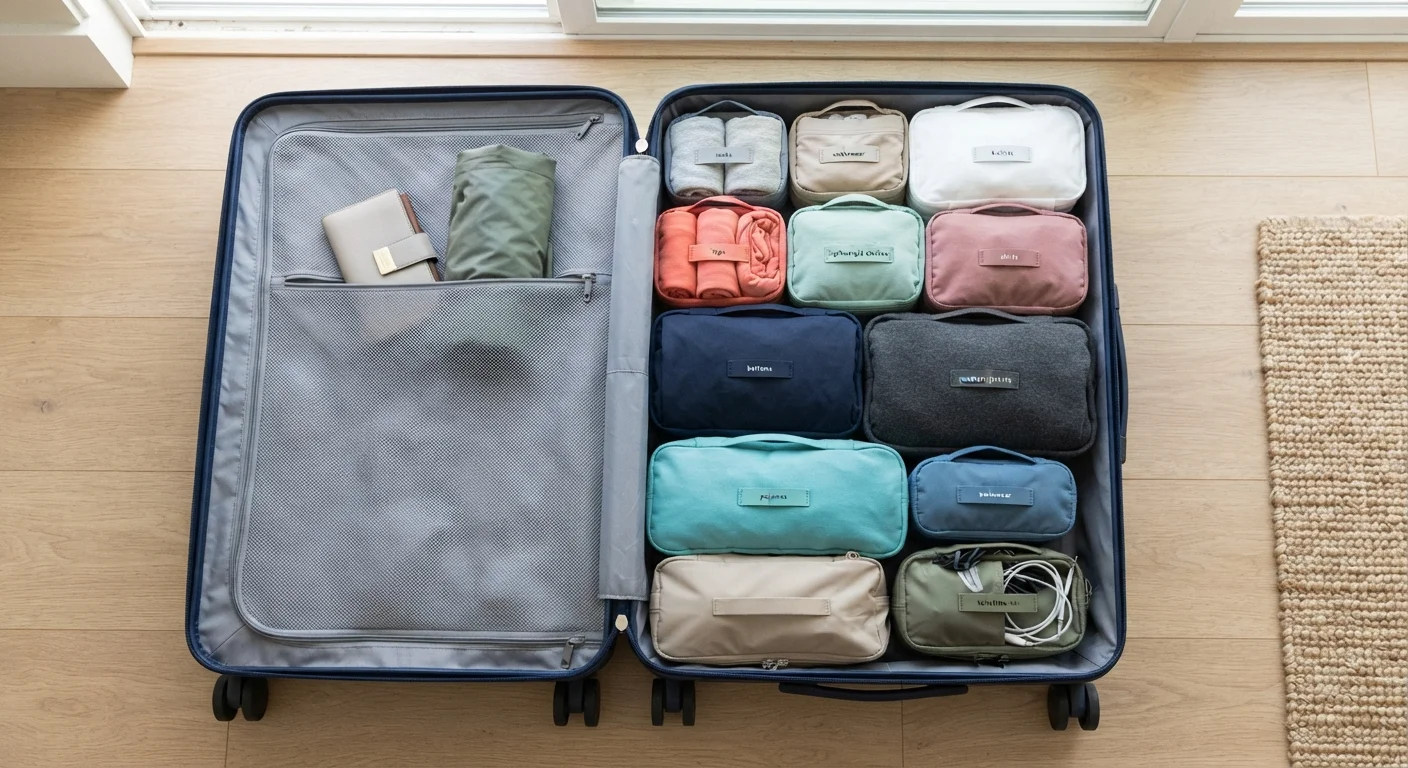
Packing cubes are zippered fabric rectangles designed to fit inside a suitcase or backpack. You fill each one with a category of clothing or gear, zip it shut, and stack the cubes inside your bag. The result is a compartmentalized bag without built-in dividers.
The system works on a simple principle: instead of fishing through a single large cavity, you pull out one cube at a time. A cube labeled for tops sits separately from one holding bottoms or workout gear. When you arrive at your hotel, you can place cubes directly in drawers without unpacking individual items at all.
For a broader look at how cube systems fit into a full packing strategy, see this end-to-end packing resource.
Separates clothing by category without extra compartments
You assign each cube a purpose (tops, bottoms, workout gear) and locate items without digging. This is most useful when a bag has a single main cavity.
Speeds up unpacking at each destination
Cubes move directly from bag to drawer, so settling into a hotel room takes minutes rather than a full unpack. On a multi-stop trip, this adds up.
Compression versions recover usable space
Double-zip compression cubes can reduce the thickness of a folded clothing stack by 20 to 30 percent, which matters when fitting a week of clothes into a carry-on.
Keeps a shared bag organized between travelers
Assigning one cube per person in a family bag makes it easy to identify and hand off each person's items without unpacking everything.
Enforces packing limits through physical constraint
If a category does not fit in its assigned cube, items must be left behind. That built-in limit can reduce the tendency to overpack.
Where the system falls short
The case against packing cubes is not that they fail at organization; it is that organization comes with costs.
Every cube adds its own weight, typically 1 to 3 ounces per cube, which matters most when you are flying on carriers with strict carry-on weight limits. Empty cubes also take up volume before a single item goes in, so a bag that once held 40 liters of clothing effectively holds a bit less when cube walls are factored in.
Cubes also impose a rigid structure. If you buy a shirt at your destination or pick up a souvenir, fitting it into an already-packed cube means reorganizing. Travelers who pack loosely and adjust on the fly often find the system more constraining than helpful.
Bags with tapered shapes, external frame pockets, or irregular cavities often leave dead space around cube corners that a loose packer would fill naturally. If you are already a disciplined packer who rolls clothing tightly, you may gain little that your existing habits do not already provide.
The clutter-function tradeoff in home organization applies here too: adding structure does not automatically reduce mess if the underlying habits are not there.
Each cube adds weight before you pack a single item
A typical fabric cube weighs 1 to 3 ounces. A set of five adds up to nearly a pound, which matters on airlines with strict carry-on weight policies.
Cube walls reduce net usable bag volume
The fabric and structure of each cube occupy space on their own, so your effective packing capacity is slightly less than the bag's listed liter volume.
Rigid structure makes in-trip additions harder
If you buy clothing or pick up items during your trip, fitting them into a full cube requires reorganizing the whole system.
Less efficient in bags with irregular shapes
Rectangular cubes leave dead space in tapered or curved bags. A loose packer can fill those odd corners naturally; a cube packer cannot.
Unnecessary for disciplined rollers or minimalist packers
Travelers who already roll clothing tightly and pack only what they need may find that cubes add process without adding benefit.
When cubes make the most sense
Multi-stop trips are the strongest use case. When you are moving between three cities in ten days, a cube system means you never have to fully unpack and repack. You can locate clean clothes quickly even when jet-lagged and pressed for time.
Family travel is another clear fit. Assigning one cube per person within a shared bag removes the argument over whose socks are whose and makes it easy for each traveler to grab their own items at the hotel. See packing strategies for family travel for practical ways to distribute the load.
Cubes also help travelers who pack a week or more of clothing into a single carry-on. The compression versions, which have a second zip that flattens the cube further, can buy back meaningful space. That approach pairs well with the techniques in packing a week's worth of clothes into one bag.
1-3 oz
Typical weight per packing cube
Weight varies by cube size and material; mesh cubes generally land at the lower end of this range compared to full-fabric versions.
20-30%
Space reduction with compression cubes
Double-zip compression cubes can noticeably flatten clothing stacks, though actual savings depend on fabric type and folding technique.
A practical approach to using them
Most experienced travelers use a partial system rather than cubing every item. Shoes, toiletry bags, and electronics typically live outside cubes and have their own pockets or pouches. Cubes handle clothing categories where the volume-to-organization payoff is highest.
Choose cube sizes based on your bag, not on what the packaging suggests. A set of three medium cubes often fits a standard carry-on better than a mixed set of five assorted sizes. Lay your intended clothing flat on a bed, group it into logical categories, and then size your cubes to match those piles before buying.
If weight is a concern, lightweight cubes made from nylon mesh let you see contents at a glance and weigh less than full-fabric versions. Mesh also breathes, which matters if worn clothing goes back in mid-trip.
Travelers who want to break overpacking habits first may find that cubes help reinforce limits: if a category does not fit in its assigned cube, it does not come. That constraint alone can change packing behavior. The psychology behind overpacking is covered in why overpacking happens and how to break the cycle.
New packers uncertain about whether they need cubes at all can start with a grounded introduction to packing basics before investing in a system.