

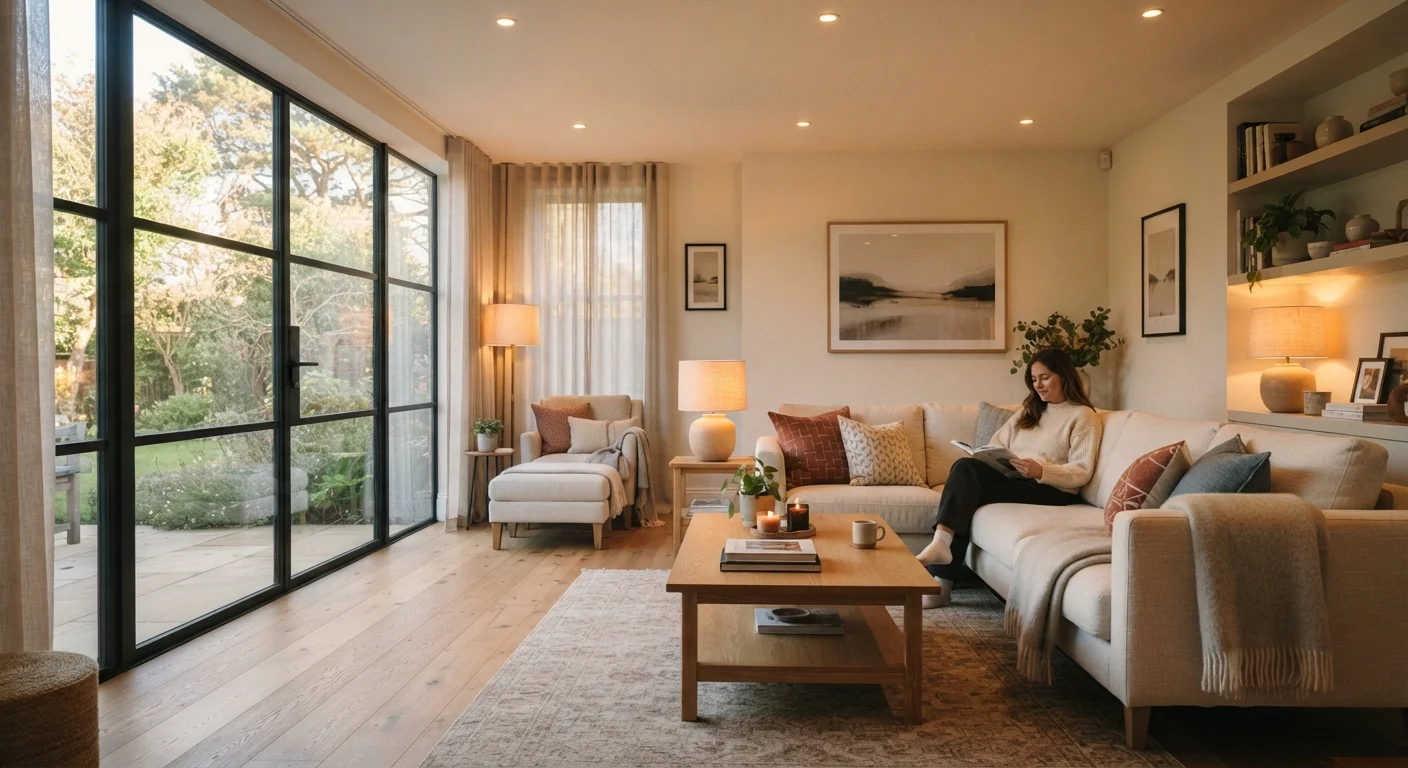
Key Takeaways
- Natural light changes throughout the day and across seasons, so rooms need artificial light to compensate.
- Color temperature (measured in kelvins) affects how both light types feel; matching them reduces visual discord at dusk.
- Layering ambient, task, and accent fixtures gives a room flexibility that a single overhead light cannot.
- Window placement and interior surface colors amplify or reduce how far natural light travels into a room.
- Dimmer switches let artificial light mirror the gradual shift of natural light, which can support a calmer evening routine.
Option A
Natural light
The free, variable light source every room already has to some degree.
Best for: Daytime living spaces where mood, color accuracy, and connection to the outdoors matter.
Option B
Artificial light
The controllable, consistent source that fills every gap natural light leaves.
Best for: Evening use, windowless rooms, task areas, and anywhere precision or ambiance must be dialed in.
If you want the most accurate color rendering for art, textiles, or paint selection
Natural light
Midday natural light has a balanced spectrum that shows colors as they truly are. North-facing windows provide the most consistent, glare-free version of this.
If you need consistent, controllable light for a home office or kitchen workspace
Artificial light
Artificial light does not shift with the weather or the hour, which matters when precision tasks require steady visibility.
If you are designing a room used heavily in the evening
Artificial light
Natural light is unavailable after sunset. A layered fixture plan, including dimmable ambient and directed task lights, carries the room through the night.
If you want to reduce eye strain and support a comfortable daily rhythm
Both, layered together
Bright, cooler-toned light during the day and warmer, dimmer artificial light in the evening give the room a rhythm that aligns with how people naturally feel at different hours.
What each light source actually does
Natural light comes from the sun, which means its intensity, direction, and color shift constantly. Early morning light is warm and low-angled; midday light is bright and near-neutral; late afternoon light deepens to amber. On overcast days, the same room reads flat and cool. These shifts are not flaws; they give a space life. But they also mean you cannot rely on natural light alone.
Artificial light is consistent by design. Flip a switch at 2 a.m. or 2 p.m. and you get the same output. That predictability is why artificial light is not optional, even in a room with generous windows. The two sources solve different problems, and a room that treats them as competitors will underperform at some point in the day.
How daylight shapes your internal clock is worth understanding before you design around it; the lighting choices in your home have a real effect on how alert or drowsy you feel at different hours.
How natural light behaves in a room
Window orientation determines a lot. South-facing windows receive direct sun for most of the day in the northern hemisphere, which means more warmth and glare to manage. North-facing windows deliver diffuse, shadow-free light that stays relatively constant, which is why artists and photographers favor it. East and west exposures bring strong, low-angled sun in the morning and evening respectively, which can be beautiful but hard to control without blinds or sheer curtains.
Surface color and finish amplify or absorb natural light once it enters. Pale, matte walls scatter light further into a room. Dark or highly saturated walls absorb it. Glossy surfaces can create hot spots. This is one reason paint color looks so different on a chip in a store versus on your wall at home. Ceiling height also changes how light moves through a space, with taller ceilings allowing reflected light to travel farther before it fades.
Indoor plants placed near windows cast dappled shadows that shift through the day, which adds visual texture but also affects the light that reaches furniture and seating behind them.
Windows and room layout interact
The depth of a room affects how far natural light penetrates. A standard 8-foot ceiling room typically receives useful natural light within about 15 to 20 feet of a window, depending on the window size and exterior obstructions. Rooms deeper than that will need supplemental artificial light even on bright days. Skylights and light tubes can bring daylight into interior rooms that no perimeter window can reach.
What artificial light needs to cover
| Criterion | Natural light | Artificial light |
|---|---|---|
| Availability | Daytime only, weather-dependent | On demand, any time |
| Color rendering | Excellent at midday | Varies by bulb type and CRI |
| Color temperature | Shifts through the day | Fixed at bulb specification |
| Cost to run | Free | Ongoing electricity cost |
| Controllability | Limited (orientation, blinds) | High (dimmers, switches, smart systems) |
| Effect on room mood | Dynamic, changes with hour and season | Consistent, set by fixture choice |
| Glare risk | High with direct sun exposure | Manageable with fixture placement |
Artificial light fills three gaps: time (after dark), place (interior rooms without windows), and precision (tasks that need directed, steady illumination). A bathroom vanity, a reading chair, and a dining table each need different things from their fixtures, which is why a single ceiling fixture rarely satisfies a whole room.
The three-layer framework of ambient, task, and accent lighting gives you a practical way to build this out. Ambient light handles overall visibility; task light targets specific activities; accent light draws attention to objects or architectural features.
Color temperature matters here. A bulb labeled 2700K produces warm, yellowish light suited to relaxing spaces. A 4000K bulb is neutral white, better for kitchens and workspaces. A 5000K bulb approaches daylight and works well where color accuracy matters. Choosing the right color temperature for each room prevents the jarring visual shift that happens when warm natural light and cool artificial light compete in the same space at dusk.
Designing for the transition between day and night
The most common lighting mistake in home interiors is not thinking about dusk. At twilight, natural light drops quickly while artificial light takes over, and if the two sources are mismatched in color temperature or intensity, the room feels uncomfortable without a clear reason why.
Dimmer switches help. When natural light fades, gradually increasing warmer artificial light maintains the room's feel without an abrupt shift. This is especially useful in living rooms and bedrooms, where the goal shifts from activity to rest as the evening progresses.
Open floor plans present a particular challenge because natural light from one end of the space may not reach the other, creating a patchwork of bright and dim zones that only artificial light can even out. Placing fixtures at consistent intervals and using reflective surfaces in darker zones helps close the gap.
Window treatments also shape this transition. Sheer curtains diffuse direct sun glare without blocking light; blackout curtains give full control when needed. Layering both on the same rod gives you flexibility across all hours and seasons.