

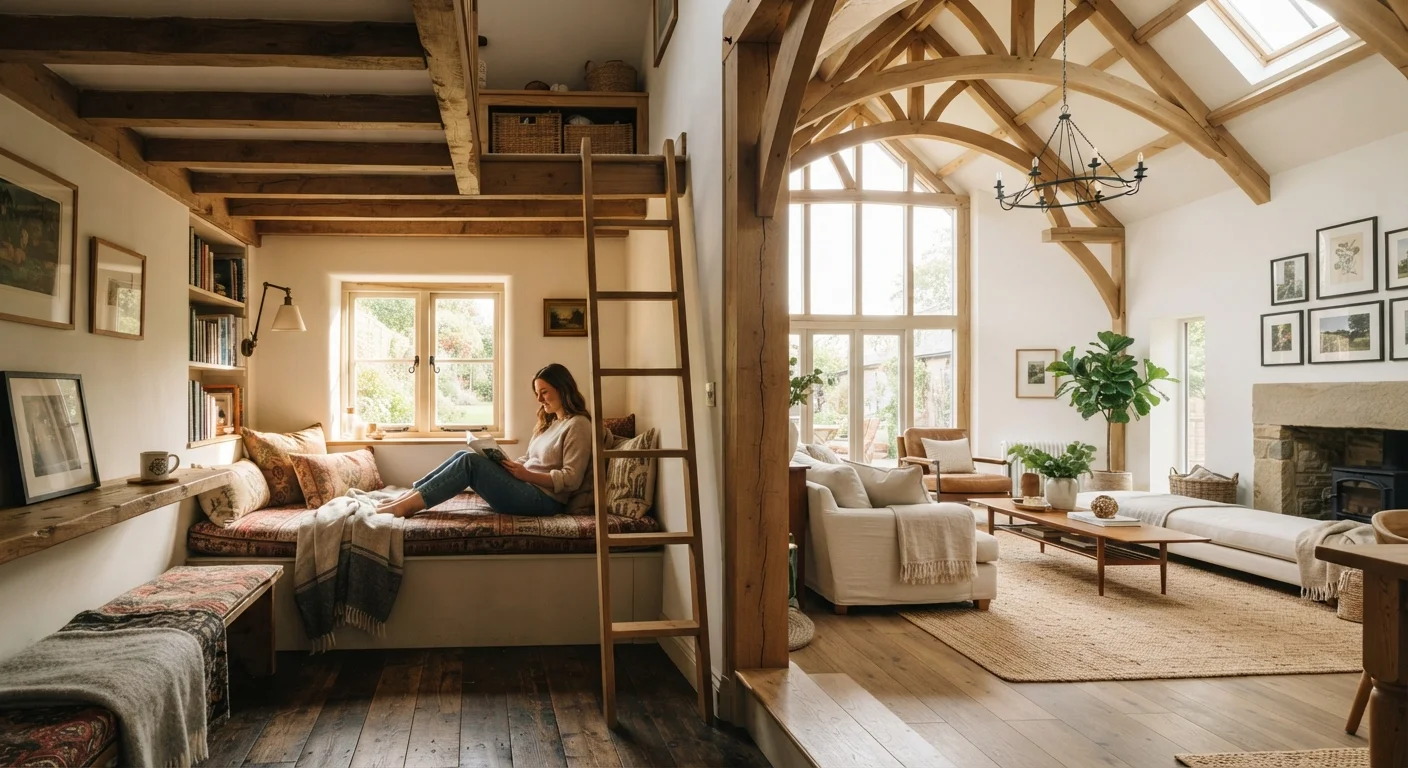
Key Takeaways
- The standard US ceiling height is 8 to 9 feet; anything noticeably above or below that range changes how a room feels.
- Low ceilings respond well to vertical lines, light colors, and upward-directed lighting.
- High ceilings can feel cold or echoey without grounding elements like lower furniture groupings and horizontal accents.
- Paint color value (lightness or darkness) affects perceived height more than hue alone.
- Lighting placement is one of the most cost-effective tools for adjusting how tall or intimate a space feels.
Ceiling height and room perception
Ceiling height is the vertical distance from the floor to the ceiling surface. It shapes how spacious, intimate, or oppressive a room feels, even before furniture is added. Most US homes built after 1990 have ceilings between 9 and 10 feet, while older construction often sits at 8 feet. Rooms with very high ceilings can feel grand but cold; low ceilings can feel snug or cramped depending on how they are treated.
Research in environmental psychology suggests that ceiling height influences abstract versus detail-oriented thinking, with higher ceilings associated with broader, more expansive thought patterns, though individual response varies.
Why ceiling height registers so strongly
A room's floor area gets most of the attention in real estate listings and renovation budgets, but ceiling height does more to determine how a space feels to occupy. The vertical dimension sets the ratio between the human body and the enclosure around it. At 8 feet, a room feels workable; at 7 feet, it starts to feel compressed; at 12 feet, it can feel like a public building rather than a home.
That perception is not purely psychological. Sound behaves differently in tall rooms: voices and footsteps reflect off more wall surface before reaching the listener, creating a subtle acoustic openness. Temperature stratifies in tall spaces too, with warm air rising away from occupants. These physical effects contribute to the overall feeling even when people cannot name what they are responding to.
Room layout choices interact with ceiling height as well. A low ceiling can feel appropriate and even cozy in a small bedroom, while the same height in a large open kitchen may feel oppressive because the floor area is too wide relative to the vertical space.
Working with low ceilings
Low ceilings respond to anything that moves the eye upward or removes visual clutter at the top of the room. The most direct approach is paint: a ceiling painted the same color as the walls, or slightly lighter, removes the hard visual boundary that emphasizes how close the ceiling is. Alternatively, painting the ceiling a bright white while keeping walls in a mid-tone creates contrast that makes the top of the room appear to recede.
Lighting choices matter just as much. Flush-mount or recessed fixtures keep hardware off the visual plane of the ceiling rather than hanging down from it. Torchiere-style floor lamps wash light upward and give the impression of a brighter, taller space. The interplay between natural and artificial light is worth thinking through here: a well-lit ceiling reads as farther away than a dim one.
For furniture and decor, choose pieces with lower profiles and exposed legs. A sofa that sits close to the floor with visible leg clearance makes the room's vertical space feel more generous by keeping mass near the ground. Floor-to-ceiling curtains hung as close to the ceiling as possible, even if the window itself is much shorter, are one of the most effective and affordable visual tools available.
Test paint colors on the ceiling first
Before committing to a ceiling color, paint a 2-foot square sample and observe it under both daylight and your artificial lighting. Ceiling surfaces receive different light than walls, and colors can shift significantly. This is especially true for off-whites, which can read yellow or pink overhead even when they look neutral on the wall.
Working with high ceilings
Tall ceilings read as luxurious in photographs but can feel uncomfortable to live in without some intentional grounding. The most common problem is acoustic: hard surfaces and large air volume create echo and a sense of emptiness. Area rugs, upholstered furniture, bookshelves with books, and curtains all absorb sound and reduce that effect.
Visually, the goal is to create a human-scale zone within the larger space. Hanging pendant lights or a chandelier lower than the ceiling's center of mass pulls the eye down and creates a defined area below. Painting the wall from floor to a horizontal line at roughly 8 feet in a contrasting or darker tone, then leaving the upper section lighter, breaks the height into two readable zones. Picture rails, wainscoting, and crown molding at lower heights all do similar work.
Furniture should be proportional. A single low sofa floating in a tall-ceilinged room will look stranded. Taller bookshelves, armoires, or built-ins that approach but do not reach the ceiling fill vertical space in a way that feels intentional rather than oversized. See also: how open floor plans handle vertical scale.
Specific choices that reinforce or offset ceiling height
A few decisions have outsized effect on how ceiling height registers:
- Crown molding: Adding molding at the ceiling line in a low-ceiling room draws attention to the boundary you want to minimize. In a tall room it can help define the top edge and make the space feel more finished.
- Curtain rod placement: In rooms with low ceilings, mounting the rod as close to the ceiling as possible (regardless of window height) consistently makes walls read as taller. In tall rooms, placing rods closer to the actual window frame keeps the visual weight lower and more intimate.
- Vertical versus horizontal artwork: Tall, narrow pieces or a vertical gallery arrangement pull the eye upward in low-ceiling rooms. Wide horizontal pieces or a grid arrangement spread across a wall do the opposite and help anchor a tall space.
- Mirror placement: A tall mirror leaned against or hung on a wall extends the perceived vertical dimension in a low room. In a tall room, a wide horizontal mirror at eye level reflects the furnished, human-scale portion of the space rather than empty upper wall.
For small rooms where ceiling height and floor area are both working against you, compact living room strategies cover additional visual techniques that layer well with these ceiling-focused choices.