

Key Takeaways
- Ambient light provides base-level brightness so a room is safely and comfortably usable.
- Task lighting puts focused light exactly where work happens, reducing eye strain.
- Accent lighting draws attention to specific objects, textures, or architectural features.
- Dimmer switches let you shift the balance between layers without buying extra fixtures.
- Color temperature affects how each layer feels; warmer bulbs (2700-3000K) suit living areas, cooler ones suit kitchens and offices.
- Layering does not require a large budget; repositioning existing lamps is often enough to start.
Layered lighting
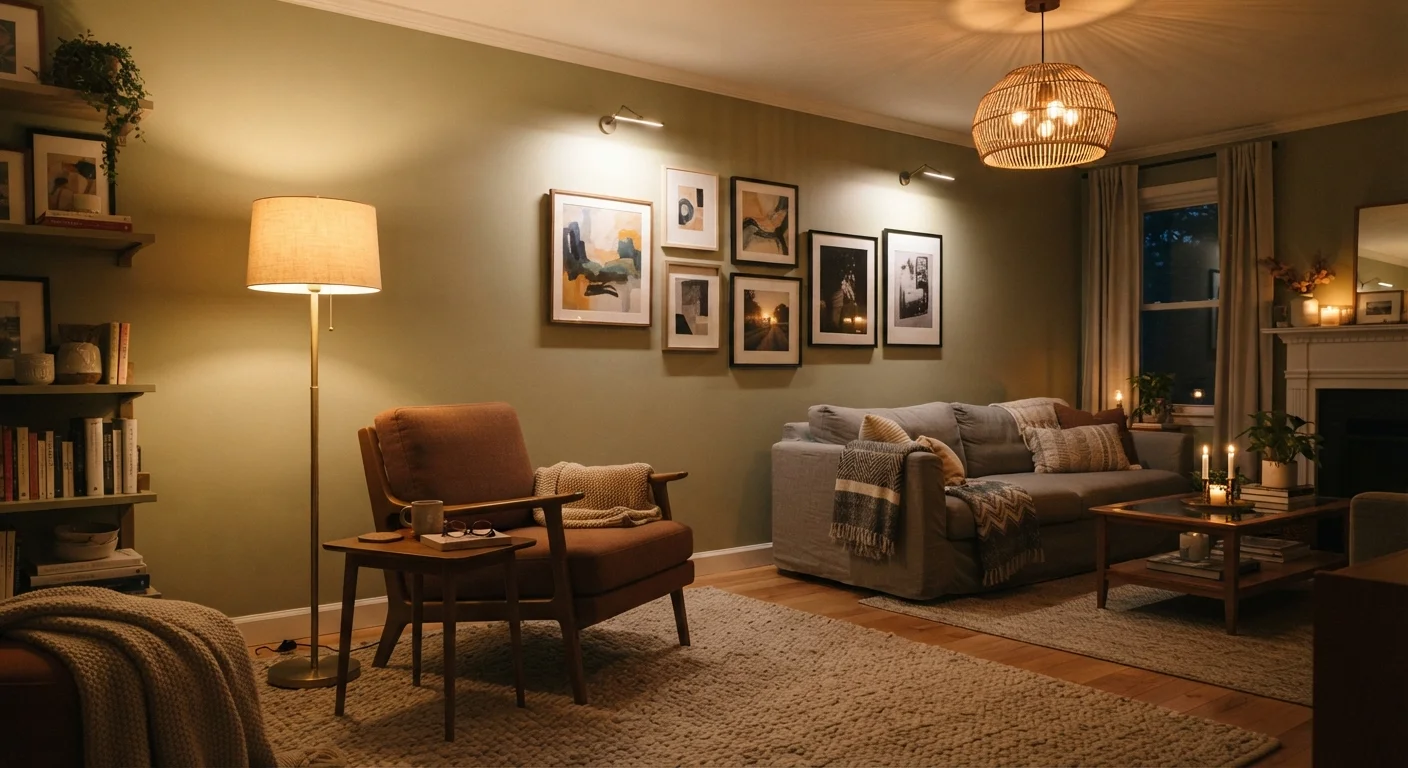
Layered lighting is a design approach that combines three types of light in one room: ambient (general illumination), task (focused work light), and accent (directional light aimed at objects or surfaces). Using all three gives a room both practical function and visual depth. A single overhead fixture handles none of these jobs particularly well on its own.
Lighting designers sometimes add a fourth layer called decorative lighting, which covers fixtures that are visual elements in themselves, such as a sculptural pendant, rather than primary light sources.
Why one overhead light is rarely enough
Most rooms come with a single ceiling fixture or a row of recessed cans. That setup handles general visibility, but it tends to flatten a space visually and leaves specific work areas either under-lit or harshly over-lit. The three-layer framework solves this by treating light as something with different jobs, not just different quantities.
Interior design vocabulary often includes layered lighting as a foundational concept because the approach scales to any room size, any budget, and any style. You do not need to hire a lighting designer or buy expensive fixtures to apply it.
Start with a dimmer, not a new fixture
Before buying additional lights, install a dimmer switch on your existing overhead fixture if it does not have one. Dimming ambient light to 40-60 percent of its maximum immediately makes table lamps and floor lamps more effective because there is less competing overhead glare. Confirm the dimmer is rated for the bulb type (LED dimmers differ from incandescent dimmers) before purchasing.
Ambient light: the base layer
Ambient light is the general illumination that lets you move through and use a room safely. It comes from ceiling-mounted fixtures, recessed downlights, flush-mount pendants, or even natural light during the day. The goal is even, diffuse coverage without harsh shadows or bright spots.
A common mistake is setting ambient light too bright, which leaves no room for the other layers to do their work. Fitting ambient fixtures with a dimmer switch lets you turn the base layer down when task or accent lights are active, which immediately makes a room feel more intentional. Ceiling height also affects how ambient light distributes: a low ceiling bounces light back down more quickly, while a tall ceiling may need supplemental floor-level sources to fill the lower half of the room.
2,700K
Warm white bulb color temperature
Bulbs rated at 2700K to 3000K are widely used for residential ambient and accent lighting because they produce a warm, incandescent-like tone suited to living and sleeping spaces.
3x
Recommended accent-to-ambient brightness ratio
Lighting design guidelines generally suggest accent light sources be approximately three times brighter than the surrounding ambient level to create visible contrast without looking harsh.
450-800
Lumens needed for comfortable reading
General guidance from lighting reference sources places comfortable reading light in the 450 to 800 lumen range directed at the page, though individual preference varies.
Task light: light where work happens
Task lighting targets a specific surface or activity. A desk lamp, under-cabinet kitchen strip, bathroom vanity bar, and bedside reading light are all task lights. The defining feature is direction: task light should fall on the work surface without creating glare in your eyes or casting your own shadow over what you are doing.
Position matters more than wattage. A lamp placed behind and to the side of a reader delivers better usable light than a brighter lamp directly overhead. In kitchens, under-cabinet lights mounted toward the front edge of the cabinet illuminate the countertop directly, which recessed ceiling lights above the cabinets cannot reliably do.
If your home has indoor plants on a desk or shelf, keep task lighting needs separate from plant lighting needs; most houseplants require different spectrum and duration than reading light provides.
Accent light: adding dimension
Accent lighting does not illuminate a room in the general sense. It draws the eye to something: a piece of art, a textured wall, a bookcase, an architectural detail like a fireplace surround. The standard recommendation is for accent light to be roughly three times brighter than the ambient level in that area, which creates enough contrast to be noticeable without looking theatrical in a typical home setting.
Common accent sources include adjustable track lights, recessed eyeball fixtures, picture lights mounted above frames, and small directional floor uplights. A feature wall becomes more effective when accent lighting grazes its surface at an angle, which makes texture readable in a way flat overhead light cannot.
Accent lighting also affects how color reads in a room. The color temperature of accent bulbs shifts the apparent hue of whatever they illuminate, so a warm-toned bulb on a cool-gray wall will push that wall toward beige.
Putting the three layers together
A practical starting point is to map each layer separately before worrying about fixtures. For each room, ask: where does the base illumination come from, where does focused work happen, and is there anything worth drawing attention to? Gaps in any of those three questions point to where an additional light source would help.
You do not need to add fixtures all at once. Plugging in a single well-placed floor lamp to supplement a weak ambient layer often improves a room immediately. From there, a clip-on task light at a desk or a battery-operated picture light above a print adds the next layer without any wiring. The goal is control: being able to adjust the mix of light types to suit whatever the room is being used for at a given moment.