

Key Takeaways
- Bodyweight training can build genuine strength and endurance without any equipment.
- Progressing difficulty through leverage, tempo, and range of motion replaces adding load.
- Matching exercise intensity to your current ability reduces injury risk and improves consistency.
- A few fundamental movement patterns cover most of the body when trained consistently.
- Rest, recovery, and adequate nutrition support the same adaptations as in any training program.
What bodyweight training actually is
Bodyweight training uses your own body as the source of resistance. No barbells, no machines, no membership required. Exercises like push-ups, squats, pull-ups, lunges, and planks load the muscles through gravity and leverage rather than added weight, but the physiological demands are the same: the muscles must work against resistance to produce force, and they adapt over time.
That adaptability is what makes bodyweight training a legitimate long-term method rather than a temporary substitute for gym access. With the right progressions, it can build meaningful strength, muscular endurance, and movement quality for people at most fitness levels. It is not, however, a shortcut or an effortless option. Like any training approach, it requires consistency, a structured approach, and an honest assessment of where you are starting from.
For adults who find gym environments unfamiliar, who travel frequently, or who prefer to exercise at home, bodyweight methods offer a practical path that removes the logistical barriers without removing the challenge. See our exercise terminology glossary if terms like reps, sets, or tempo are unfamiliar.
This article is for general informational purposes only and is not medical advice. Consult a qualified healthcare professional before starting any new exercise program, particularly if you have existing health conditions or injuries.
The movement patterns that structure a complete program
Rather than listing individual exercises, a more useful way to think about bodyweight training is through movement patterns. Each pattern trains a broad range of muscles and, when combined, produces a balanced program. The main patterns are: push (horizontal and vertical), pull (horizontal and vertical), squat, hinge, and core anti-movement.
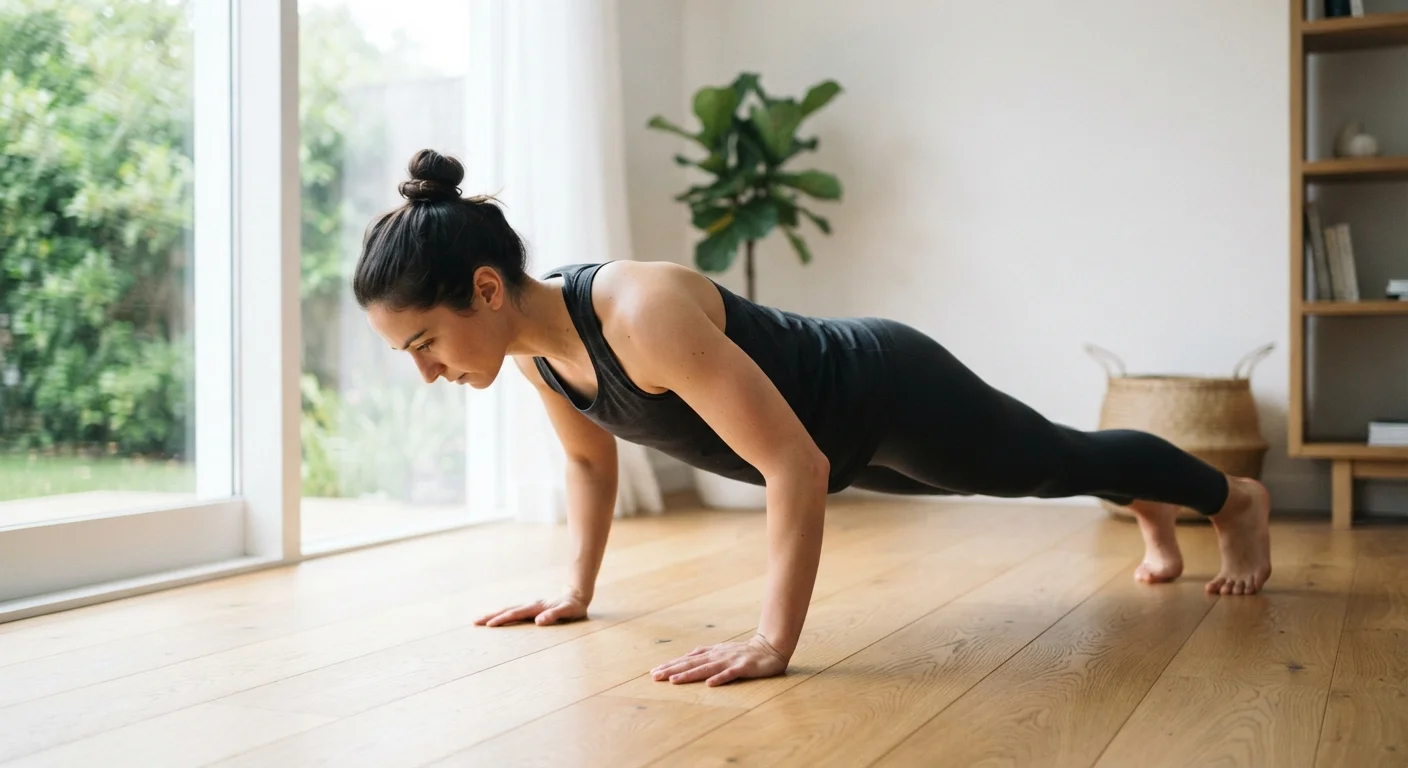
- Push movements: push-ups and their variations cover horizontal pressing; pike push-ups and handstand work cover vertical pressing.
- Pull movements: rows using a table edge or suspension trainer cover horizontal pulling; pull-ups and chin-ups cover vertical pulling.
- Squat patterns: bodyweight squats, split squats, and eventually single-leg pistol squats train the quads, glutes, and hip stability.
- Hinge patterns: glute bridges, single-leg bridges, and hip hinge drills load the posterior chain including the hamstrings and glutes.
- Core anti-movement: planks, hollow body holds, and dead bugs build stability by resisting extension, flexion, and rotation rather than producing it.
Organizing your sessions around these patterns, rather than a loose list of exercises, produces more coherent and balanced training. Our article on fundamental movement patterns covers this framework in depth.
How to progress without adding weight
The most common concern about bodyweight training is that it will eventually stop producing results once a person can perform high repetitions comfortably. This concern is valid only if the person never changes the exercise difficulty. The solution is the same principle that governs all strength training: progressive overload.
Without a barbell to load incrementally, bodyweight training uses other variables to increase demand:
- Leverage: Moving the load point farther from the base increases mechanical difficulty. An elevated-feet push-up is harder than a flat push-up; a single-leg squat is harder than a two-leg squat.
- Tempo: Slowing the lowering phase (eccentric) to three to five seconds increases time under tension and muscular demand without changing the movement.
- Range of motion: Deeper squats, push-ups performed with hands elevated on blocks to allow greater chest depth, and full-range hip hinges increase the muscular work per repetition.
- Stability demands: Reducing points of contact, such as switching from two-arm to single-arm work, increases the stabilizing demand on the working muscles and the core.
- Rest reduction: Shortening rest intervals within a session increases cardiovascular demand and metabolic stress without changing the exercise itself.
When first learning a harder variation, practice it at the beginning of a session when you are fresh rather than after fatigue from easier exercises. Skill and strength development both require quality repetitions.
Neuromuscular learning is more efficient when the nervous system is not already fatigued, which makes early-session practice more effective for acquiring new movement skills.
Track your sessions even briefly: noting which variation you used and how many reps you completed gives you concrete data to progress from, rather than relying on memory.
Without a record of previous performance, it is difficult to apply progressive overload systematically, which is the mechanism behind long-term strength gains.
Combining two or more of these variables at once can make progressions more gradual and sustainable, which helps avoid stalling or injury from advancing too quickly.
Adapting bodyweight training to your fitness level
One of the practical strengths of bodyweight training is that most exercises have accessible entry points. Someone who cannot yet perform a full push-up can begin with a wall push-up or an incline push-up using a counter, then progress to a knee push-up, then to a full push-up over weeks or months. The movement pattern is the same; the load is adjusted through position.
For beginners, the priority is learning the movement patterns with good form before adding difficulty. This means lower repetitions performed cleanly rather than high repetitions with compensated technique. For intermediate trainees who can perform 15 to 20 clean reps of a standard variation, the focus shifts to harder progressions and shorter rest periods. Advanced trainees can pursue skills like the one-arm push-up, pistol squat, and pull-up variations that take months to years of consistent practice to achieve.
People with joint concerns or those returning from an injury should read our overview of low-impact exercise options before selecting movements, and should consult a physiotherapist or physician before progressing intensity.
Common mistakes and how to avoid them
The most frequent problem in bodyweight training is staying too comfortable. Because there is no visible weight to add, many people repeat the same exercises at the same difficulty indefinitely and then conclude that the method does not work. Consistent progression, even small adjustments to tempo or range of motion, is what drives adaptation.
A second common issue is neglecting the pull pattern. Push exercises are intuitive and easy to set up, so programs often end up push-heavy. Without horizontal or vertical pulling, the muscles of the upper back and the rear shoulder go undertrained relative to the chest and front shoulder. Over time this can affect posture and shoulder health. Rows using a low bar, rings, or a sturdy table are the most accessible pulling solution for home training.
A third mistake is skipping recovery. Bodyweight training still creates muscular stress that requires adequate sleep and nutrition to repair. Two to three sessions per week with rest days between is a reasonable starting point for most adults. Nutrition basics, covered in our foundational nutrition guide, support the recovery process just as they do in any training program.
Watch for compensations in technique
When a movement becomes difficult, the body naturally finds shortcuts: flared elbows in push-ups, caved knees in squats, or arched lower backs in planks. These compensations reduce the effectiveness of the exercise and can, over time, contribute to discomfort or injury. If your form breaks down, reduce the difficulty rather than pushing through poor mechanics. If you experience pain (not normal muscular effort) during an exercise, stop and consult a healthcare professional before continuing.
Fitting bodyweight training into your weekly routine
Because bodyweight training requires no travel time and minimal setup, the barrier to fitting it into a week is lower than most forms of exercise. A session of 20 to 30 minutes covering one push pattern, one pull pattern, one leg pattern, and one core drill is a complete training stimulus for most people.
If time is the main constraint, our article on making short strength sessions count covers how to structure efficient workouts without sacrificing quality. For planning multiple sessions per week across different fitness goals, building a weekly workout schedule walks through the key decisions involved.
Consistency over any given session quality is the factor that produces results over months and years. A 20-minute session three times per week, repeated for six months, produces far greater adaptation than two intense weeks followed by a break.