

Key Takeaways
- Low-impact exercise reduces joint stress while still building cardiovascular fitness and strength.
- Swimming, cycling, walking, and water aerobics each offer distinct benefits suited to different goals.
- Consistency over intensity produces the best long-term outcomes for joint-conscious adults.
- Most low-impact options are accessible without specialized equipment or facilities.
- Consulting a healthcare provider before starting a new exercise program is especially important for those managing joint conditions.
Why joint load matters in exercise selection
Joint pain or sensitivity does not have to mean choosing between discomfort and inactivity. The type of force a joint absorbs during exercise, not the effort level, is what determines whether an activity aggravates or suits a particular person. High-impact activities generate large, rapid forces on landing or contact; low-impact alternatives spread load more evenly or reduce it through buoyancy, support, or continuous contact with a surface.
For adults managing osteoarthritis, recovering from an injury, returning to exercise after a long gap, or simply wanting to reduce wear on their joints, low-impact exercise covers a wide range of activities with genuinely different demands. The options below vary in equipment needs, setting, skill level, and which muscle groups they work. That variety matters: exercise habits that are hard to sustain often share a common feature, which is that they are too rigid to adapt when life or physical capacity changes.
Low-impact does not mean low-effort
Reducing joint stress does not mean reducing the cardiovascular or muscular demands of a workout. Swimming, cycling, and elliptical training can all be performed at high intensity while keeping impact forces low. The distinction is about load type, not effort level. Adjusting duration, resistance, or pace within any of these activities allows for meaningful progression over time.
This article is general health information and is not a substitute for medical advice. If you are managing a joint condition, injury, or chronic illness, consult a qualified healthcare provider before starting or changing an exercise routine.
Seven low-impact options worth considering
Swimming
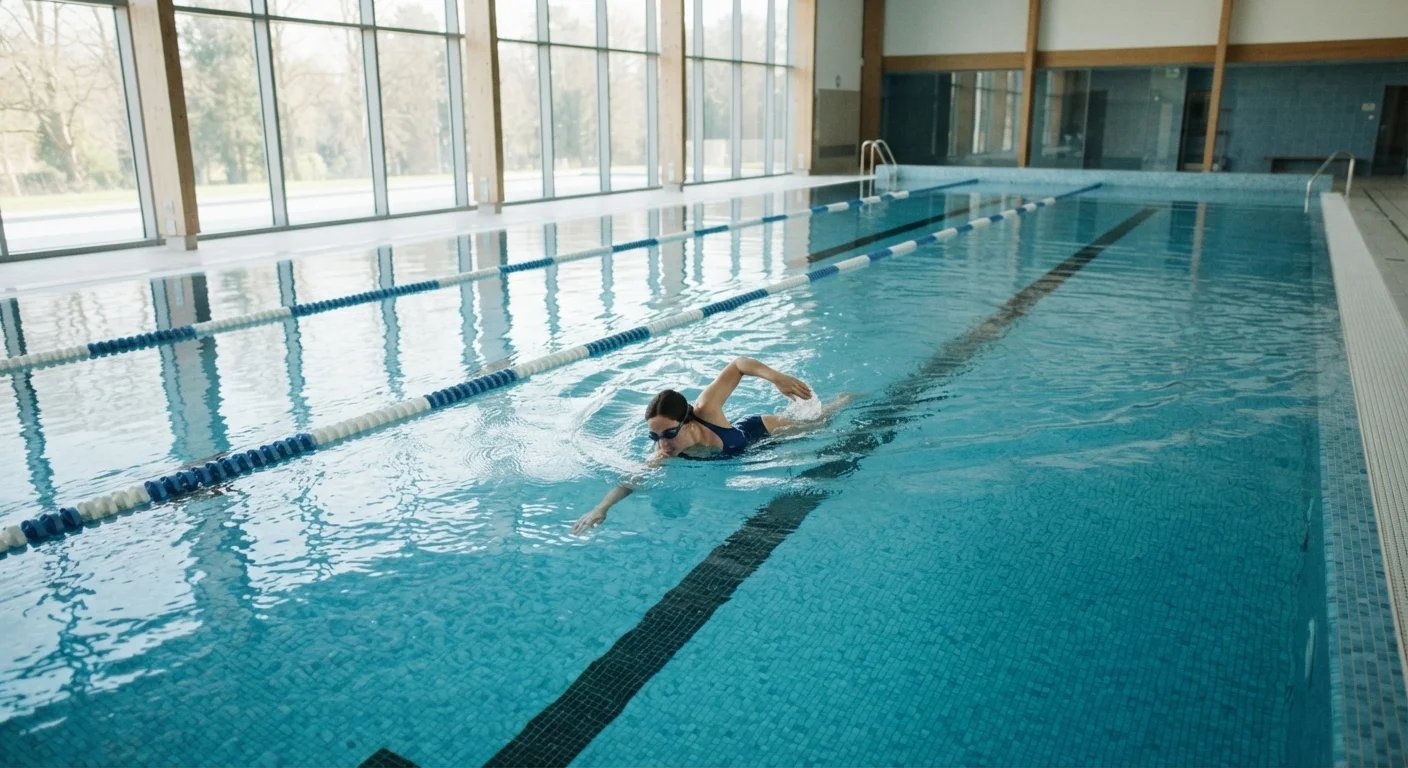
Water supports up to 90 percent of body weight when submerged to shoulder depth, which removes most of the compressive load from hips, knees, and the spine. That property makes swimming one of the most joint-protective aerobic activities available. Freestyle, backstroke, and breaststroke each engage large muscle groups and raise cardiovascular demand without ground-reaction force.
Swimming also builds shoulder and core strength alongside aerobic capacity. The resistance water provides is roughly proportional to how fast you move through it, so the exercise scales naturally: beginners work at a gentler pace, and more conditioned swimmers increase speed or distance to stay challenged. Pool lanes are available at most public recreation centers at low or no cost.
Water removes up to 90 percent of body weight, eliminating most joint compression during exercise.
Cycling (stationary or outdoors)
Pedaling places minimal axial load on the joints because the saddle bears most of the rider's weight. Knee tracking stays controlled within a fixed arc of motion, which many orthopedic clinicians consider favorable for people managing patellofemoral pain or mild osteoarthritis. Both stationary bikes and road or trail cycling offer a cardiovascular workout whose intensity is easy to adjust through resistance or terrain.
Stationary cycling has the added advantage of removing balance demands, making it accessible for adults who are deconditioned or managing coordination issues. Seat height and handlebar position matter: a properly fitted bike reduces strain on the lower back and knees. If outdoor cycling feels daunting, recumbent stationary bikes reduce upper-body strain even further by positioning the rider in a reclined seat with back support.
A properly fitted bike reduces strain on the lower back and knees during every session.
Walking
Walking generates impact forces roughly equal to body weight per step, which is substantially lower than running (two to three times body weight) or jumping activities. For most adults with joint concerns, those forces are well within a tolerable range and may support bone density without aggravating cartilage. Walking requires no equipment beyond supportive footwear and no scheduled facility access.
Pace, incline, and duration are all simple levers for progression. Flat terrain at a comfortable pace is a reasonable starting point; adding hills or brisk intervals increases cardiovascular demand without changing the fundamental mechanics. See our breakdown of low- and high-intensity cardio for context on how walking fits into broader cardiovascular training approaches.
Walking impact forces are far lower than running, making it viable for most joint-conscious adults.
Water aerobics
Water aerobics classes use the resistance and buoyancy of pool water to provide a full-body workout that combines cardiovascular conditioning with light resistance training. Participants typically stand in chest-deep water and perform movements like leg kicks, arm sweeps, and lateral shuffles. The buoyancy reduces joint load while the water's drag adds enough resistance to build muscular endurance.
Group classes also provide structure and social interaction, which many adults find helpful for sustaining a routine. Most public pools offer sessions at multiple ability levels. Unlike lap swimming, water aerobics does not require swimming proficiency, broadening its accessibility considerably.
Water aerobics delivers cardiovascular and resistance benefits without requiring swimming proficiency.
Yoga and stretching-based movement
Yoga combines controlled movement with breath and sustained holds, building flexibility, balance, and functional strength. Styles vary considerably: restorative and chair yoga minimize joint stress almost entirely, while more dynamic styles such as vinyasa can become moderately demanding. Adults managing joint concerns do best starting with gentle or restorative formats and progressing from there based on comfort.
The balance and proprioception work in yoga has practical relevance beyond a single session. Falls are a leading cause of injury in older adults, and regular balance training is associated with improved stability. Yoga also incorporates foundational movement patterns such as hip hinging and thoracic rotation, which support functional mobility in daily life.
Balance and proprioception work in yoga has measurable relevance to fall prevention in older adults.
Elliptical training
The elliptical machine replicates a walking or running stride pattern while keeping the feet in contact with the pedals throughout the movement. That eliminates the impact phase entirely. Research comparing treadmill running and elliptical exercise has found similar cardiovascular responses at matched effort levels, with the elliptical producing significantly lower ground-reaction forces.
Most ellipticals include moveable handlebars, which add upper-body engagement and distribute the workload more broadly. Resistance and stride length are adjustable, allowing the machine to accommodate a range of fitness levels. For adults who want the cardiovascular output of jogging without the repetitive impact, the elliptical is one of the most direct substitutes available.
Elliptical training eliminates the impact phase entirely while matching treadmill cardio output.
Resistance training with controlled load
Resistance training is not inherently high-impact. When load, range of motion, and tempo are managed carefully, strength work can be fully compatible with joint sensitivity. Machines and cables guide movement through a fixed path, which can reduce the stabilization demands that free weights place on joints. Starting with bodyweight progressions, as covered in our complete overview of bodyweight training, allows adults to develop strength before adding external load.
Preserving muscle mass as adults age is directly tied to joint health: stronger muscles absorb and redistribute the forces that would otherwise stress cartilage and connective tissue. Resistance training two to three times per week, within a pain-free range of motion, is a general starting point that most adults can work toward, though anyone managing a specific joint condition should get clearance from a healthcare provider first.
Stronger muscles absorb force that would otherwise stress cartilage and connective tissue.
Building a consistent routine around these options
Mixing two or three of these activities across a week reduces the repetitive stress any single movement pattern places on a joint while keeping the overall volume of exercise sustainable. A person might walk on most days, cycle twice a week, and attend a water aerobics class on weekends. That combination covers cardiovascular conditioning, some muscular endurance, and low cumulative joint stress.
Warming up properly before each session also reduces injury risk and helps joints move more freely, particularly in cooler environments or early in the morning when tissue stiffness tends to be higher. Starting each session at a lower intensity for five to ten minutes before increasing effort is a practical habit regardless of which activity you choose.