

Key Takeaways
- A workout schedule built around your actual availability is more likely to stick than an ideal one you rarely meet.
- Combining different movement types across the week reduces injury risk and keeps training balanced.
- Rest days are a planned part of progress, not a sign of failure.
- Starting with two or three sessions per week is a legitimate and effective approach for most adults.
- Tracking completed sessions, even briefly, helps you spot patterns and adjust before motivation fades.
What you will need
Why most workout schedules fail within weeks
The most common reason a workout plan collapses is that it was designed for an idealized version of the week rather than the actual one. People build five-day programs when three consistent sessions would have produced better results over time. They choose workouts they think they should do rather than ones they can realistically sustain.
Sustainability comes from fit, not discipline alone. A schedule that matches your energy levels, available time, and preferred movement types asks less of your willpower and more of your planning. Focusing on foundational movement patterns rather than complex programs also reduces the mental overhead of figuring out what to do each session.
This guide walks through the decisions that determine whether a schedule holds. You will need the prerequisites above before starting, and the steps are meant to be followed in order. Each builds on the one before it.
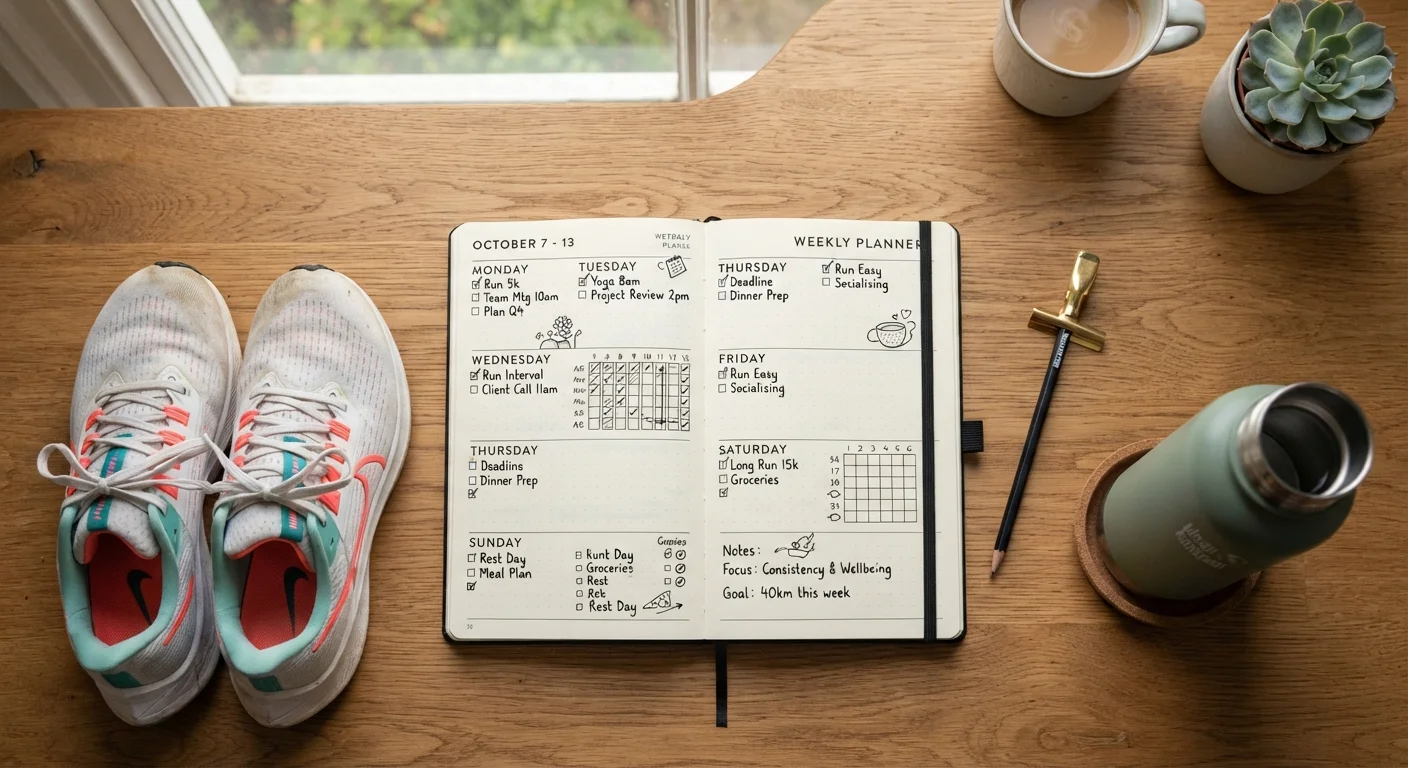
Weekly calendar or planner
Maps your available time slots so you can place sessions where they realistically fit.
Notebook or tracking app
Records completed sessions and any notes on how each felt, giving you data to refine future weeks.
Timer or interval app
Keeps sessions structured and on schedule, especially for shorter workouts.
What you will need
How to build your schedule step by step
The steps below take you from an empty calendar to a written, realistic weekly plan. Budget 20 to 45 minutes for the planning process itself. Once it is done, you will have something specific enough to act on.
Audit your real available time
Pull up your calendar for a typical week and mark every fixed commitment: work hours, commute, family obligations, and regular social events. What remains is your actual candidate time, not your theoretical free time. Look for windows of at least 20 to 30 minutes where the energy cost of a workout is manageable, not just the clock time.
Count how many of those windows appear per week. If you find three reliable slots, plan for three sessions. If you find two, plan for two. A realistic starting number matters more than an ambitious one you abandon by week three.
Choose movement types that match your goals and access
A balanced week typically includes some combination of cardiovascular activity, strength work, and flexibility or mobility. You do not need all three in every session. Spreading them across the week reduces cumulative fatigue and works different physical systems.
Consider what you actually have access to. If a gym is not convenient, bodyweight training covers strength and mobility with no equipment. If time is tight, short strength sessions of 20 to 30 minutes can produce real results when structured well. Match the format to your situation rather than to someone else's program.
Assign sessions to specific days and times
Translate your available windows into concrete calendar entries. Write down: Monday at 7 a.m., strength. Wednesday at 12:30 p.m., a 25-minute walk or jog. Friday at 6:30 p.m., a longer session. Specificity converts intention into action.
If your schedule varies week to week, identify the anchor days that are consistently free and build around those. For unpredictable schedules, a flexible structure (any three days from the seven, with at least one rest day between intense sessions) gives you a target without locking you into slots that may not hold. Time blocking is one way to protect those windows on chaotic weeks.
Build in rest and recovery days
Rest days are not wasted days. Muscle tissue repairs and adapts during recovery, not during the session itself. Most adults starting out benefit from at least two full rest days per week. Active recovery, such as a short walk or gentle stretching, is acceptable on those days and often reduces next-day soreness.
Good sleep supports this process directly. Consistent sleep habits help your body make the most of recovery time, even when your schedule is irregular.
Plan a warm-up for each session
Every session should begin with a few minutes of preparation. A proper warm-up raises muscle temperature, mobilizes joints, and reduces the chance of strain. It does not need to be long: five to ten minutes of dynamic movement tailored to the session ahead is enough for most purposes.
See the warm-up guide for specific approaches you can adapt to any workout type. Build this into your scheduled time so it does not come at the expense of the main session.
Track and review after the first two weeks
After completing your first two weeks, look back at what actually happened. Note which sessions you completed, which you skipped, and why. If the same slot gets skipped repeatedly, the problem is usually the time or the session type, not willpower. Adjust the schedule to fit the pattern you observed, not the pattern you intended.
A morning routine built around your workout can also help sessions become habitual rather than deliberate decisions. Decisions take energy; routines do not.
This article is for general informational purposes only and is not a substitute for personalized advice from a qualified healthcare or fitness professional. If you have any health conditions, injuries, or concerns about starting an exercise program, consult a licensed provider before beginning.