

Key Takeaways
- Each spending category gets a fixed cash allocation at the start of the budget period.
- When an envelope runs out, spending in that category stops until the next period.
- The method works well for people who overspend in specific categories rather than across the board.
- Digital envelope tools replicate the structure without requiring physical cash.
- The system does not automatically handle fixed bills like rent or utilities, which still leave your account directly.
The envelope method
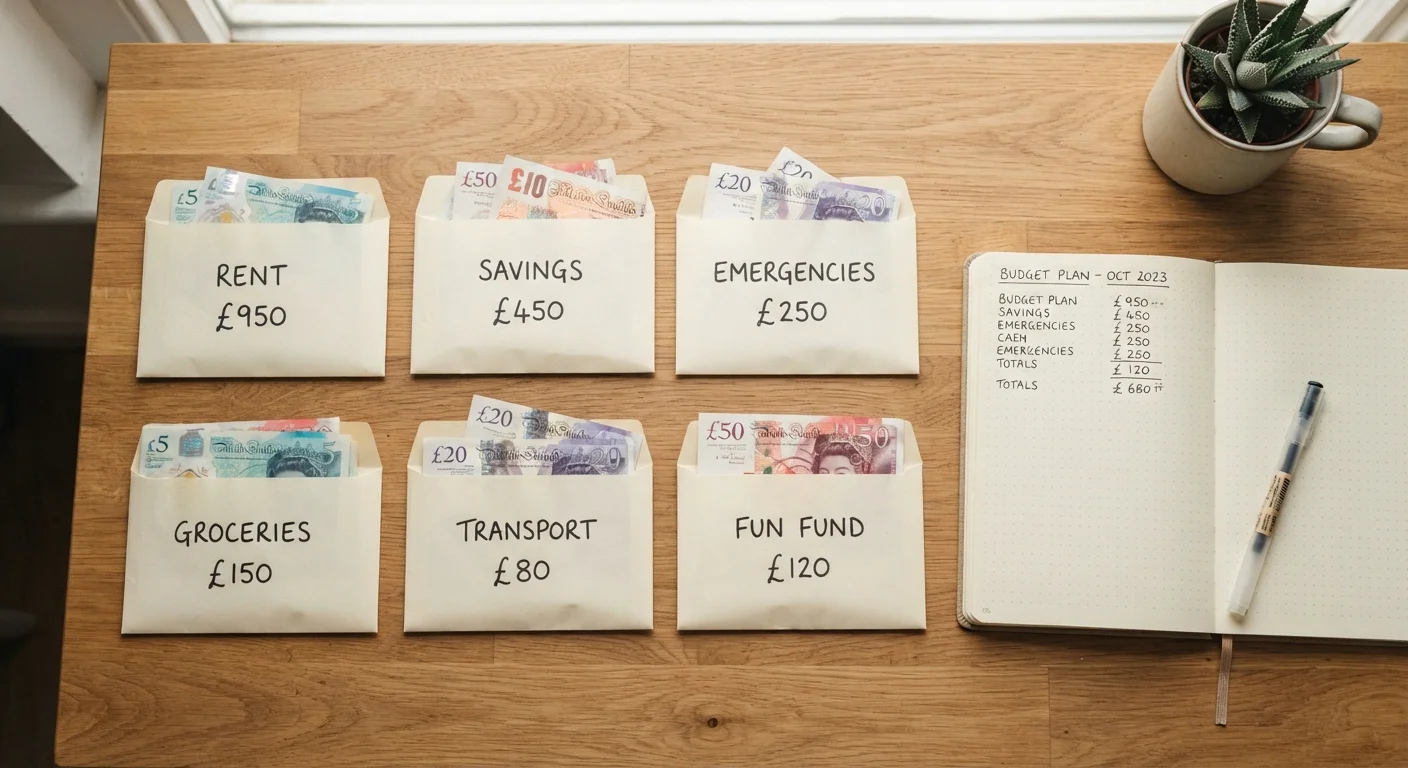
The envelope method is a cash-based budgeting system where you divide your income into labeled envelopes, each representing a spending category such as groceries, gas, or dining out. Once an envelope is empty, spending in that category stops for the month. The physical boundary of the envelope acts as a hard limit that digital accounts often cannot replicate.
Digital versions of the envelope method use budgeting software to create virtual category buckets, preserving the allocation logic without requiring physical cash.
What the envelope method actually does
The envelope method works on one principle: money assigned to a category can only be spent in that category. At the start of each pay period, you divide your available income into labeled envelopes, one for groceries, one for gas, one for entertainment, and so on. You spend from the relevant envelope during the month, and when it is empty, spending in that category stops.
That hard stop is the mechanism. Most digital payment systems allow spending to continue regardless of a budget you set earlier. An envelope removes that option. Research on payment method and spending behaviour suggests that handling physical cash creates a stronger psychological sense of loss than swiping a card, which is part of why the physical version of this system has a long track record.
The method does not cover every dollar automatically. Fixed expenses like rent, insurance, and loan payments leave your account on schedule and sit outside the envelope structure. The system is most useful for the variable, discretionary spending that tends to creep beyond intentions.
How to set it up
Start by listing every variable spending category in your monthly budget. Assign a dollar amount to each based on past spending or a target you want to hold. The total should not exceed the income available after fixed expenses and savings contributions are set aside.
If you use physical cash, withdraw the total and sort it into labeled envelopes at the start of each period. If you prefer a digital approach, apps such as those built around zero-based budgeting assign every incoming dollar to a named category before any spending begins. The logic is identical; only the format changes.
Pairing the envelope method with a daily spending tracker makes it easier to see which categories drain fastest, so you can adjust allocations in future periods rather than guessing.
Start with two or three envelopes
Running the full system across every spending category at once can be overwhelming. Start with the two or three categories where you most often overspend. Once those feel routine, add more envelopes gradually. A simpler system you follow is more useful than a complete one you abandon.
For couples, agreeing on category amounts before the period starts prevents disputes mid-month. Each partner can hold the envelopes relevant to their spending, or one shared set can cover household categories while personal discretionary envelopes stay separate.
Who benefits most from this approach
The envelope method suits people who know roughly where their money goes but find that certain categories regularly run over. If groceries and dining together absorb more than intended every month, separating them into two envelopes with firm limits creates immediate visibility and a boundary.
It is less suited to people with highly variable income, because allocating fixed amounts before money arrives requires estimation. It can also feel restrictive for people managing complex finances across multiple accounts. In those cases, a percentage-based approach may be more practical.
If a budget feels technically correct but psychologically punishing, the problem is often the category amounts rather than the system itself. Adjusting allocations to reflect actual priorities usually produces better long-term compliance than tightening limits across the board.
~30%
Average share of income spent on discretionary categories
According to U.S. Bureau of Labor Statistics Consumer Expenditure data, discretionary spending typically accounts for roughly 30% of household budgets, the segment where envelope limits have the most effect.
1 in 3
U.S. adults without a monthly budget
Survey data from the National Foundation for Credit Counseling has consistently found that a significant share of American adults do not follow a formal budget, suggesting many overspend without a structural limit in place.
Common pitfalls and how to handle them
The most frequent problem is setting category amounts that do not match reality. If the grocery envelope is funded at $300 but a household consistently spends $420, the envelope runs out before the month ends and the system appears to fail. The fix is to track actual spending for two or three months first, then set amounts based on real numbers rather than aspirations.
A second pitfall is raiding one envelope to cover another without recording the transfer. Moving money between categories is sometimes necessary, but doing it without acknowledgment defeats the purpose. Treating any transfer as a deliberate budget revision keeps the system honest.
Finally, the method covers spending but not saving. A separate process for directing money toward an emergency fund or retirement account needs to run alongside the envelope structure. The envelope system is a spending-control tool; a qualified financial adviser can help integrate it into a broader financial plan.
This article is for general informational purposes only and does not constitute personalised financial advice. Consult a licensed financial professional for guidance specific to your situation.