

Key Takeaways
- Percentage-based budgets scale with income, so a raise or pay cut adjusts every category without rebuilding the plan.
- The 50/30/20 split (needs, wants, savings) is the most widely recognized starting framework, but the right percentages depend on your situation.
- This method works best for people with variable income, such as freelancers or hourly workers with shifting hours.
- Fixed expenses like rent may not shrink when income drops, which is a real limitation to plan for.
- Percentage budgeting is general financial guidance, not personalized advice. A licensed financial adviser can tailor a plan to your circumstances.
Percentage-based budgeting
Percentage-based budgeting is a method where you assign a fixed share of your income to each spending category rather than a fixed dollar amount. When income rises or falls, every category adjusts in proportion automatically. This makes the budget more flexible than one built around rigid dollar targets.
The method is often applied to after-tax (take-home) income, though some frameworks use gross income. Clarify which base you are using before setting your percentages.
How the method works
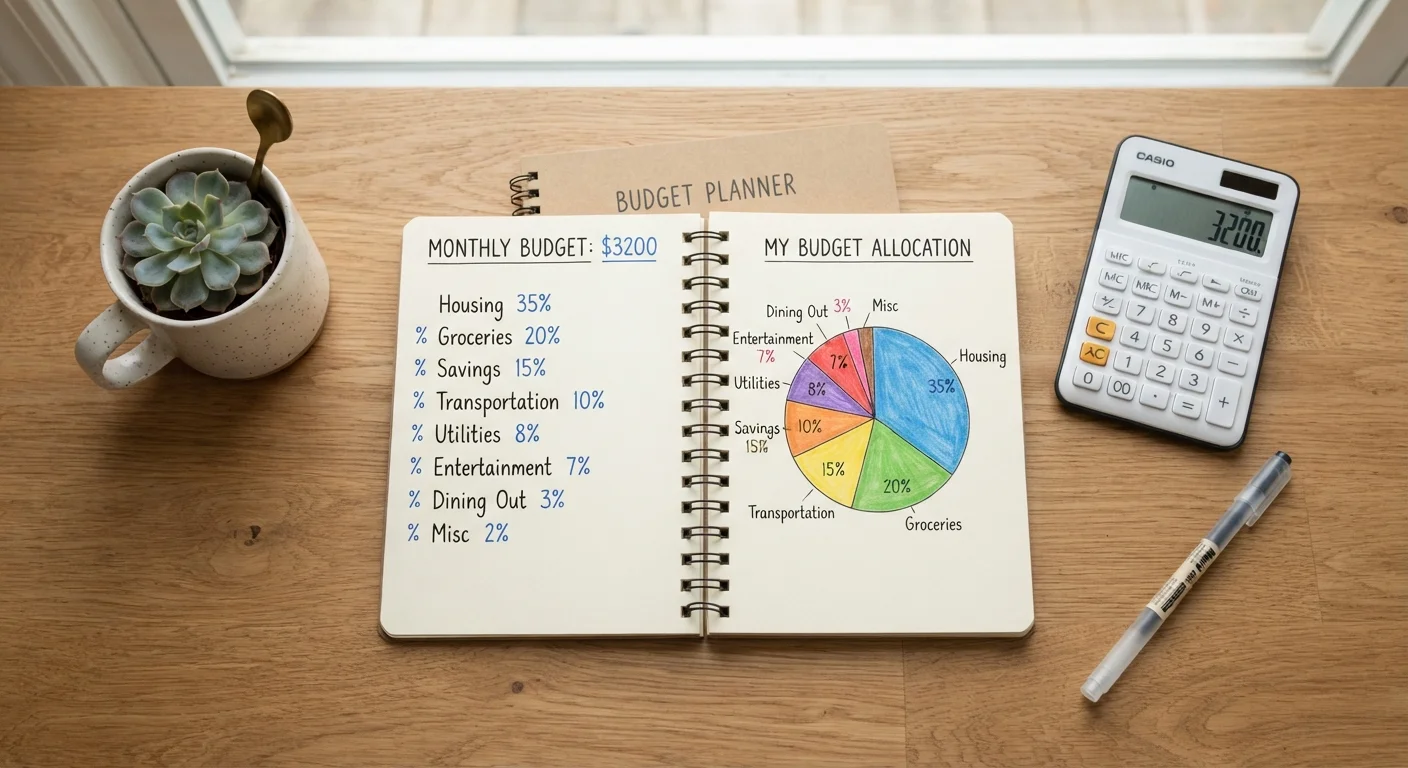
With a dollar-amount budget, you write down that groceries cost $400 a month and rent is $1,200. Those numbers stay fixed until you manually revise them. Percentage-based budgeting works differently: you decide that housing gets 30% of take-home pay, groceries get 12%, and so on. Every category is a share of the whole, not a hard number.
The practical consequence is automatic adjustment. If your paycheck is $3,500 one month and $4,200 the next, your allocations shift in proportion without any recalculation. A category set at 15% claims 15% whether income is high or low that period.
The most cited framework is the 50/30/20 split: roughly half of after-tax income to needs (housing, utilities, groceries, minimum debt payments), 30% to wants (dining, entertainment, subscriptions), and 20% to savings and additional debt payoff. That structure comes up often in personal finance writing because it is easy to remember and broadly applicable, but it is a starting point, not a universal rule. Pay-yourself-first budgeting follows a different logic, prioritizing savings before any other allocation.
Where percentage budgeting is most practical
People with variable income get the clearest benefit. Freelancers, gig workers, commission-based employees, and hourly workers whose schedules change month to month all face the problem that a fixed-dollar budget becomes outdated the moment income shifts. Percentages sidestep that problem.
It also works well for households going through major life changes such as a new job, a move to a higher-cost city, or a growing family. Rather than rebuilding a budget from scratch, the proportions carry forward and the absolute amounts adjust with the new income level.
Couples who pool income often find percentage budgeting easier to agree on than fixed amounts, since both partners can accept the fairness of proportionality. For more on shared budgeting approaches, see budgeting as a couple.
50/30/20
Common percentage split for needs, wants, and savings
This framework appears widely in personal finance education as a starting structure for after-tax income allocation.
~35%
Average share of income spent on housing by US renters
The U.S. Census Bureau has consistently reported median gross rent as a share of household income near or above 30% for renter households.
The real limitations
Fixed costs do not shrink because income drops. Rent, a car payment, or an insurance premium stays the same regardless of what percentage it represents. If housing costs 40% of income in a good month, they could consume 55% after a pay cut, leaving every other category underfunded.
This is not a flaw in percentage budgeting specifically; it is the nature of fixed obligations. The method surfaces the problem clearly (your percentages simply won't add up to 100 under the target allocations), which is useful information, but it does not solve the underlying affordability issue.
A related limitation: percentage budgeting does not naturally prompt you to notice categories you forgot to include, such as annual fees, irregular medical costs, or car registration. If a category has no assigned percentage, it has no place in the plan, and expenses in it will arrive unbudgeted.
If your budget consistently feels off even when the math looks right, the issue may be a values mismatch rather than a structural one. Realigning a budget that feels wrong addresses that situation directly.
Setting your own percentages
Start with three to four months of actual spending data. Calculate what share of take-home income each category consumed on average. Compare those real percentages against whatever framework you are using as a reference. The gaps tell you where spending is out of proportion with your priorities.
From there, set target percentages that are achievable given your fixed costs, not percentages copied from a template. Housing at 35% of income is a reality for many households in high-cost cities; forcing it to 30% through a framework that assumes national averages is not useful. Adjust the other categories to compensate.
Review the percentages at least twice a year, or whenever income changes materially. The everyday money habits that make budgeting stick are usually small, consistent check-ins rather than annual overhauls.
This article is for general informational and educational purposes only and does not constitute personalized financial advice. For guidance specific to your situation, consult a licensed financial adviser.