

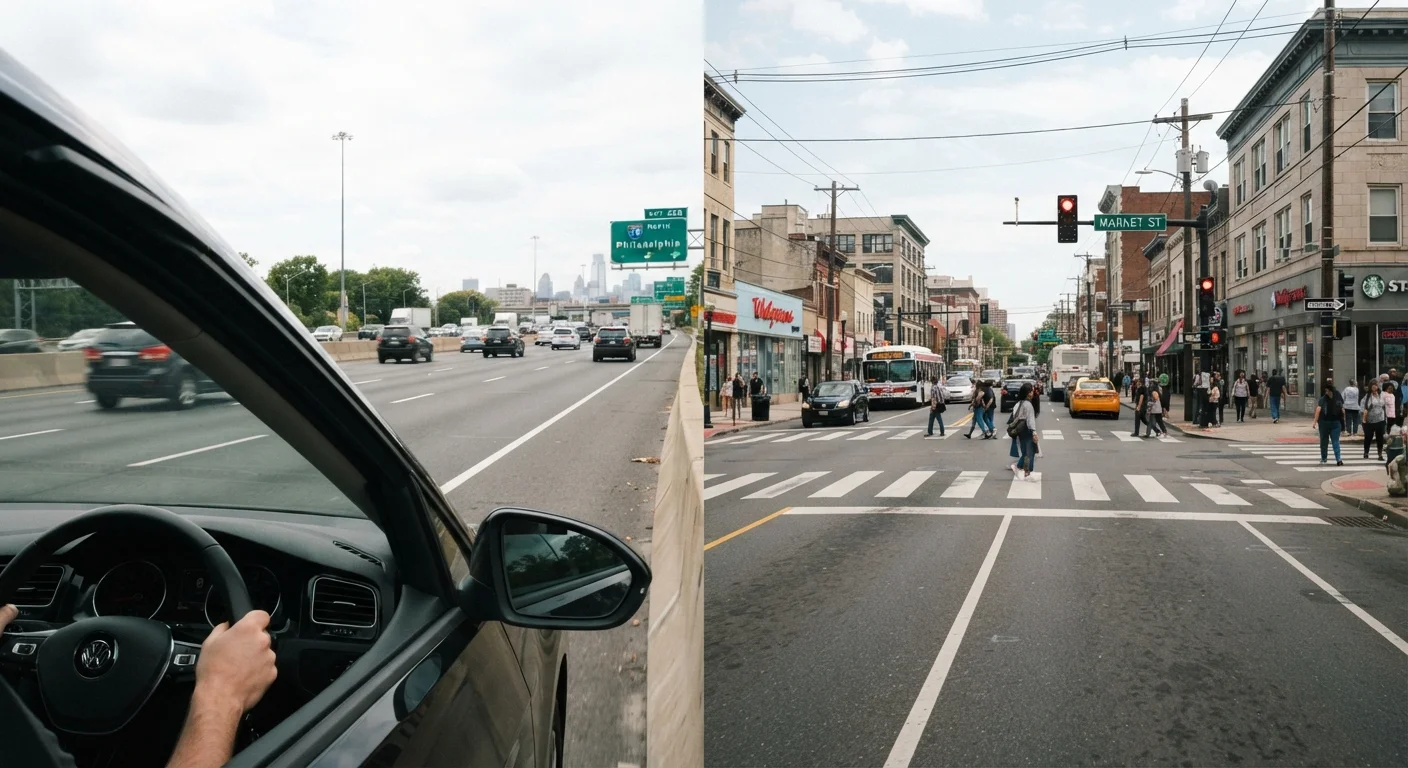
Our Verdict
Neither environment is inherently safer for every driver. Freeways demand sustained attention at speed and precise merging behavior. Surface streets demand constant scanning for pedestrians, cyclists, turning vehicles, and signal changes. Matching your attention strategy to the environment you are actually in is what reduces risk.
| Best for | Recommended |
|---|---|
| Drivers covering long distances with few stops | Freeway |
| Short urban trips requiring frequent turns and stops | Surface street |
| New drivers building confidence at lower speeds | Surface street (with gradual progression to freeway) |
| Drivers hauling large loads where lane width and fewer stops matter | Freeway |
How the two environments differ at a structural level
Freeways are designed for uninterrupted flow: no traffic signals, no cross traffic, controlled access points, and speed limits that generally run from 55 to 80 mph depending on the state and road type. Surface streets, by contrast, are built around access. They connect driveways, parking lots, and intersections. Speed limits typically range from 25 to 45 mph in urban and suburban settings, and drivers encounter signals, stop signs, crosswalks, cyclists, and turning vehicles in quick succession.
That structural difference shapes the entire risk profile. On a freeway, the main hazards are speed-related: rear-end crashes, lane departure, and problems during entry and exit. On surface streets, the hazards multiply in type: angle crashes at intersections, pedestrian and cyclist conflicts, door zones near parked cars, and drivers making left turns across oncoming lanes.
| Factor | Freeway | Surface street | |
|---|---|---|---|
| Typical speed limit | 55 to 80 mph | 25 to 45 mph | |
| Primary crash type | Rear-end, lane departure | Angle, pedestrian, left-turn | |
| Conflict points per mile | Few (controlled access) | Many (intersections, driveways) | |
| Fatality rate per mile | Higher on rural highways | Lower overall, higher crash volume | |
| Key legal obligation | Speed matching, keep-right laws | Yield to pedestrians, signal compliance | |
| Distraction impact | Distance covered per lapse is greater | More decision points missed per lapse |
Freeway-specific rules and risks
Federal and state guidelines set freeway speed limits, but the legal obligation to match the flow of traffic while staying within that limit is equally important. Driving significantly below the posted limit in a travel lane can itself be a violation in many states, because it creates a speed differential that leads to rear-end crashes.
Merging is where many freeway errors begin. Drivers entering via an on-ramp are generally expected to match highway speed before merging, not stop and wait. Proper merging technique requires using the full length of the acceleration lane and signaling early. Once on the freeway, following distance should increase with speed: at 65 mph, a three-second gap is a minimum, and four seconds or more is safer in heavy traffic or poor conditions.
Lane discipline also differs from surface streets. The left lane on a multi-lane freeway is for passing in most states, and lingering there at slower speeds is illegal in roughly 29 states under keep-right laws. Freeway fatigue is a separate concern on long trips: monotonous highway driving reduces alertness faster than varied city driving, and nighttime freeway driving compounds that fatigue risk considerably.
Surface street-specific rules and risks
Surface streets demand a different kind of attention: shorter reaction windows, more decision points per mile, and a much wider range of road users to track. Pedestrians can enter a crosswalk legally at any marked or unmarked intersection, and in most states drivers must yield to them whether or not a signal is present. Cyclist and pedestrian right-of-way rules vary by state, so checking local statute matters.
Intersections are the highest-risk locations on surface streets. Left turns across oncoming traffic account for a disproportionate share of urban angle crashes. Uncontrolled intersections, where two roads meet without signals or stop signs, require drivers to apply right-of-way rules correctly every time. Roundabouts, which replace some traditional intersections, follow their own right-of-way logic that trips up drivers who treat them like a four-way stop.
Speed is lower, but the consequences of distraction are still serious. At 30 mph, a one-second lapse covers 44 feet, more than enough to enter a crosswalk or run a red light. Passenger-related distraction tends to be more disruptive in stop-and-go city traffic than on a freeway where inputs are fewer.
Scanning technique on surface streets
On surface streets, shift your eye focus 12 to 15 seconds ahead rather than fixating on the car directly in front. Check intersecting sidewalks before you reach the stop line, not as you cross it. This gives you time to react to pedestrians or cyclists entering the road from your blind side.
What the crash data actually shows
A common assumption is that freeways are more dangerous because speeds are higher. Federal crash data from the National Highway Traffic Safety Administration tells a more nuanced story. Urban surface streets account for a large share of total crash volume because of the sheer density of conflict points. However, rural highways and freeways produce higher fatality rates per mile traveled, largely because crash speeds are greater and emergency response times are longer.
Aggressive driving is a factor in both environments but looks different in each. On freeways, it often involves tailgating, unsafe lane changes, and speeding. On surface streets, it tends to involve running red lights and failing to yield. The legal distinction between aggressive driving and road rage matters in either setting, because the charges and penalties differ.