

| Minimum passing distance (most states) | 3 feet from cyclist (Governors Highway Safety Association, 2024) |
| States with explicit passing distance laws | More than 35 (League of American Bicyclists) |
| Crosswalk obligation | Yield to pedestrians in all marked and most unmarked crosswalks (Uniform Vehicle Code, adopted by most states) |
| Bike lane access for drivers | Permitted only when turning, entering a driveway, or directed by traffic control |
| States requiring yield to waiting pedestrians | Oregon, Hawaii (and others with similar provisions) |
| Dooring liability | Person opening the door is typically at fault (Illinois Vehicle Code as one example) |
The legal foundation: why these rules exist
Traffic laws governing interactions between motor vehicles, cyclists, and pedestrians exist at the state level, not federal. That means the specific distance required when passing a cyclist in California may differ from what Texas law mandates. However, every state shares a common legal principle: drivers have a duty of care toward more vulnerable road users. Violating that duty, even without intent, can result in a traffic citation, civil liability, or criminal charges if injury follows.
Most states base their pedestrian and cyclist protections on the Uniform Vehicle Code, a model statute that many legislatures have adopted in full or in part. Understanding this framework helps drivers recognize that the rules are not arbitrary, they reflect which road users are most exposed to serious harm in a collision.
For more on how right-of-way rules work in a specific road context, see how roundabouts handle pedestrian interactions.
| Minimum passing distance (most states) | 3 feet from cyclist (Governors Highway Safety Association, 2024) |
| States with explicit passing distance laws | More than 35 (League of American Bicyclists) |
| Crosswalk obligation | Yield to pedestrians in all marked and most unmarked crosswalks (Uniform Vehicle Code, adopted by most states) |
| Bike lane access for drivers | Permitted only when turning, entering a driveway, or directed by traffic control |
| States requiring yield to waiting pedestrians | Oregon, Hawaii (and others with similar provisions) |
| Dooring liability | Person opening the door is typically at fault (Illinois Vehicle Code as one example) |
Passing cyclists: the 3-foot rule and beyond
As of 2024, more than 35 states have enacted minimum passing distance laws for cyclists, with the most common threshold being 3 feet of clearance when a motor vehicle overtakes a bicycle. Some states, including Pennsylvania and Wisconsin, require 4 feet. A handful allow drivers to cross a double yellow center line to give adequate clearance, as long as oncoming traffic is clear.
The 3-foot requirement is a minimum, not a target. At highway speeds, even 3 feet provides little margin for error. Traffic safety researchers have consistently found that closer passes increase crash risk significantly, particularly when cyclists encounter wind turbulence from large vehicles.
Drivers are generally required to:
- Slow down before passing a cyclist, not just after moving into a wider position
- Avoid returning to the original lane until well past the cyclist
- Give additional clearance when roads are wet, visibility is reduced, or the cyclist is a child
In states without an explicit distance law, the general standard is a "safe" or "reasonable" distance, which courts interpret based on circumstances. That vagueness does not protect a driver who passes too closely and causes a crash.
Crosswalk laws and when drivers must yield
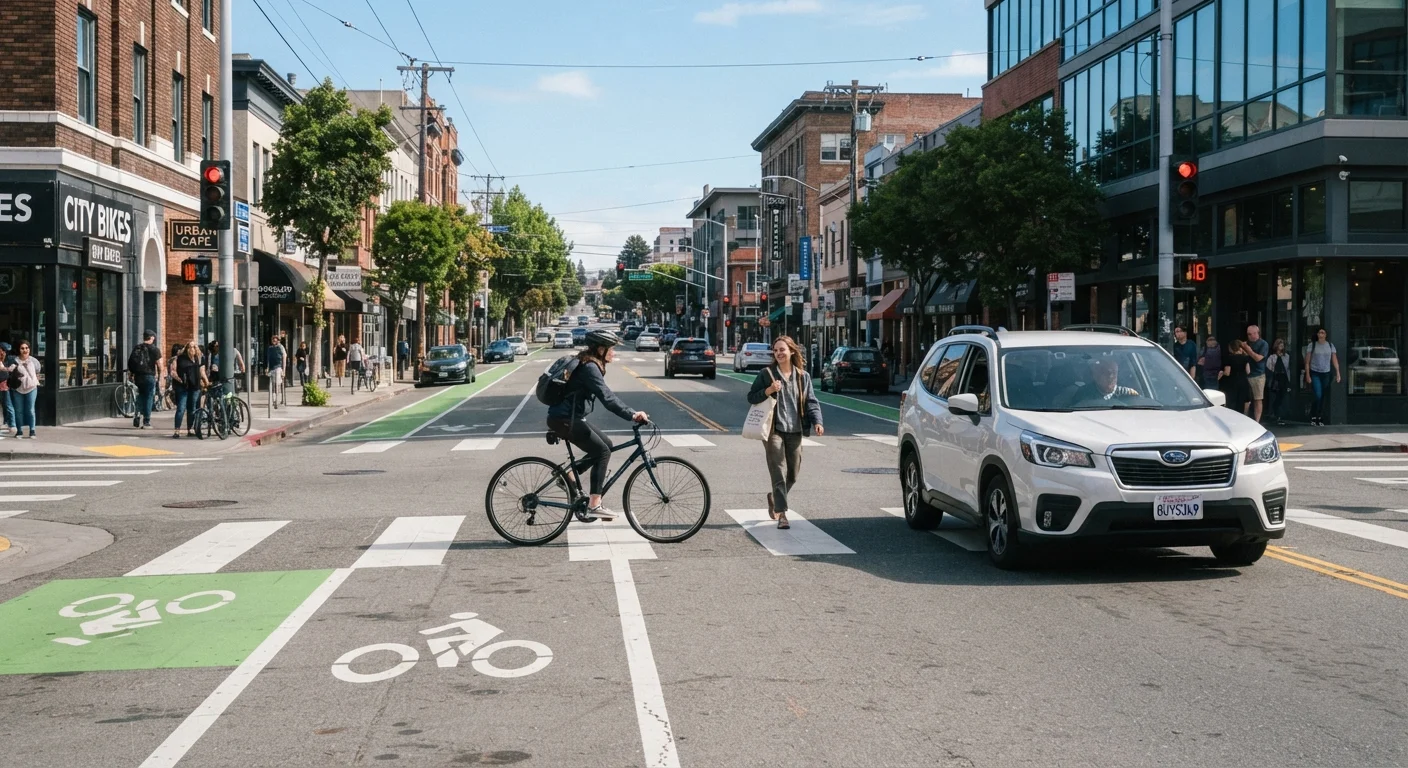
Every state requires drivers to yield to pedestrians in marked crosswalks. Most also require yielding in unmarked crosswalks, which are the implied pedestrian paths at any intersection where sidewalks would logically meet, even if no paint is present.
A few specific rules that many drivers do not know:
- Oregon and Hawaii require drivers to yield to pedestrians waiting at the curb, not just those already in the crosswalk.
- Most states prohibit drivers from passing a vehicle that has stopped for a pedestrian, even if the pedestrian is not yet visible to the passing driver.
- A pedestrian pressing a crossing button and stepping off the curb generally has the right of way, regardless of a parallel green light for traffic.
Pedestrians do not have unconditional right of way. Most state laws prohibit pedestrians from suddenly leaving a curb into the path of traffic so close that it is impossible for a driver to stop. However, that shared responsibility does not reduce a driver's obligation to be prepared to stop near any crossing.
Surface-street environments generate far more pedestrian interactions than freeways. For a direct comparison of the risk environments involved, see freeway vs. surface street driving rules and risks.
Bike lanes, door zones, and shared lane markings
Drivers are legally prohibited from driving in a designated bike lane except in specific circumstances: turning at an intersection, entering or exiting a driveway, or in some states, when directed by an emergency. Even in those cases, a driver must yield to any cyclist already in the lane before entering it.
The door zone is a frequent crash site. When a driver or passenger opens a door into the path of a cyclist, the person opening the door is typically found liable under state dooring statutes. Illinois, for example, explicitly prohibits opening a vehicle door on the traffic side unless it can be done safely.
Shared lane markings (sometimes called sharrows) indicate a lane where cyclists and motor vehicles travel together. They do not grant the cyclist exclusive use, but they signal that drivers should expect bicycle traffic and adjust speed accordingly.
Distraction is a consistent factor in cyclist and pedestrian crashes. Research on passenger-related driver distraction is relevant here: anything that draws a driver's attention away from the forward roadway increases the risk of missing a vulnerable road user.
This article provides general legal information for educational purposes. Traffic laws vary by state and change over time. Consult your state's driver handbook or a licensed attorney for guidance specific to your situation.