

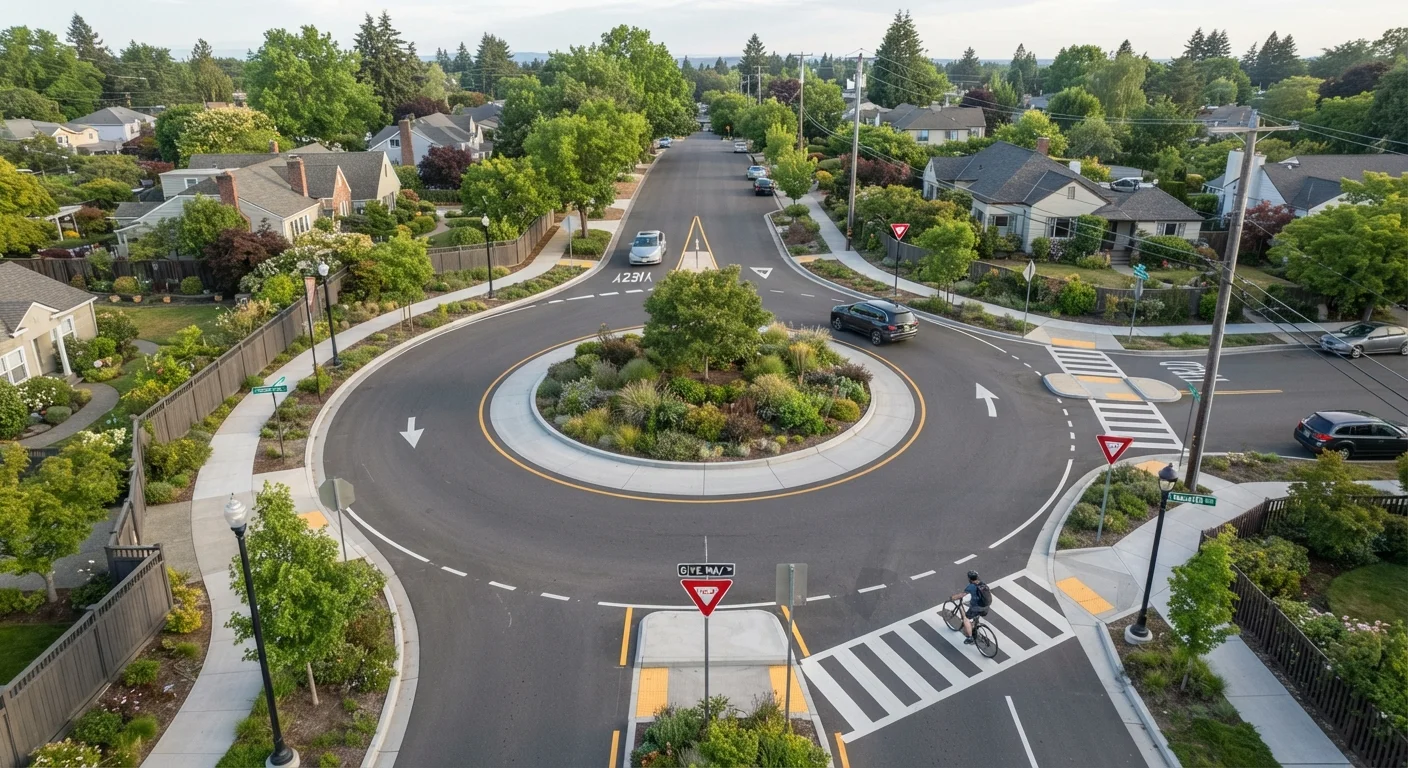
Key Takeaways
- Vehicles inside the roundabout always have the right of way over entering traffic.
- Drivers must yield at the entry point, not stop unless traffic requires it.
- Multi-lane roundabouts require lane selection before entry, not inside the circle.
- Pedestrians cross only at marked crosswalks on the approach, not across the central island.
- Roundabouts reduce fatal and injury crashes significantly compared with traditional stop-controlled intersections.
Roundabout
A roundabout is a circular intersection where traffic flows continuously in one direction around a central island. Vehicles entering the circle must yield to traffic already inside it. No traffic signal is required because the yield rule alone manages the flow.
Roundabouts differ from older traffic circles and rotaries in that entering traffic always yields, speeds are kept low by tight geometry, and approaches are typically channelized with splitter islands.
Why roundabouts exist and why they confuse American drivers
Most US drivers grew up navigating intersections controlled by traffic signals or stop signs. A roundabout replaces that familiar stop-and-go sequence with continuous flow, and the shift in logic trips people up. The confusion is not about intelligence; it is about experience. Many Americans encounter roundabouts rarely, so the rules never become automatic.
The Federal Highway Administration has been promoting roundabout construction since the 1990s because crash data consistently show they outperform traditional intersections on safety. Serious injury and fatal crashes drop sharply because the intersection geometry eliminates right-angle collisions, which are the deadliest type. Vehicles move at low speed through a curve, and if contact does happen, it tends to be a sideswipe at low speed rather than a broadside impact.
Understanding common driving safety myths is part of navigating modern roads confidently, and roundabouts are one area where instinct and habit often lead drivers wrong.
The core rule: yield on entry, not inside the circle
The single rule that governs every roundabout in the United States is this: traffic inside the circle has the right of way. Drivers approaching the entry point must yield to circulating vehicles. The yield sign posted at each entry is not a suggestion; it is the legal basis for the entire system.
Yielding does not mean stopping. If the circle is clear, a driver enters without stopping. Unnecessary stopping at an empty roundabout is a common error that confuses drivers behind you and degrades traffic flow. Watch for a gap in circulating traffic, then enter smoothly.
Once inside the roundabout, maintain your lane, keep your speed low (typically 15 to 20 mph through the curve), and signal before your exit. Signaling your exit helps pedestrians and other drivers anticipate your movement.
Signal your exit, not your entry
Many drivers instinctively signal left when entering a roundabout to indicate they are joining the circle. This can confuse other drivers. Instead, signal right as you approach your intended exit. This tells pedestrians and vehicles on that exit approach that you are leaving the circle, which is the information they actually need.
Multi-lane roundabouts: choosing and holding your lane
Single-lane roundabouts are straightforward. Multi-lane roundabouts require one extra step: pick your lane before entry.
As a general guide, use the right lane when taking the first or second exit (turning right or going straight through a standard four-approach roundabout). Use the left lane when continuing past the halfway point or turning left. Pavement markings and approach signs specify this for each particular roundabout, and those markings override any general rule.
Once you enter, hold your lane. Do not change lanes inside the circle. The geometry is tight, sight lines to adjacent vehicles are limited, and a lane change at that point is how sideswipe collisions happen. If you miss your exit, continue around and take it on the next pass.
This lane discipline mirrors what good merging practice requires on other road types. The zipper merge principles that apply on highway on-ramps share the same underlying logic: commit early, hold your position, and yield at the right moment.
Pedestrians and cyclists at roundabouts
Pedestrian crossings at roundabouts are located on each approach leg, set back several feet from the yield line. This placement gives drivers a clear view of the crosswalk before entering the circle and gives pedestrians a shorter crossing distance per lane.
Drivers must yield to pedestrians in those crosswalks, exactly as at any other marked crosswalk. Pedestrians should cross one lane at a time, pause on the splitter island between lanes, and then cross the second lane when clear. Attempting to cross both lanes in one continuous movement is dangerous at busy roundabouts.
Cyclists have two legal options in most states: ride through the roundabout as a vehicle (taking the lane, following the same yield and flow rules as cars) or dismount and use the pedestrian crossings. Slower or less confident cyclists often choose the crosswalk route. For more on driver obligations to cyclists and pedestrians generally, see what drivers are legally required to do around cyclists and pedestrians.
Trucks, emergency vehicles, and special situations
Large trucks and buses need extra room. Many roundabouts have a slightly raised concrete apron ringing the central island. This apron allows the rear wheels of long vehicles to track over it without climbing the main curb. Drivers of standard passenger vehicles should stay in their lane and not use the truck apron.
If an emergency vehicle approaches while you are inside a roundabout, do not stop in the circle. Exit at the next available exit, then pull to the right and stop clear of the roadway. Stopping inside the circle blocks all circulating traffic and obstructs the emergency vehicle.
Roundabouts also interact with traffic signal systems at nearby intersections. Understanding how signal timing works at adjacent intersections can help drivers anticipate queuing on approaches when signals upstream create platoons of vehicles.