

Key Takeaways
- Most US states require drivers to yield when entering a highway from an on-ramp, not the reverse.
- The zipper merge is the safest and most traffic-efficient method when a lane ends ahead.
- Highway drivers have a general duty to facilitate safe merges where road conditions allow.
- Matching highway speed before merging is both legally expected and physically safer.
- Aggressive blocking of merging vehicles can cross into legally actionable behavior.
What the law generally says about merging
Traffic law in the United States is set at the state level, so exact wording varies. That said, a consistent principle runs through nearly every state's vehicle code: a driver entering a highway from an on-ramp must yield to traffic already traveling on the main roadway. The on-ramp driver does not have automatic right-of-way simply because a merge lane exists.
What that means practically is that the entering driver bears primary responsibility for timing the merge safely, matching speed, and finding a gap. Most states also prohibit abrupt lane changes without signaling, which applies equally to merging drivers and to highway drivers who dart over to block someone entering.
Some states go further. Minnesota's statute, for example, codifies the zipper merge and instructs drivers to use a full merge lane until its endpoint rather than moving over early. Several other states have moved toward similar language as traffic engineering research has accumulated. Check your state's DMV handbook for the specific statute that applies where you drive, because the details matter if a collision leads to an insurance or liability dispute.
For a broader look at how freeway driving rules differ from city streets, see our freeway vs. surface street guide.
The zipper merge: how it works and why it matters
The zipper merge describes a specific technique: when a lane is ending, drivers in both lanes continue at highway speed to the merge point and then alternate, one car from each lane, like teeth of a zipper. Drivers do not need to rush over early or fight for position.
Research from the Minnesota Department of Transportation found that early-merge behavior, where drivers move over as soon as they see a "lane ends" sign, creates a long single-file queue in the remaining lane while the closing lane sits empty. That imbalance increases total delay and raises the risk of rear-end collisions. The zipper merge keeps both lanes active longer and reduces queue length by roughly 40 percent in congested conditions, according to that agency's findings.
The technique requires cooperation from both sides. The driver staying in the closing lane must maintain steady speed rather than accelerating aggressively past waiting traffic. The driver in the continuing lane must leave a consistent gap and not close it deliberately to block entry. Neither behavior is negotiable for the merge to work.
Use the full length of the on-ramp to reach highway speed before merging
Entering at a significantly lower speed than surrounding traffic forces sudden braking from highway drivers and increases rear-end collision risk. On-ramps are engineered for speed-matching; stopping or crawling onto the highway wastes that design.
Stay in a closing lane until the marked merge point, then alternate with adjacent traffic
Moving over far before the lane ends creates an uneven queue in one lane while the other sits underused. Both lanes staying active until the endpoint distributes traffic more evenly and reduces total backup length.
Check mirrors and blind spots before committing to any lane change during a merge
Side mirrors leave a blind-spot zone roughly alongside and behind the vehicle. Relying only on mirrors during a merge has caused collisions when a vehicle sitting in that zone was not visible.
Signal your merge intent at least three to four seconds before changing lanes
A signal gives drivers in adjacent lanes time to adjust speed or position. Late or absent signals remove that reaction window and can leave other drivers with no safe option.
Leave a consistent gap for zipper-merging vehicles rather than closing it
Deliberately closing a gap on a driver who is running out of ramp can force a dangerous stop or an emergency maneuver. It also prolongs the overall queue for everyone behind.
On-ramp technique: matching speed and finding a gap
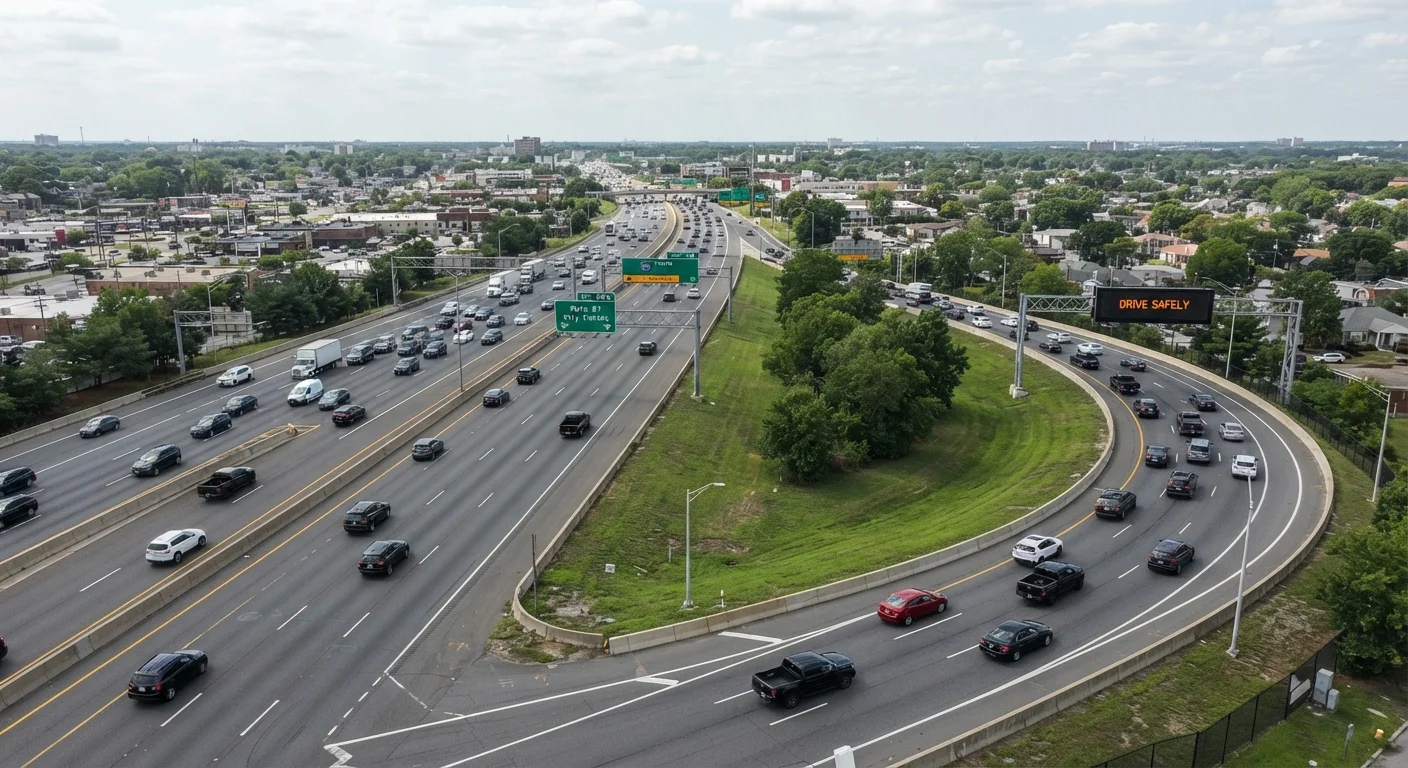
An on-ramp is designed to give entering drivers space to reach highway speed before the merge point. Using that full length is both the legal expectation and the physically correct approach. A driver who enters the highway at 40 mph into 70 mph traffic creates a speed differential that forces sudden braking from highway drivers behind them.
Before the ramp ends, check your mirrors and identify a gap in the right lane. Signal early so nearby drivers know your intent. Accelerate to match the speed of traffic in that gap, not just the posted limit. If no gap exists, adjust your acceleration to create one, and be prepared to slow briefly at the ramp's end if the ramp has a yield line.
Highway drivers in the right lane are not legally required to move over for merging traffic in most states (that obligation typically applies only for stopped emergency vehicles), but many choose to do so when it is safe, and doing so improves overall flow. If you are driving in the right lane and can safely shift left to open space for an entering vehicle, that is good practice. Forcing a merge by staying rigidly in the lane while a driver alongside you runs out of ramp can, depending on circumstances, constitute aggressive driving. See our explainer on aggressive driving vs. road rage for where those behaviors sit under US law.
Common errors that cause merge collisions
Most merge-related crashes trace back to a handful of predictable mistakes. Stopping at the end of a ramp is one of the most dangerous. It forces a driver to accelerate from zero into fast-moving traffic and leaves no room to maneuver. Ramps have yield lines, not stop signs, for exactly this reason.
Merging without checking blind spots is another frequent factor. Mirrors alone do not cover the area just behind and beside your vehicle. A quick shoulder check before committing to the lane change is standard practice and is part of most state driving tests for a reason.
Late signaling, or no signaling at all, reduces the time nearby drivers have to react. Signals do not grant right-of-way, but they communicate intent and give other drivers the chance to adjust. For more on how driver behavior around intersections and signals works in practice, our signal timing article covers the engineering logic behind what you see on the road.
This article provides general information about driving practices and traffic law principles. Traffic laws vary by state. Consult your state's official DMV resources or a qualified legal professional for advice specific to your situation.