

Key Takeaways
- Teen drivers face sharply higher crash risk with peer passengers in the car.
- Adult drivers can also be distracted by passengers, though the effect is less severe.
- Conversation type matters: emotionally charged or complex discussions draw more attention away from the road.
- Passengers who are aware of road conditions can help reduce distraction rather than add to it.
- Graduated driver licensing laws in most states restrict passengers for new drivers precisely because of this risk.
Passenger-induced driver distraction
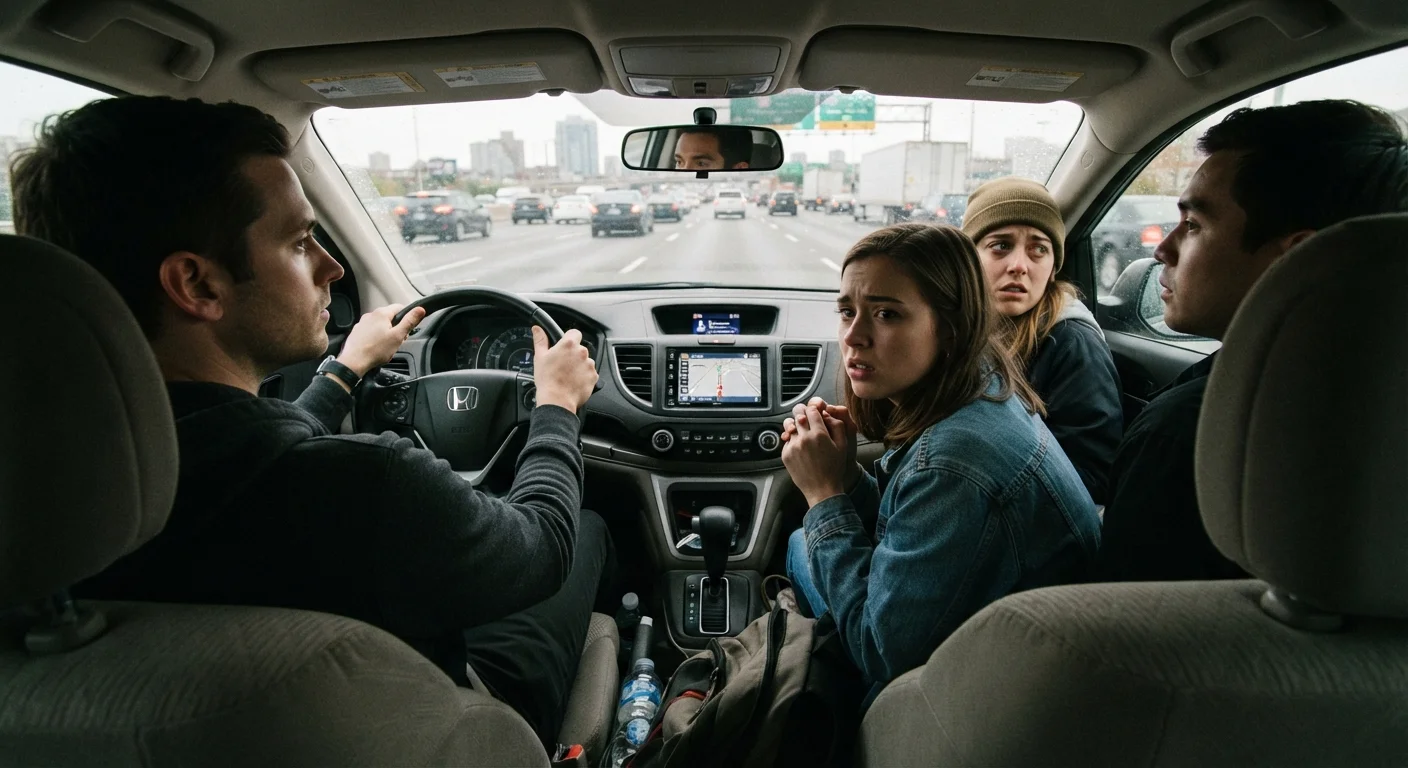
Passenger-induced driver distraction describes how the presence of other people in a vehicle affects the driver's attention, speed choices, and risk tolerance. Unlike phone-based distraction, this influence is often social and unconscious. It can work in both directions: some passengers stabilize driver behavior, while others increase crash risk.
Researchers sometimes distinguish between 'cognitive distraction' (mental load from conversation) and 'social facilitation' (behavior changes driven by the perceived expectations of an audience).
What the research actually shows
The relationship between passengers and crash risk is well documented in traffic safety research, but it does not point in one simple direction. For teenage drivers, the data is clear: crash risk rises with each additional peer passenger. The AAA Foundation for Traffic Safety has reported that the presence of a teen passenger roughly doubles fatal crash risk for a teen driver, with risk increasing further when two or more peers are present.
For adult drivers, the picture is more nuanced. Studies have found that adult passengers can, in some situations, reduce crash involvement because an alert co-rider may warn the driver of hazards or simply because their presence encourages more careful behavior. The key variable is whether the conversation or social dynamic demands the driver's attention at the wrong moment.
Drowsy driving research offers a useful comparison point: both fatigue and social distraction impair performance through mechanisms the driver often cannot accurately self-assess. In both cases, the driver may feel fully functional while their response time and hazard detection have already degraded.
Why peer passengers affect teen drivers differently
Adolescent brain development plays a direct role. The prefrontal cortex, which governs impulse control and consequence evaluation, is not fully developed until the mid-20s. When peers are present, teen drivers are more likely to run yellow lights, follow more closely, and exceed the speed limit. This is not simply carelessness; it reflects how social reward circuits respond to an audience at that stage of development.
Graduated driver licensing (GDL) programs, now in place in all 50 states in some form, address this directly by restricting the number of passengers a newly licensed driver may carry, particularly during the first six to twelve months of solo driving. Restrictions vary by state, so drivers and parents should check their state's specific GDL rules.
Set expectations before the trip
Before driving with passengers, especially younger ones, a brief, direct conversation about in-car behavior is more effective than trying to manage distractions once they have started. Letting passengers know you may ask for quiet during complex maneuvers removes the social friction from that request later.
The effect is not limited to driving. Teen passengers sometimes actively encourage risky behavior, whether through direct pressure or simply by laughing or reacting positively when a driver speeds or makes an aggressive maneuver. Understanding this dynamic helps both drivers and parents set clear expectations before handing over the keys.
How conversation type affects attention
Not all in-car conversation carries the same cognitive cost. Research on driver distraction has found that emotionally charged discussions, arguments, and complex problem-solving conversations draw significantly more mental resources away from driving than light, casual talk. The brain has a finite attention budget, and when a conversation is absorbing, driving tasks that require decision-making, such as navigating an unfamiliar intersection or managing a merge, get less of it.
This is different from how a passenger physically in the car interacts with the driver compared to a phone caller. A phone caller has no visibility of road conditions and will not pause mid-sentence because the driver is approaching a busy interchange. A passenger who is paying attention to the road will often naturally reduce conversational demands in those moments, which is one reason in-car conversation is generally treated as less risky than hands-free calling in research literature.
For drivers heading into more complex environments, freeway and surface street conditions each carry their own demands, and both can be complicated by an inattentive or distracting passenger.
What drivers and passengers can each do
The driver carries legal and practical responsibility for attention behind the wheel. However, passengers are not neutral factors. An aware passenger who monitors the road, stays calm, and avoids escalating difficult conversations is a genuine safety asset. One who demands constant engagement, plays loud audio, or reaches toward the controls is a liability.
For drivers, a few habits make a real difference. Setting clear expectations before the trip begins, especially with younger or unfamiliar passengers, removes the social awkwardness of asking for quiet at a critical moment. Pulling over to address a problem rather than managing it while driving is always the safer choice, regardless of how minor the situation seems.
Sharing the road requires the same sustained attention that passenger dynamics can erode. A distracted driver is slower to notice a cyclist entering the lane or a pedestrian stepping off the curb, and slower reaction times have direct consequences in those scenarios.