

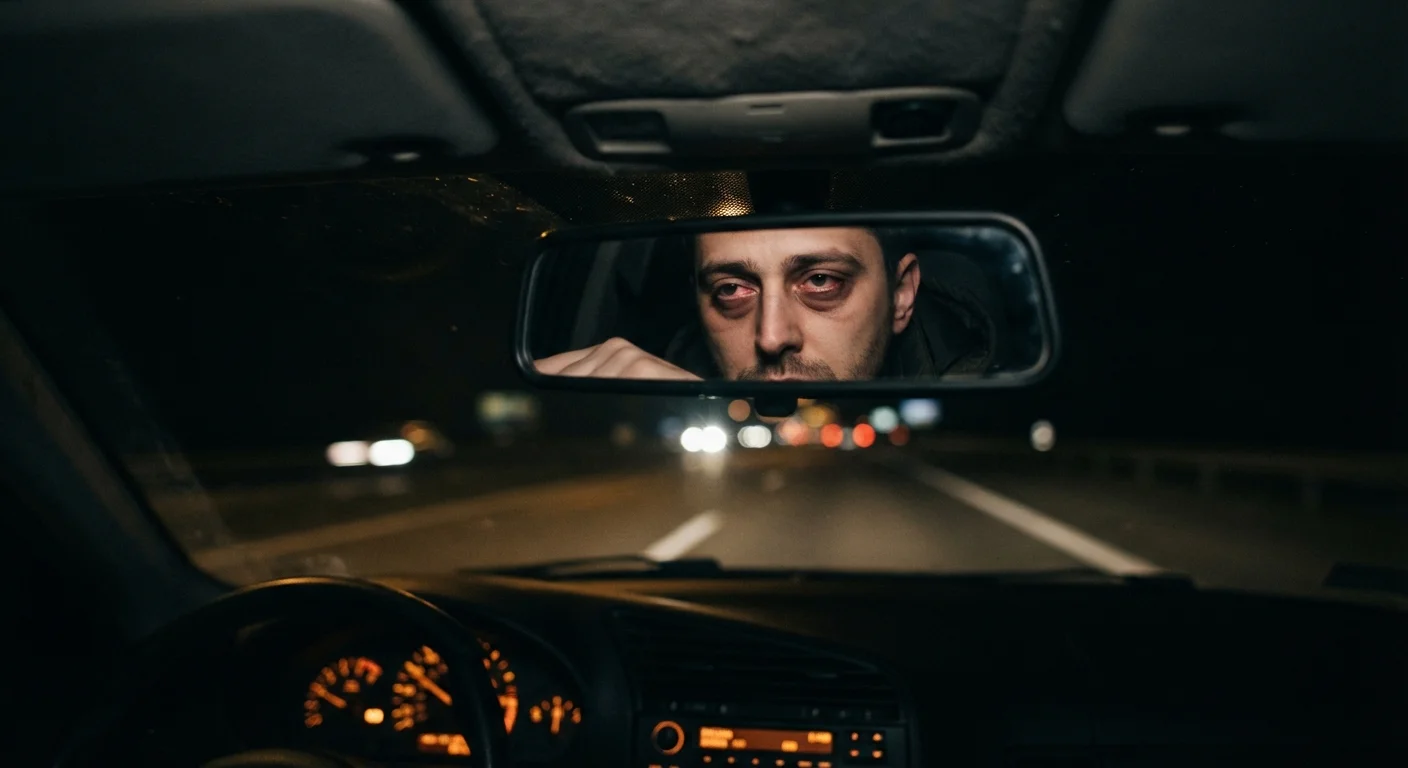
Key Takeaways
- Missing 18 or more hours of sleep can impair driving ability as much as a measurable blood alcohol level.
- Drowsy driving contributes to an estimated tens of thousands of crashes annually on US roads.
- A handful of states have passed laws that treat severely fatigued driving as a criminal offense under certain conditions.
- Microsleep episodes, brief involuntary blackouts lasting a few seconds, can occur without the driver noticing.
- No amount of caffeine or cold air reliably reverses serious sleep deprivation while driving.
Drowsy driving
Drowsy driving means operating a vehicle while significantly sleep-deprived or fatigued, to the point where cognitive function, reaction time, or alertness is noticeably reduced. It is not simply feeling a little tired; it refers to a state where the brain's ability to process information and respond quickly is measurably compromised. Traffic safety researchers compare moderate sleep deprivation to low-level alcohol intoxication in terms of impairment severity.
Studies published by the AAA Foundation for Traffic Safety found that missing 17 to 19 hours of sleep produces performance deficits comparable to a blood alcohol concentration of 0.05%, and missing 24 hours approaches 0.10% BAC-level impairment.
How fatigue impairs the brain behind the wheel
The brain needs sleep to maintain the functions most critical to safe driving: sustained attention, quick reaction, accurate hazard recognition, and sound judgment. When sleep is cut short, those functions degrade in sequence, with attention declining first, followed by reaction speed, then higher-order decision-making.
The AAA Foundation for Traffic Safety has documented this degradation quantitatively. Drivers who slept six to seven hours the night before a drive were 1.3 times more likely to crash than those who slept eight or more hours. That figure rose to nearly 12 times more likely for drivers who got fewer than four hours. These are not minor margins.
A particularly dangerous phenomenon is microsleep: an involuntary lapse in consciousness lasting one to thirty seconds. The driver's eyes may be open, but the brain has effectively gone offline. At 65 miles per hour, a two-second microsleep means roughly 190 feet of road covered with no driver input whatsoever. Because microsleep episodes end as abruptly as they start, many drivers are unaware they occurred, which makes them especially hard to self-monitor.
Pull over at the first warning sign
If you yawn repeatedly, lose track of recent miles, or drift in your lane, do not try to push through. Pull off at the next safe exit or rest area. A 20-minute nap is one of the few interventions with documented short-term benefit on driving alertness.
Drowsy driving is often discussed alongside distracted driving as a parallel impairment problem. Distracted driving laws in the US address a related set of cognitive failures behind the wheel.
The comparison to alcohol impairment
Traffic safety researchers began comparing sleep deprivation to alcohol intoxication in the 1990s, and the evidence has held up consistently. Staying awake for 17 to 19 hours produces performance deficits roughly equivalent to a blood alcohol concentration (BAC) of 0.05%. At 24 hours without sleep, the impairment approaches what is observed at 0.10% BAC, which exceeds the legal driving limit in every US state.
The comparison matters because most drivers understand that a certain number of drinks makes them unfit to drive, but they do not apply the same reasoning to fatigue. A driver who would refuse to get behind the wheel after three drinks might not think twice about driving after an all-night work shift, even though the cognitive profile is similar.
1 in 25
Adult drivers who report falling asleep at the wheel in the past 30 days
According to CDC survey data on drowsy driving prevalence among US adults.
~91,000
Police-reported drowsy driving crashes per year
NHTSA estimates this figure, while acknowledging that the true number is likely much higher due to underreporting.
12x
Increased crash risk after fewer than 4 hours of sleep
AAA Foundation for Traffic Safety research comparing crash likelihood across sleep duration categories.
Unlike alcohol, there is no roadside test for drowsiness. Law enforcement cannot administer a breathalyzer equivalent for fatigue, which complicates both enforcement and post-crash attribution. This gap is one reason drowsy driving crash statistics are widely considered underreported.
How US law treats drowsy driving
No federal statute specifically criminalizes drowsy driving. At the state level, most jurisdictions address it indirectly, through reckless driving, negligent operation, or vehicular manslaughter charges applied after a crash has already occurred.
New Jersey passed what is commonly called Maggie's Law in 2003, making it the first state to explicitly define fatigued driving as reckless driving in a fatal crash context. The law defines fatigue as being without sleep for 24 or more consecutive hours. A driver who causes a fatal crash under those conditions can be prosecuted for vehicular homicide. Arkansas has passed a comparable measure. Several other states have introduced similar legislation without enacting it.
The absence of a specific law does not mean drowsy driving carries no legal consequences. Prosecutors in most states can and do charge fatigued drivers with vehicular manslaughter or aggravated reckless driving when crash evidence supports it, particularly if the driver admitted to being severely sleep-deprived or if driving patterns (lane departures, no braking before impact) point to a loss of consciousness. Night driving hazards intersect with this risk, since fatigue is more acute during the hours when the body's circadian rhythm pushes toward sleep.
High-risk groups and common crash patterns
Drowsy driving crashes have a recognizable profile. They tend to occur between midnight and 6 a.m., or in the early-to-mid afternoon, when circadian dips in alertness are steepest. They often involve a single vehicle leaving the road without any sign of braking, because the driver did not react before impact. They are disproportionately fatal, partly because high-speed roadways see more drowsy driving and partly because an unconscious driver cannot take evasive action.
Certain groups are overrepresented in these crashes. Shift workers finishing overnight shifts, commercial truck drivers on long hauls, young male drivers under 25, and people with untreated obstructive sleep apnea all face elevated risk. People with sleep apnea are up to five times more likely to have a traffic accident than those without the condition, according to data from the National Highway Traffic Safety Administration (NHTSA).
The social dimension of driving also matters. Driving with passengers can either raise or lower crash risk depending on circumstances. A passenger who stays awake and engaged can serve as a second set of eyes, while a car full of sleeping passengers removes that check entirely.
What actually reduces the risk
The only reliable countermeasure for drowsy driving is sleep. Caffeine can delay subjective sleepiness for a short window, but does not restore the reaction time or judgment that deprivation has already degraded. Opening a window, turning up the radio, or splashing cold water on the face have no documented effect on driving performance.
Short naps of 20 minutes have shown measurable short-term benefit in controlled studies, which is why traffic safety advocates recommend the strategy of pulling over and napping before resuming a drive. Combining a short nap with caffeine taken just before the nap can extend alertness somewhat further, since caffeine takes roughly 20 to 30 minutes to take effect. Neither approach substitutes for adequate nightly sleep on an ongoing basis.
For long trips, planning rest stops every two hours or 100 miles is a widely cited guideline from NHTSA. Drivers who feel even the earliest warning signs, including yawning repeatedly, difficulty staying in the lane, or losing track of the last few miles, should treat those signals as directives to stop, not as challenges to push through.