

Key Takeaways
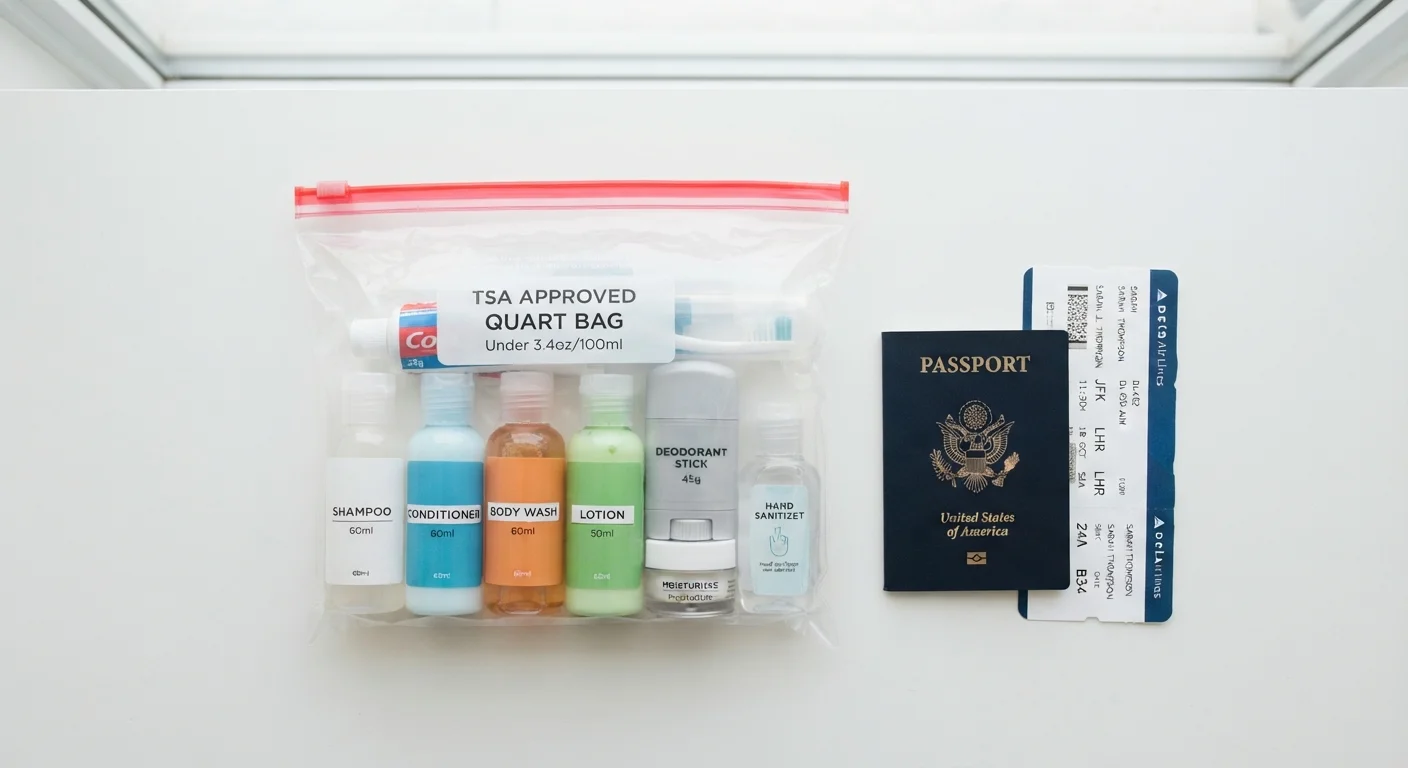
- Each liquid container must hold 3.4 oz (100 ml) or less, and all containers must fit in one quart-sized clear bag.
- Many items travelers assume are solids (gel deodorant, peanut butter, mascara) are treated as liquids by TSA.
- Medically necessary liquids and infant formula are exempt from the 3-1-1 rule but must be declared at the checkpoint.
- Duty-free liquids purchased airside are generally allowed if they stay sealed in the retailer's tamper-evident bag.
- Checking the TSA website before each trip is the only reliable way to confirm current rules, as policies can change.
Why the 3-1-1 rule trips people up
The TSA's 3-1-1 liquids rule has been in place since 2006, yet it still accounts for a large share of checkpoint delays. The confusion is not laziness. The rule has real edge cases, and TSA officers apply it to categories that many travelers do not think of as liquids at all.
The rule itself is straightforward: each liquid, gel, aerosol, cream, or paste must be in a container of 3.4 oz (100 ml) or less. All containers must fit in a single, quart-sized clear zip-top bag, and each passenger gets one bag. That bag comes out of your carry-on and goes in a bin by itself during screening.
Where things go wrong is in the word "liquid." TSA uses that term broadly. Gel, paste, aerosol, and cream all fall under the same restriction. So does anything with a consistency that is not clearly solid. If you are unsure whether something qualifies, the TSA website has a searchable "What Can I Bring?" tool that gives item-specific answers.
For a broader look at how liquids fit into a full packing strategy, see our complete packing resource.
Myth
A container labeled 4 oz is fine as long as it is not completely full.
Fact
The restriction applies to the container size, not the fill level. A 4 oz bottle is not allowed in carry-on even if it is half empty.
TSA officers check the volume printed on the container, not how much product is inside. A bottle labeled 4 oz (118 ml) fails the rule regardless of how much liquid remains. The only way to carry that product through security is to transfer it into a container labeled 3.4 oz or less.
Myth
Gel deodorant, mascara, and peanut butter are solids, so they do not count as liquids.
Fact
TSA classifies gels, pastes, and creamy substances as liquids. Gel deodorant, mascara, nut butter, and similar items all fall under the 3-1-1 rule.
The category is not limited to water-like products. Anything with a gel, paste, cream, or spreadable consistency is treated as a liquid. This catches a lot of travelers off guard at the checkpoint. Stick deodorant (a true solid) is not subject to the limit, but gel or "invisible solid" formulas are. If the product smears or flows, treat it as a liquid for packing purposes.
Myth
You can bring multiple quart-sized bags as long as each one fits in your carry-on.
Fact
Each traveler is allowed exactly one quart-sized bag for liquids. Having a second bag is a violation regardless of bag size or how full it is.
The "1" in 3-1-1 refers to one bag per person. A checkpoint officer will ask you to consolidate or surrender the extra bag. If your toiletries genuinely do not fit in a single quart bag, the options are to check a bag, ship products ahead, or buy items at your destination. Some travelers find that switching to solid-form toiletries frees up enough space to stay within one bag.
Myth
Snow globes and liquid-filled souvenirs are fine in carry-on if they are small.
Fact
Snow globes and similar liquid-filled items are generally not permitted in carry-on regardless of size, because the liquid volume cannot be accurately determined.
TSA specifically calls out snow globes as items that do not fit neatly into the 3.4 oz standard, since there is no label confirming liquid volume. The agency's general guidance is that snow globes should be packed in checked luggage. When in doubt about any liquid-filled item, check the TSA "What Can I Bring?" tool before you pack.
Myth
Aerosol cans of dry shampoo or sunscreen are not liquids, so they go in the main bag.
Fact
Aerosols are explicitly included in the 3-1-1 rule. They must be 3.4 oz or less and fit in the quart-sized bag.
The rule covers "liquids, aerosols, gels, creams, and pastes." An aerosol can of dry shampoo, hairspray, or spray sunscreen counts. Check the net weight on the label: many standard-size aerosol cans are well over 3.4 oz and cannot go in carry-on at all. Travel-sized aerosols labeled 3.4 oz or under are permitted but still occupy space in your quart bag.
Exceptions and edge cases worth knowing
A few categories get different treatment at checkpoints, and misunderstanding them causes separate problems.
Medically necessary liquids: Prescription medications, over-the-counter liquids taken for a medical reason, and related supplies (such as liquid nutrition or saline) are exempt from the 3.4 oz cap. They must be declared to a TSA officer before screening and may be subject to additional inspection. Quantities must be reasonable for the trip length. For full guidance on traveling with medications, see packing medications safely and legally.
Infant formula and breast milk: These are also exempt and can exceed 3.4 oz. TSA allows juice and food for toddlers in the same category. Declare these items separately before the bin goes through the X-ray.
Duty-free liquids: Liquids purchased after the security checkpoint at international airports are generally permitted in carry-on bags, provided they remain in the original tamper-evident retailer bag with the purchase receipt visible. If you have a connecting flight that requires clearing security again, the rules at that country's checkpoint apply, and the sealed bag rule may not be honored everywhere. Verify before you travel.
International connections can change the rules
If your itinerary includes a connection through a foreign airport, that country's security rules apply at its checkpoint, not TSA rules. Some countries do not honor the duty-free sealed-bag exemption for liquids over 3.4 oz. Check the security requirements for every airport in your route before you travel, especially for flights with tight layovers.
Travelers on cruises face an additional layer: cruise lines have their own restrictions on what liquids can be brought aboard, which are separate from TSA rules. See what first-time cruise packers often miss for more on that.
Practical steps to avoid checkpoint problems
The most reliable move is to buy travel-sized containers and transfer only what you need for the trip. Hardware and travel stores carry reusable bottles in sizes well under 3.4 oz. Label each one clearly, since unlabeled bottles sometimes prompt extra inspection.
Use a dedicated quart-sized bag and keep it at the top of your carry-on so it comes out quickly. A bag that is overfull will not zip, which is a red flag at the checkpoint. If your toiletries do not fit, move some items to checked luggage rather than trying to compress the bag.
For items that come in both solid and liquid forms (deodorant, shampoo, sunscreen), choosing the solid version removes the item from the 3-1-1 count entirely. Solid bars of shampoo and conditioner have no size restriction in carry-on.
Business travelers who fly frequently and carry consistent toiletry kits should still re-check the TSA rules periodically. The agency updates its guidance, and items that were once restricted may change status. The TSA website and the myTSA app are the authoritative sources. For a full look at carry-on strategies for work trips, see packing for a business trip.
This article provides general travel information. TSA policies and airline rules can change. Always verify current requirements at tsa.gov and with your carrier before traveling.