

Key Takeaways
- USDA zones measure only average annual minimum winter temperature, not heat, rainfall, or frost dates.
- You can find your zone in seconds using the official USDA hardiness zone lookup by ZIP code.
- A plant rated 'hardy to Zone 6' should survive winter in Zone 6 and all warmer zones.
- Microclimates in your own yard can make a single spot behave like a zone warmer or colder than your official rating.
- Zone information guides perennial and tree selection but does not replace attention to soil, water, and sun requirements.
USDA plant hardiness zone
A USDA plant hardiness zone is a geographic area defined by its average annual extreme minimum winter temperature. The US Department of Agriculture divides the country into 13 numbered zones, each spanning a 10-degree Fahrenheit range. Plant labels and seed packets use these zone numbers to tell you whether a perennial or woody plant can survive winter in your area.
Each zone is further split into two 5-degree subzones labeled 'a' (colder) and 'b' (warmer), giving finer resolution for borderline planting decisions.
What the zone number actually measures
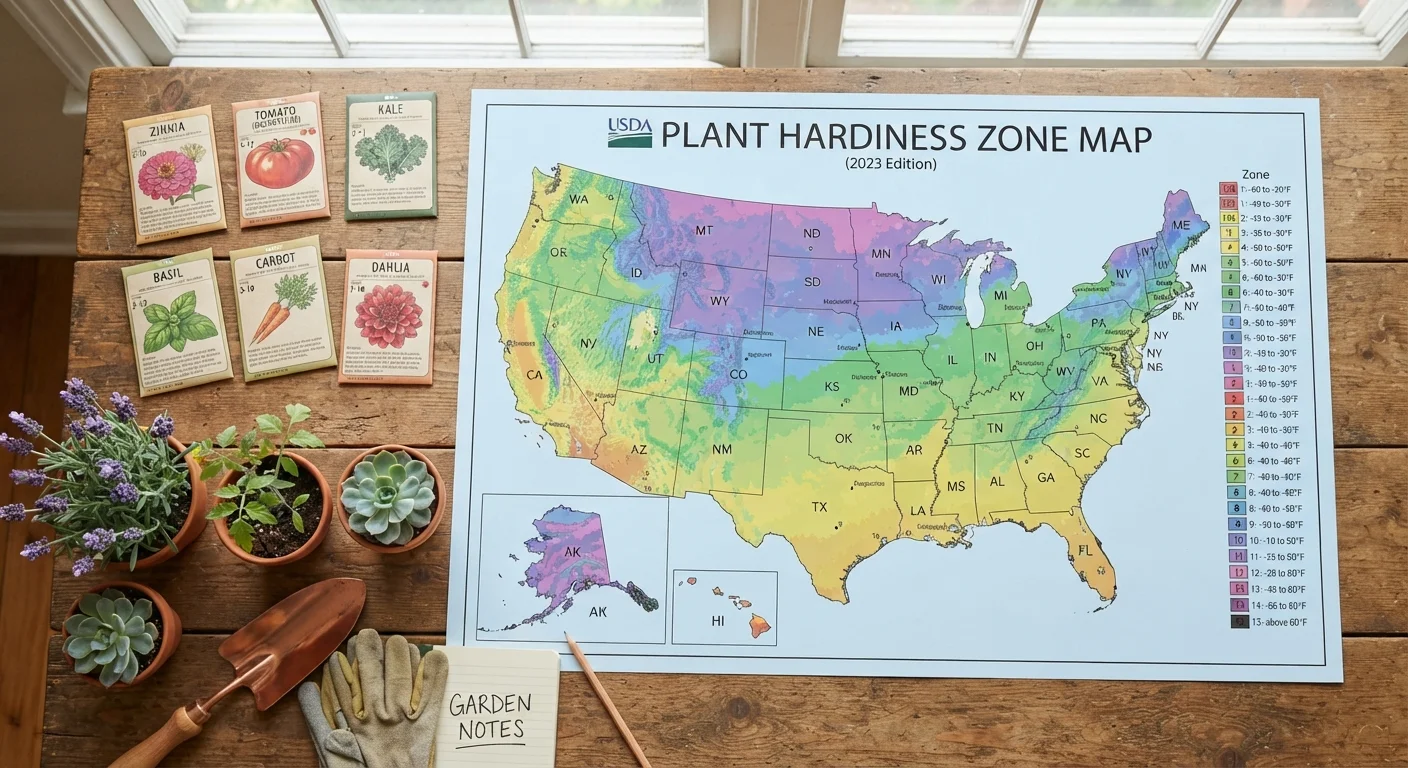
The USDA Plant Hardiness Zone Map assigns every location in the United States a zone number based on one specific figure: the average annual extreme minimum temperature recorded over a 30-year period. That is the coldest night a location typically sees in a given year, averaged across decades.
Zone 1 covers the coldest areas, with minimum temperatures below -50 degrees Fahrenheit. Zone 13 covers the warmest, with minimums above 60 degrees Fahrenheit. Most of the contiguous United States falls between Zone 4 and Zone 9.
The number tells you nothing about summer heat, rainfall totals, humidity, soil type, or the length of the growing season. Those factors matter enormously for plant health, but they are not part of the zone calculation. The zone answers one question only: can this plant survive the cold of a typical winter here?
This matters because perennial plants, shrubs, and trees must survive dormant winters to return the following year. Annuals complete their entire life cycle in one season, so winter hardiness does not apply to them in the same way. When a plant tag reads "hardy to Zone 5," it means the plant's root system and crown can generally withstand the minimum temperatures typical of Zone 5 and warmer zones.
How to look up your zone and read a plant tag
The USDA Agricultural Research Service hosts the official interactive map at planthardiness.ars.usda.gov. Enter your ZIP code and the tool returns your zone and subzone. Your cooperative extension service, which operates through state land-grant universities, often publishes the same data alongside local frost date information.
On a plant tag or in a seed catalog, zone information typically appears as a range: "Zones 4-8" means the plant is cold-hardy enough for Zone 4 winters and heat-tolerant enough for Zone 8 summers. If your zone falls within that range, the plant is a reasonable candidate for your garden. If your zone is colder than the lower number, the plant will likely die over winter without protection.
Seed packets carry additional planting data beyond zone ratings, including days to germination, planting depth, and spacing. Reading those numbers alongside zone information gives a fuller picture of whether a plant suits your site and schedule.
Check the 2023 map if your tags seem off
The USDA updated the Plant Hardiness Zone Map in 2023. If your plant labels or older references were printed before that update, your location may now fall in a warmer subzone than the tag assumes. Pull up the current ZIP code lookup to confirm your actual zone before ruling out a plant.
Microclimates and why your zone is a starting point
Your official zone describes a broad geographic area. Within that area, small variations in elevation, slope direction, proximity to pavement, wind exposure, and nearby bodies of water create microclimates that can behave one or even two zones warmer or colder than the official rating.
A south-facing brick wall absorbs heat during the day and releases it at night, creating a warmer pocket that can protect marginally hardy plants. A low spot in the yard where cold air settles on calm nights is a frost pocket, and it may kill plants that the rest of the yard handles fine. A dense hedge that blocks prevailing north winds can extend the effective growing season along the sheltered side.
Paying attention to these patterns over a season or two gives you practical information no map can provide. Note where frost appears first in fall, where snow lingers longest in spring, and which spots dry out fastest after rain. Soil conditions interact with those microclimate effects, since waterlogged soil in a cold pocket is far harder on plant roots than either factor alone.
Using zone information in real planting decisions
Zone data is most useful when you are choosing perennials, shrubs, ornamental grasses, and trees that you want to persist for years. For those plants, matching the zone rating to your location is a foundational step before considering sun, water, and spacing needs.
For annual vegetables and flowers, focus on frost dates and days to maturity rather than hardiness zones. A tomato does not need a zone rating because it will not survive winter regardless. What matters is whether your frost-free window is long enough for the variety to mature. Watering practices and soil preparation still determine whether a correctly chosen plant actually thrives.
When trying a plant at the edge of its listed range, consider starting with one or two specimens rather than a large planting. Give them the best microclimate you have, mulch the root zone before winter to buffer temperature swings, and observe how they respond over two winters before expanding. Some gardeners in colder zones also grow tender perennials in containers that can be moved to an unheated garage or basement before the first hard freeze.
Common gardening misconceptions include the idea that a zone rating guarantees success or failure. It is one data point. A plant perfectly matched to your zone can still struggle if the drainage is poor, the soil pH is off, or the light exposure is wrong.