

Key Takeaways
- Biophilic design connects indoor spaces to nature through light, plants, natural materials, and spatial patterns.
- You do not need a renovation to apply it: small additions like plants, wood, and improved natural light access can have real impact.
- The concept goes beyond decoration and includes how space flows, how views are framed, and what materials feel like underfoot and overhead.
- Layering multiple natural elements together produces a stronger effect than any single change alone.
- Room function should guide which biophilic elements you prioritize.
Start here
What biophilic design actually means
Build the foundation
The three core principles
Get practical
How to apply biophilic design room by room
Refine your choices
Materials, color, and texture choices
Avoid the pitfalls
Common mistakes and how to avoid them
What biophilic design actually means
The word "biophilic" comes from the Greek roots for life (bios) and love (philia). In a home context, it describes an approach to interior design that deliberately maintains a sensory connection to the natural world inside a built space. The idea draws on the observation that humans have long spent most of their time outdoors, and that interior environments missing natural cues can feel sterile or fatiguing.
Biophilic design is not a single style. It does not require exposed timber beams or a living plant wall, though either could be part of it. The approach includes how light enters a room, what materials surround you, whether you have sight lines to outdoor spaces, and even how sound moves through a space. For a broader vocabulary of interior concepts, see the interior design vocabulary reference.
Biophilia
The idea that humans have an instinctive connection to other living systems and the natural world, shaped by long evolutionary history spent outdoors.
Natural analog
A material or pattern that represents nature without being the real thing, such as a wood-grain finish or a botanical print on fabric.
Prospect and refuge
A concept in spatial design where people feel most comfortable when they have a sheltered position (refuge) and an open view ahead (prospect), mirroring conditions favored in natural environments.
Circadian light
Light that changes in color and intensity over the course of a day, as natural daylight does. Exposure to this pattern can support sleep and alertness rhythms.
Organic pattern
A repeating or irregular pattern that echoes forms found in nature, such as leaf veining, branching structures, or the texture of bark.
The three core principles
Most biophilic design frameworks organize the concept into three overlapping areas.
Direct experience of nature
This means actual contact with natural elements inside the home: plants, water features, natural light, fresh air, and the presence of natural materials you can see and touch. A window that opens to a garden view, a small indoor fountain, or a pot of herbs on a kitchen windowsill all qualify.
Indirect experience of nature
Indirect experience uses representations or analogs of nature rather than the real thing. This covers wood-grain finishes, stone tiles, nature photography, botanical prints, and patterns that echo organic forms such as spirals, branching lines, and irregular textures. Natural color palettes, including earth tones, greens, and warm neutrals, also fall here.
Experience of space and place
This principle addresses how spatial arrangement affects a sense of safety and orientation. Rooms that offer both a sheltered position (a chair set into an alcove, for example) and an open view (looking out across the room or outdoors) satisfy instinctive spatial preferences. Room layout choices interact directly with how a space feels, which is covered in more depth in how room layout affects mood and wellbeing.
How to apply biophilic design room by room
The most practical approach is to start with the rooms where you spend the most time and identify which biophilic element is currently weakest.
Living room
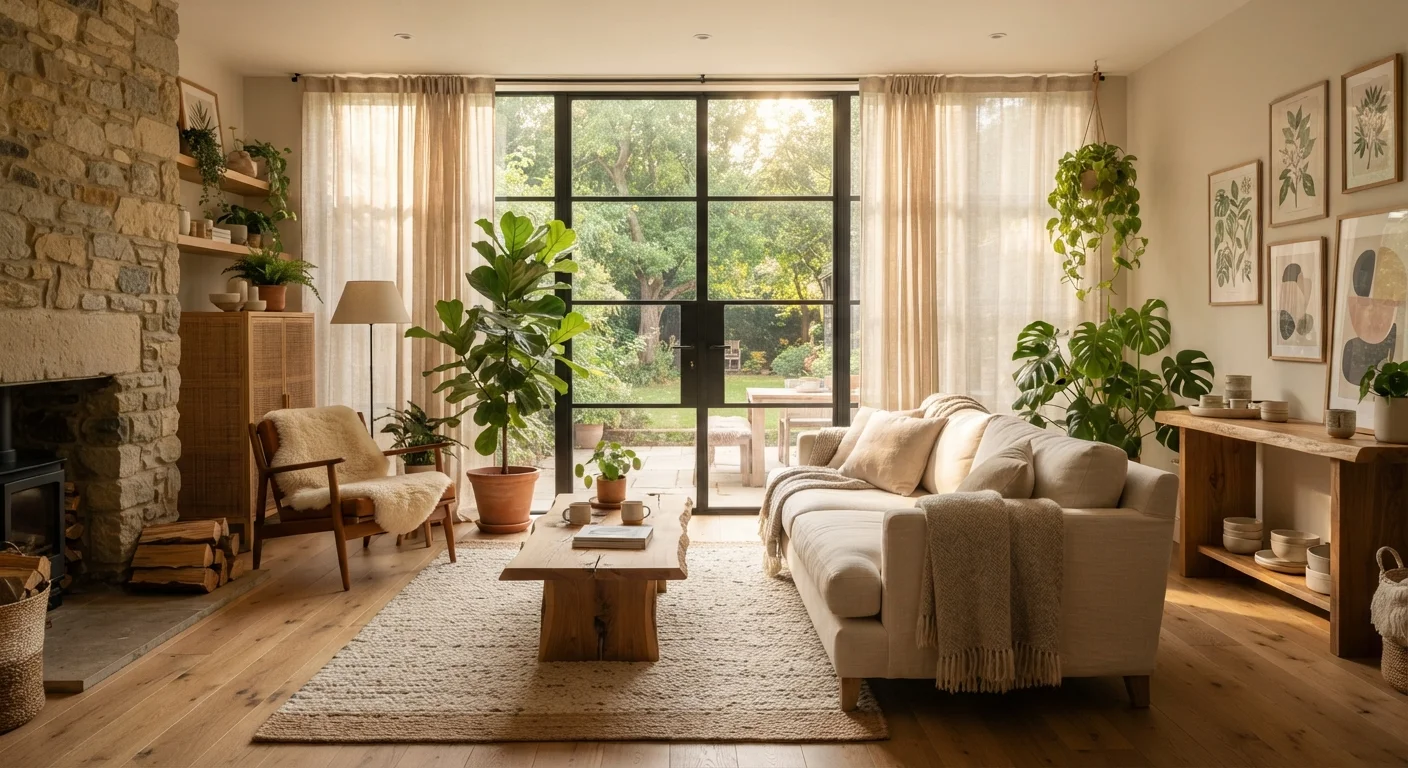
Prioritize natural light access by pulling window treatments back during the day and positioning seating so occupants face or are adjacent to windows. Add plants at varied heights: a floor-level plant alongside a shelf-height trailing plant creates more visual depth than a single specimen. Use textiles with natural fibers such as linen, cotton, or wool.
Bedroom
Keep plant choices manageable here, since a cluttered bedroom works against rest. One or two low-maintenance plants, blackout curtains you can open each morning to admit daylight, and natural wood or rattan furniture are enough to shift the feel of the space.
Kitchen and bathroom
These rooms typically have the least floor space for plants, so focus on materials and light. Stone or wood countertops, a small herb pot on the windowsill, and a window kept unobstructed carry the biophilic quality without adding clutter. See also how to design with natural and artificial light for guidance on layering light sources effectively.
Start with your worst-lit room
If you have a room that feels closed off or flat, the most impactful first step is usually improving natural light access before adding any plants or materials. Clean the windows, remove or thin the window treatments, and trim any outdoor growth blocking the glass. Natural light amplifies every other biophilic element you add afterward.
Materials, color, and texture choices
Natural materials do more work in a biophilic interior than almost any other single choice. Solid wood, stone, bamboo, cork, and natural fibers each introduce organic variation that synthetic materials typically lack. That variation, the grain in a plank, the veining in marble, the weave of a jute rug, registers as familiar and calming in a way that uniform surfaces do not.
Color palettes drawn from nature tend toward muted greens, warm browns, sandy neutrals, and soft blues. Highly saturated colors in large quantities can work against the calm effect biophilic design typically aims for, though accent colors taken from natural forms, such as ochre or terracotta, fit well in moderation.
Texture matters as much as color. A room with varied surface textures, smooth stone, rough linen, polished wood, and a soft rug, feels more complex and restful than a flat, uniform one. If you are incorporating outdoor plants or expanding a garden to complement the interior, native plants in the home garden offers relevant context on plant selection and the trade-offs involved.
Common mistakes and how to avoid them
Adding plants without considering light is the most frequent error. A plant placed in a dark corner for visual balance will decline quickly, which adds maintenance and visual disorder rather than calm. Match each plant to the actual light conditions of its location before buying.
Over-accessorizing with "natural" objects can produce visual noise that undermines the effect. A collection of fifteen small natural objects reads as clutter. Choose a few pieces with genuine material quality and give them space.
Synthetic imitations of natural materials, such as vinyl wood-look flooring or faux stone wallpaper, provide some of the indirect-nature effect but less than the real material. They are a reasonable budget option, but should be balanced with at least some authentic natural elements elsewhere in the room to avoid an entirely simulated environment.
Finally, treating biophilic design as purely visual ignores the sensory dimension. Opening a window for fresh air, using an unscented natural wood finish that has a mild smell, or adding a small tabletop water feature that produces soft sound all contribute to a fuller effect than visual changes alone can achieve.