

Key Takeaways
- A bank statement is an official record of every transaction, fee, and balance change in a set period.
- The available balance and the ledger balance are different figures; confusing them can lead to overdrafts.
- Pending transactions have not yet fully cleared and can change your available balance without appearing in the ledger.
- Monthly fees, ATM charges, and interest on overdraft lines appear as separate line items you should check every cycle.
- Reviewing your statement each month is the foundation of any reliable personal finance system.
Start here
What a bank statement actually is
Next
The header section: account basics
Then
Balance figures and what they mean
Go deeper
Transaction entries: debits, credits, and pending items
Watch for
Fees, interest, and other charges
Apply it
Putting it all together: a monthly review habit
What a bank statement actually is
A bank statement is an official summary your financial institution produces for a defined period, typically one calendar month. It lists every transaction posted to your account, your opening and closing balances, and any fees or interest applied. Banks are required under US federal regulations to provide these records, and they serve as a formal audit trail of your account activity.
Statements arrive by mail or, more commonly now, as downloadable PDFs through online banking. Either format carries the same legal weight. For most people, the statement is the most complete picture of their spending that exists in one place. That makes it a natural starting point for the budgeting basics that underpin any serious approach to managing money.
Ledger balance
The official account balance based on all fully settled transactions. It does not subtract pending items or holds.
Available balance
The portion of your ledger balance you can spend right now, after subtracting any pending transactions, holds, or reserved funds.
Debit
Any transaction that takes money out of your account, such as a purchase, withdrawal, or outgoing transfer.
Credit
Any transaction that adds money to your account, such as a direct deposit, incoming transfer, or refund.
Posting date
The date a transaction fully settles and appears permanently in your account history, which may differ from the date you made the purchase.
Statement period
The specific date range a statement covers, typically one calendar month.
The header section: account basics
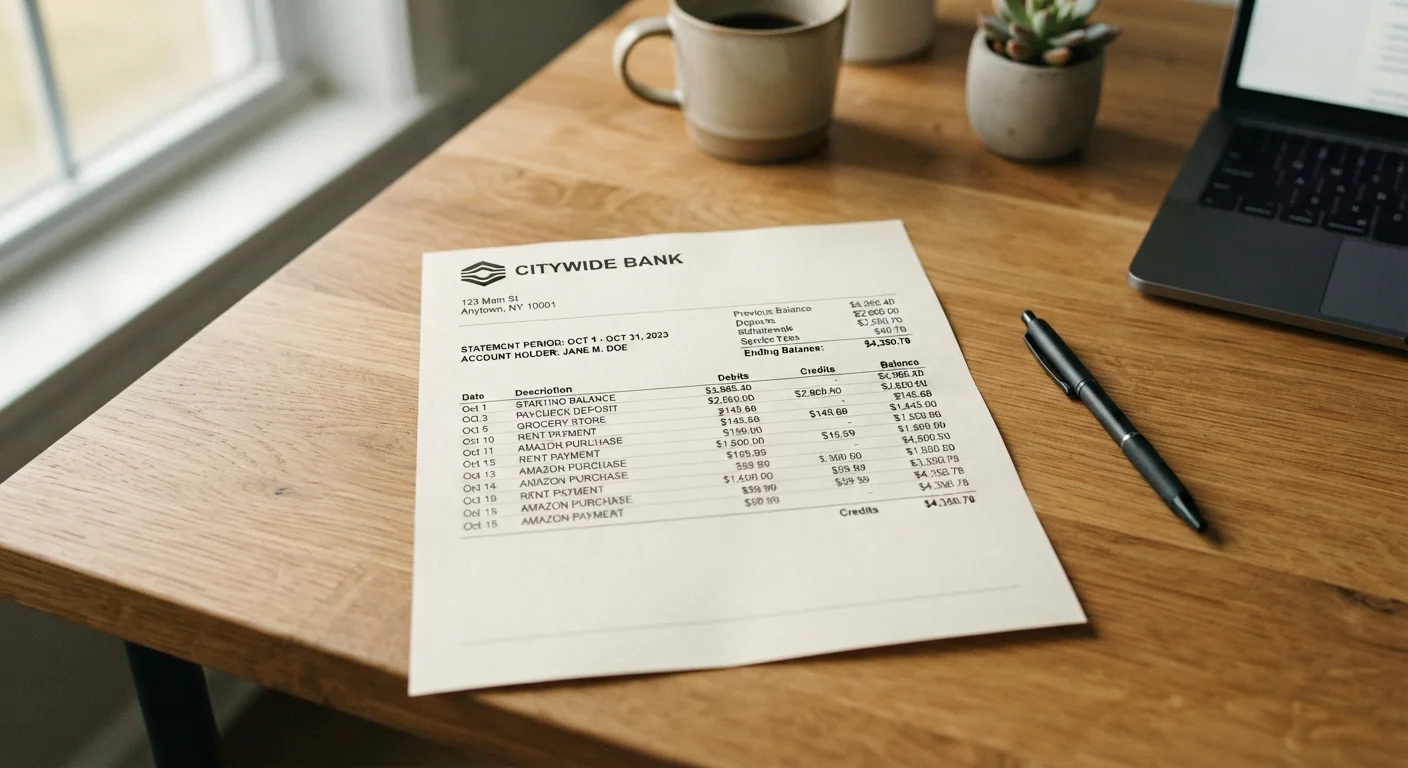
At the top of every statement you will find identifying information: the bank's name and contact details, the account holder's name and mailing address, the account number (usually partially masked for security), and the statement period. The statement period defines the exact date range the document covers, such as March 1 through March 31.
Check this section first. Confirm the account number matches the account you intended to review, and verify the period aligns with the month you are reconciling. If you hold multiple accounts, such as a checking account and a savings account, each produces its own statement. Mixing them up is a common source of confusion when totals do not match expectations.
Balance figures and what they mean
Most statements display at least two distinct balance figures. The opening balance is the amount in the account at the start of the period. The closing balance (also called the ending balance) is the amount at the end of the period after all posted transactions are counted. Some statements also show a running balance column that updates after each line item.
The available balance is a separate figure and often appears only in online banking rather than on a printed statement. It reflects your closing balance minus any holds or pending items. Spending based on the closing balance when pending transactions exist is a common reason overdraft fees occur. For a fuller explanation of how these figures connect to your overall financial picture, see what net worth means and why it is worth tracking.
Transaction entries: debits, credits, and pending items
The transaction register is the longest part of the statement. Each row typically shows a date, a description, and a dollar amount. Amounts that reduce your balance are debits: purchases, bill payments, ATM withdrawals, and transferred funds going out. Amounts that increase your balance are credits: direct deposits, transfers in, and refunds.
The description column is where many readers get lost. Merchants often appear under a parent company name or an abbreviated processor ID rather than the store name you recognize. If a description is unfamiliar, check the amount and date against your own records before flagging it as fraudulent. Writing down or photographing receipts at the point of purchase makes this comparison much faster. The practical system for tracking daily spending covers this habit in more detail.
Pending transactions are a special case. They appear in your online banking view but generally do not appear on your printed monthly statement until they fully post. Their dollar amounts are already subtracted from your available balance, which is why your available balance can be lower than your closing balance on any given day.
Flag unknowns before assuming fraud
Before disputing a transaction, search the exact description text online. Many legitimate charges appear under a payment processor's name rather than the retailer's. Cross-referencing the amount and date with your own records resolves most unfamiliar entries without a formal dispute.
Fees, interest, and other charges
Fees appear as debit entries but often lack a merchant name, which makes them easy to overlook. Common fee types include monthly maintenance fees, ATM surcharges, overdraft fees, and wire transfer fees. If your account earns interest, a credit entry for interest earned will appear, usually near the end of the statement period.
Go through the fee entries each month and confirm you recognize each one. Banks are required to disclose their fee schedules, so if a charge appears that you cannot match to a disclosed fee, contact the bank directly. Some fees, such as overdraft fees, can sometimes be waived as a one-time courtesy for account holders with a good history. Automating bill payments reduces the likelihood of overdrafts in the first place; automating your finances explains how to set that up.
Putting it all together: a monthly review habit
Set aside 10 to 15 minutes once a month, ideally within a few days of your statement closing date, to read through the document top to bottom. Start with the header to confirm the period and account. Move to the opening and closing balances. Then scan each transaction, checking for amounts you do not recognize and confirming that expected credits, such as your paycheck, arrived on time.
Flag any fees and decide whether to contest them. Compare your closing balance against what you expected based on your budget. If the numbers diverge, the transaction register will show you exactly where the difference came from. This habit feeds directly into tools that make money management easier over time; digital tools for everyday finance tasks covers apps and e-statement organizers that can streamline the process. Your bank statement is also the primary document you will use when reading and interpreting your credit report, since both records need to align for a complete financial picture.
This article is for general informational purposes only and does not constitute personalized financial or legal advice. Consult a licensed financial professional for guidance specific to your situation.