

Key Takeaways
- A credit report has five distinct sections, each telling a different part of your credit story.
- Errors in any section can drag down your score; you have the right to dispute them at no cost.
- Negative marks such as late payments can remain on a report for up to seven years.
- Hard inquiries stay on your report for two years but typically affect scoring for about one year.
- Reviewing your report regularly is one of the most practical habits in personal finance.
What you will need
Why the credit report matters more than the score
A credit score is a three-digit summary. The credit report is the full record it is calculated from. Lenders, landlords, and insurers use reports to verify what the score compresses into a single number. Reviewing the report gives you something the score alone cannot: the ability to see exactly which entries are helping or hurting your standing, and whether any of them are wrong.
The three major bureaus, Equifax, Experian, and TransUnion, each maintain a separate file. They do not automatically share data with one another, so your report can look slightly different at each one. Pulling all three at once gives you the full picture. If you are building credit from scratch, the report also shows you what is (and is not) being reported, which is the starting point for any credit-building plan.
Federal law under the Fair Credit Reporting Act gives every consumer the right to one free report from each bureau per year through AnnualCreditReport.com. Checking your own report is a soft inquiry and does not affect your score.
What you will need
How to work through each section
Review your personal information section
The first section lists identifying details: your full name, current and previous addresses, date of birth, Social Security number (partially masked), and sometimes employment history. This information does not affect your credit score, but errors here can signal mixed files, where another person's credit data has merged with yours. Check that every address and name variation is actually yours.
Read through the accounts section
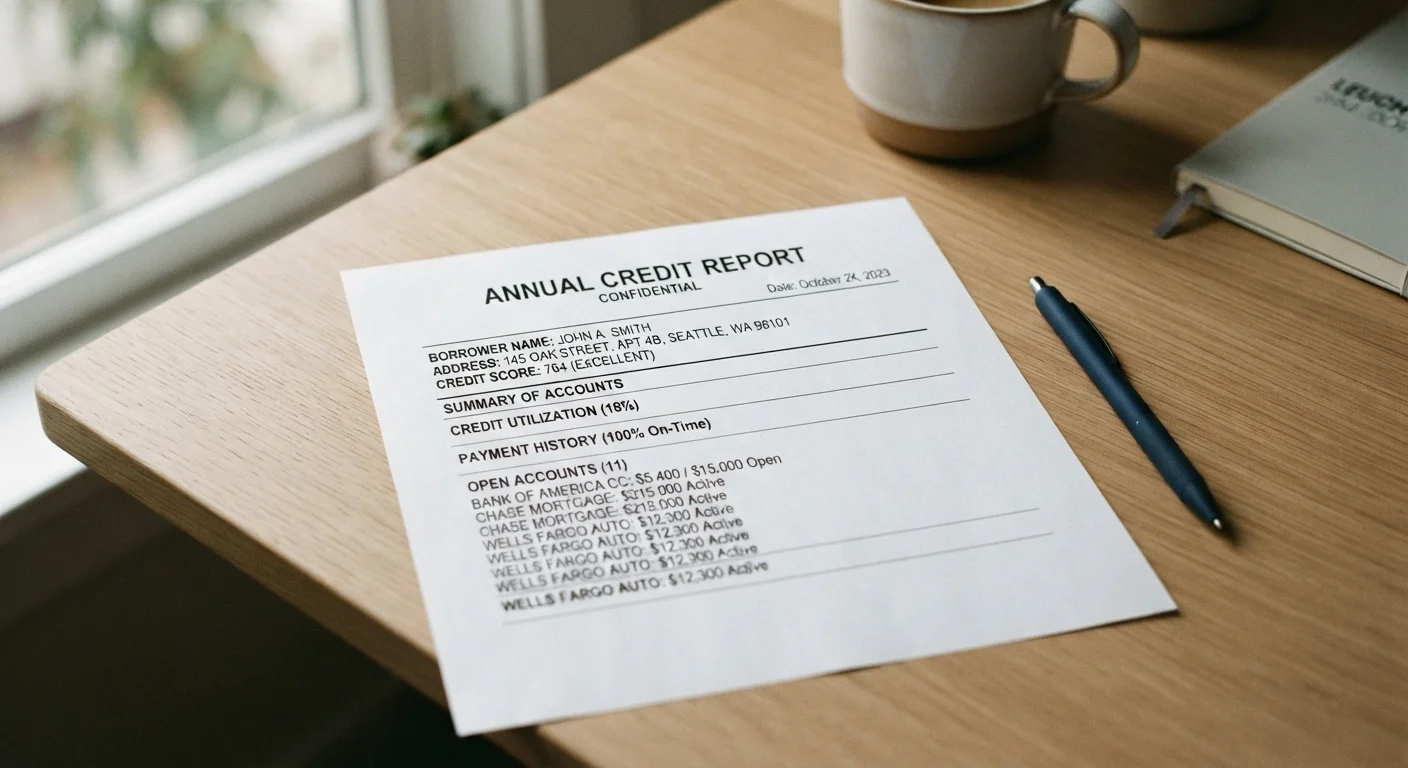
The accounts section (sometimes called trade lines) is the most detailed part of the report. Each open or closed account appears here, including credit cards, auto loans, mortgages, and student loans. For every account, look at:
- The creditor name and account number (partially masked)
- Account type and whether it is individual or joint
- Date opened and, if applicable, date closed
- Credit limit or original loan amount
- Current balance and monthly payment amount
- Payment history, often shown as a month-by-month grid
- Account status (open, closed, charged off, in collections)
The payment history grid uses codes. An "OK" or blank typically means on-time payment. A number such as 30, 60, or 90 indicates how many days past due the payment was at that point. Even a single 30-day late mark can lower your score. Credit utilization, shown through the balance-to-limit ratio on revolving accounts, is one of the most influential scoring factors, so review those balances carefully.
Check the public records section
Public records once included tax liens and civil judgments, but since 2018 the three major bureaus stopped including most of those items. Today, the main public record you may see is a bankruptcy filing. A Chapter 7 bankruptcy stays on the report for ten years from the filing date; a Chapter 13 stays for seven years. If this section is empty, that is the expected outcome for most consumers.
Examine the collections section
Collection accounts appear when a creditor sells or transfers an unpaid debt to a collection agency. Each collection entry shows the original creditor, the collection agency name, the amount, and the date of first delinquency. That last date matters because it sets the seven-year clock for how long the account can stay on your report. Verify the original delinquency date is accurate, because an incorrect date can illegally extend the reporting window.
Review the inquiries section
This section lists everyone who has accessed your report. Hard inquiries occur when you apply for credit; they are visible to other lenders and can reduce your score slightly for about one year, though they remain on the report for two years. Soft inquiries (from pre-approval checks, employer background reviews, or your own review) do not affect your score and are typically visible only to you. Hard inquiries can raise concerns, but a single application rarely causes lasting damage. If you see a hard inquiry from a lender you never applied with, that warrants a dispute and possibly a fraud alert.
Set a calendar reminder to review annually
Pulling one bureau's report every four months (rather than all three at once) gives you three checkpoints per year at no cost. This spread makes it easier to catch new errors or unfamiliar accounts shortly after they appear rather than a year later.
This article is for general informational purposes only and is not personalized financial or legal advice. For guidance specific to your situation, consult a licensed financial adviser or credit counselor.
What to do when you find an error
Errors on credit reports are not uncommon. The dispute process is free and required by law. Write a clear dispute letter or use the bureau's online portal, state exactly which entry is wrong, and attach any supporting documents (account statements, payment confirmations, identity documents). The bureau has 30 days to investigate and must notify you of the result.
If the same error appears at more than one bureau, dispute it with each one separately. A correction at Experian does not automatically update your TransUnion file. Track every dispute in writing and keep copies of all correspondence. If a legitimate negative item is holding down your score, the most effective long-term approach is consistent on-time payment going forward, since payment history carries the largest weight in most scoring models. For a broader view of how day-to-day money decisions connect to your credit file, the Budgeting Basics hub covers the spending and saving habits that support financial stability over time.