

Key Takeaways
- Engine oil degrades through heat, oxidation, contamination, and additive depletion, not just accumulated mileage.
- Degraded oil loses its ability to lubricate, increasing friction and internal engine wear.
- Ignoring oil changes can lead to sludge buildup, overheating, and costly engine damage.
- Oil condition varies by driving style, so change intervals should follow your owner's manual, not guesswork.
- Checking oil level and color regularly is one of the simplest ways to catch problems early.
Engine oil degradation
Engine oil degradation is the process by which motor oil loses its ability to protect and lubricate engine components over time. Heat, contamination, and chemical breakdown reduce the oil's viscosity and its additive package until it can no longer do its job effectively. Fresh oil is a carefully formulated blend; degraded oil is a compromised fluid that can accelerate engine wear.
Oil degradation involves both physical changes (viscosity breakdown, evaporation) and chemical changes (oxidation, nitration, acid formation) that alter the oil's molecular structure.
What engine oil actually does
Motor oil performs several functions at once. It forms a thin film between metal surfaces to prevent direct contact, reducing friction and heat. It carries heat away from the combustion zone, suspends contaminants so they can be captured by the filter, and neutralizes acids produced during combustion. The oil's additive package handles much of this chemical work, including anti-wear agents, dispersants, and antioxidants mixed into the base oil.
Because oil is doing so much simultaneously, its condition matters as much as its presence. A full crankcase of badly degraded oil offers far less protection than fresh oil at the correct level.
The four main causes of oil degradation
Oxidation is the most common cause. When oil molecules react with oxygen at high temperatures, they form acidic compounds and varnish deposits. Each heat cycle accelerates this process, which is why short trips that never fully warm the engine can actually oxidize oil faster than highway driving.
Thermal breakdown occurs when sustained high temperatures physically shear the long polymer chains that give oil its viscosity rating. Once those chains break, the oil thins and cannot maintain the protective film between moving parts.
Contamination arrives from several directions. Combustion gases push past piston rings and carry soot, water vapor, and unburned fuel into the crankcase. Coolant leaks introduce glycol, which is particularly destructive to oil film strength. Each contaminant compounds the oil's chemical deterioration.
Additive depletion is less visible but equally serious. The anti-wear additives, detergents, and acid-neutralizing compounds built into the oil are consumed as they do their job. Once they are exhausted, the base oil is essentially unprotected, regardless of how clear it may look on the dipstick.
Check your oil between changes
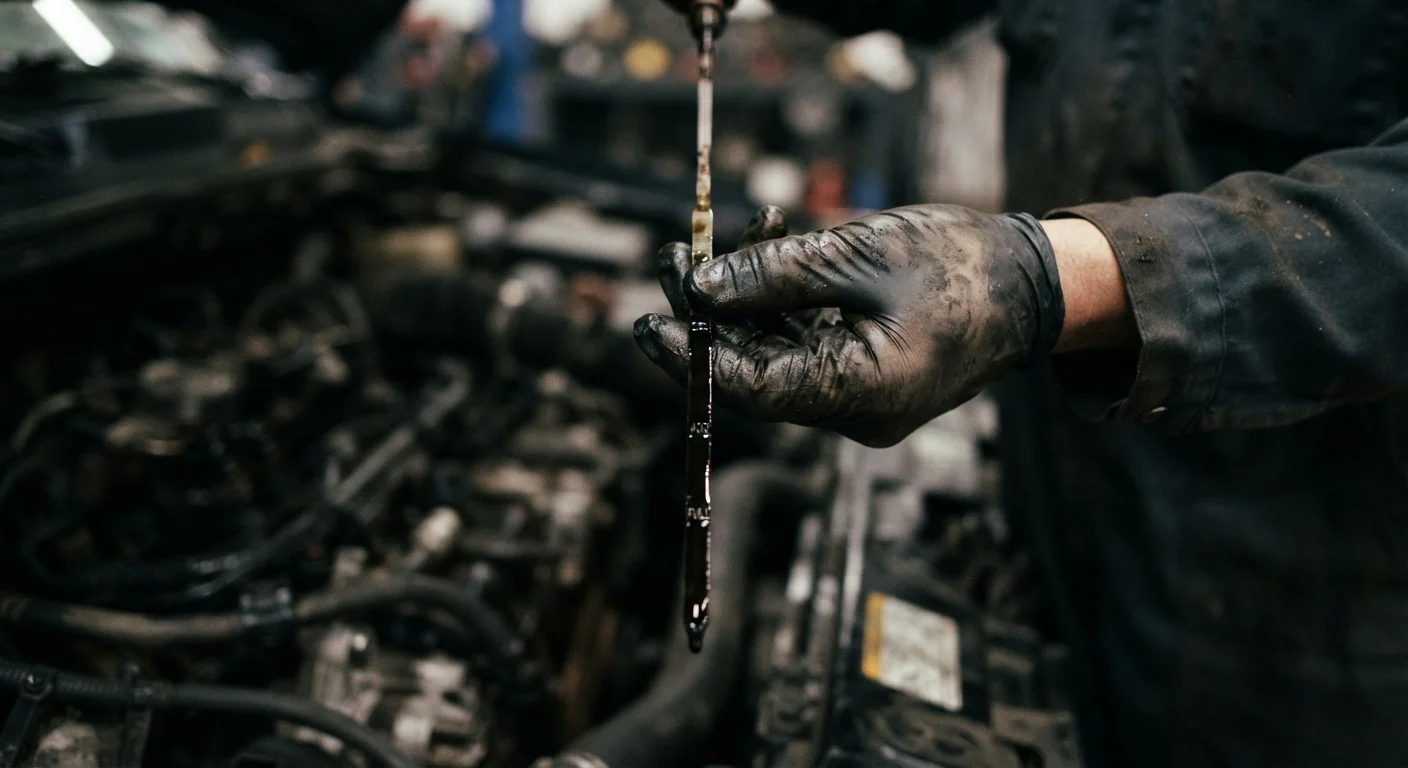
Pull the dipstick every few weeks and wipe it on a white cloth. Fresh oil leaves a light amber stain; severely degraded oil leaves a nearly black, opaque mark. Checking level and color together takes under two minutes and can alert you to a problem well before a scheduled service date.
What happens inside the engine when oil degrades
As oil loses viscosity and lubrication quality, metal surfaces that should never touch begin to make contact under load. Bearings wear faster, camshaft lobes lose material, and piston rings lose their seal. This wear produces metal particles that circulate through the engine, accelerating damage to every surface they pass.
Sludge formation is the most visible consequence of neglect. Degraded oil, water, and combustion byproducts combine into a thick, gel-like deposit that accumulates in oil galleries, on valve covers, and around the oil pump pickup screen. Blocked oil passages cause localized oil starvation, meaning sections of the engine run dry even when the dipstick shows adequate total volume.
Overheating follows naturally. Oil contributes to engine thermal management, and degraded oil transfers heat poorly. A compromised cooling loop compounds this effect. For more on how these two systems interact, see how the cooling system works.
3,000+
RPM at which oil film is most critical
At higher engine speeds, the oil film between bearing surfaces carries the full load; even brief film collapse causes measurable metal-to-metal wear.
40%
Reduction in oil viscosity from severe thermal shear
Engine oil viscosity tests conducted in extended-drain studies have shown that sustained high-temperature operation can reduce oil film thickness by this margin or more before a standard interval is reached.
200°F+
Temperature at which oxidation accelerates sharply
Oil oxidation rates roughly double for every 18 to 20 degrees Fahrenheit rise above approximately 200 degrees Fahrenheit, a threshold that turbocharged and high-load engines routinely exceed.
How driving style affects how fast oil degrades
Mileage alone is an imprecise guide to oil condition. Driving patterns have a large influence on how quickly oil breaks down. Frequent short trips, stop-and-go city driving, towing, and operation in extreme temperatures all accelerate degradation compared to steady highway commuting. Oil in a vehicle driven primarily on short errands may reach the end of its useful life well before the mileage interval printed in the owner's manual.
High-mileage vehicles face additional pressure. Older engines often have more blow-by past worn piston rings, pushing more combustion gases into the crankcase and contaminating oil faster. Older vehicles with high mileage may benefit from more frequent oil inspection even if they are not yet at the standard change interval.
Oil does not degrade identically across engine types either. Turbocharged engines expose oil to much higher temperatures around the turbocharger bearing housing, which accelerates thermal breakdown in that circuit. Diesel engines introduce more soot, which increases contamination load on the oil faster than most gasoline engines.
What skipping oil changes actually costs
Minor engine wear from prolonged oil change neglect is cumulative and largely invisible until a symptom appears. By then, the damage is done. Bearing replacement, camshaft resurfacing, or a piston ring job are labor-intensive repairs. A full engine replacement can run into thousands of dollars depending on the vehicle.
There is also a depreciation angle. A documented service history with regular oil changes is one of the factors that preserves resale value. A buyer or dealer inspection that finds sludge or excessive internal wear will affect what the vehicle is worth. See how deferred maintenance affects vehicle value for more context.
Oil changes rank among the lowest-cost maintenance items on any service schedule. The same logic applies to other fluids that degrade over time. Transmission fluid follows a similar degradation pattern and carries equally serious consequences when neglected. For a broader picture of what drivers commonly defer, annual maintenance tasks that often get skipped covers the full list.