

Key Takeaways
- Drip irrigation delivers water directly to plant roots, making it the most water-efficient option for gardens.
- Soaker hoses are a lower-cost alternative to drip systems and work well in straight, dense planting rows.
- Sprinkler systems cover large areas quickly but lose more water to evaporation than the other two methods.
- Setup complexity and maintenance demands vary significantly across all three system types.
- The best choice depends on plant type, garden layout, local water restrictions, and your budget.
Our Verdict
Drip irrigation is the most water-efficient system and suits most home vegetable and flower gardens. Soaker hoses offer a simpler, cheaper entry point for straight rows and dense beds. Sprinklers remain practical for lawns and large open areas where blanket coverage matters more than precision.
| Best for | Recommended |
|---|---|
| Water-conscious gardeners with mixed plantings | Drip irrigation |
| Budget-focused gardeners with row-style vegetable beds | Soaker hoses |
| Homeowners irrigating large lawns or ground cover | Sprinkler systems |
| Gardeners with irregular layouts who need flexible coverage | Drip irrigation |
How the three systems work
Each irrigation type delivers water differently, and that difference shapes how well it suits a given garden situation.
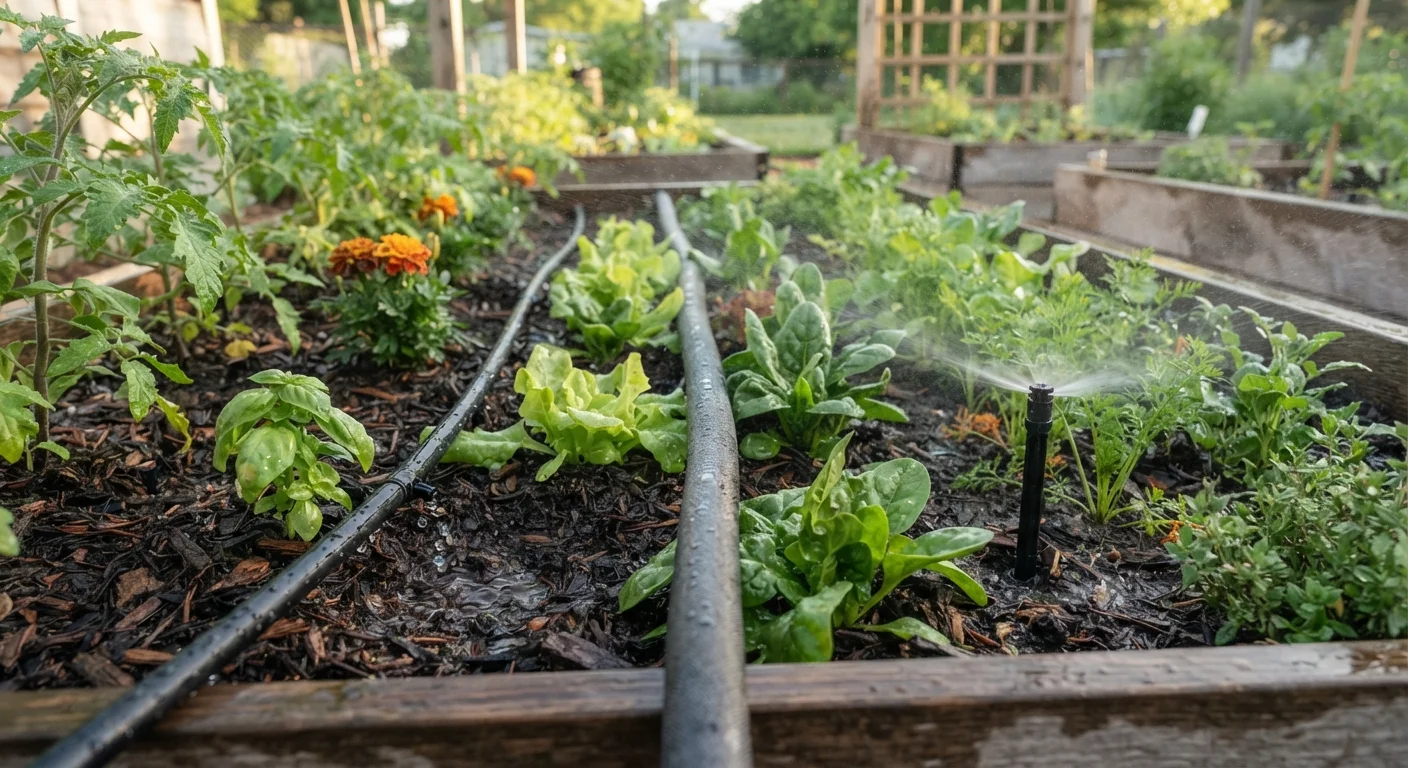
Drip irrigation uses a network of plastic tubing with small emitters placed near individual plants. Water seeps out slowly, wetting the soil directly around each root zone. Because water goes where it is needed and not onto surrounding soil or foliage, runoff and evaporation stay low.
Soaker hoses are porous rubber or recycled-plastic tubes that weep water along their entire length. You lay them along planting rows, and water seeps into the soil at a slow, steady rate. The setup is simpler than drip but less targeted, since water reaches the full length of the hose rather than specific plants.
Sprinkler systems spray water through the air to mimic rain. Pop-up heads, rotary heads, and oscillating sprinklers all broadcast water across a broad area. They cover ground quickly but send water onto leaves, pathways, and bare soil alongside the plants you are trying to water.
Understanding these basics helps when reading about efficiency and cost below. For a closer look at how watering depth and timing interact with plant health, see watering schedules that actually work.
Water efficiency
Water efficiency is where the three systems differ most. Drip irrigation is widely cited by cooperative extension programs and water utilities as the most efficient method for garden beds, with application efficiency figures often above 90 percent when a system is properly designed and maintained. Water goes into the root zone before the sun can evaporate it, and because foliage stays dry, fungal diseases spread less readily.
Soaker hoses run at lower pressure and also deliver water close to the soil surface, which limits evaporation. They are less precise than drip because the entire hose length releases water, but in dense planting rows where most of the soil is occupied by roots, that distinction matters less.
Sprinklers are the least efficient method for garden beds. Water sprayed through warm air evaporates before it reaches the soil, and wind can carry it off target. Watering early in the morning reduces those losses, but sprinklers still use noticeably more water than the other two options to deliver the same amount of moisture to plant roots.
| Drip irrigation | Soaker hoses | Sprinkler systems | |
|---|---|---|---|
| Water efficiency | Very high (targeted root delivery) | High (low-pressure seeping) | Lower (evaporation and overspray) |
| Upfront cost | Moderate ($30 to $100+) | Low (under $20 for most) | Wide range ($5 to thousands) |
| Installation difficulty | Moderate (planning required) | Easy (connect and lay) | Easy to complex (in-ground needs professional) |
| Best garden type | Individual plants, mixed beds | Dense rows, raised beds | Lawns, large open areas |
| Maintenance level | Low (filter cleaning, emitter checks) | Very low (flush and store) | Low to moderate (winterization needed) |
| Automation compatibility | Excellent with timer | Good with timer | Good; in-ground often built-in |
If you are unsure whether your plants are receiving the right amount of water regardless of system type, reading the signs your plants give you can help you adjust.
Cost and installation
Soaker hoses have the lowest entry cost. A standard 50-foot hose typically runs from a few dollars to around twenty, and all you need to connect it is a standard hose bib. There is no emitter spacing to plan and no pressure regulator required, though adding one is inexpensive and protects the hose from splitting.
Drip systems cost more upfront because you need tubing, emitters, a pressure regulator, a filter, and end caps. For a small vegetable garden the materials cost can range from roughly $30 to over $100 depending on the layout and emitter count. The trade-off is flexibility: you can place emitters exactly where each plant sits, adjust flow rates by swapping emitters, and expand the system later without replacing the whole setup.
Sprinkler systems span the widest cost range. A simple oscillating sprinkler on a hose costs almost nothing, while an in-ground system with multiple zones, a backflow preventer, and a timer can run into the hundreds or thousands of dollars installed. In-ground systems also require trenching, and most local codes require a licensed plumber or irrigation contractor to connect them to the water main. Always check your local permit requirements before beginning that kind of installation.
Ease of use and maintenance
Soaker hoses are the most straightforward to set up and store. Unroll, position, attach to the spigot, and water. At the end of the season, flush the hose, coil it, and store it out of freezing temperatures. The main maintenance task is checking for cracks or uneven seeping along the hose length.
Drip systems take more time to design and install initially, but once in place they are largely hands-off. Emitters can clog, particularly in areas with hard water, so periodic flushing and filter cleaning are necessary. Adding a timer makes drip systems nearly automatic, which is a genuine advantage for gardeners who travel or have irregular schedules.
In-ground sprinkler systems need seasonal winterization in cold climates, which usually means blowing out the lines with compressed air. This is a task many homeowners hire out to avoid damaging pipes. Above-ground sprinklers need only to be moved indoors before freezing weather.
One maintenance point that applies to all three: debris in your water supply can clog emitters and nozzles. A simple inline filter at the water source reduces that problem considerably. Common gardening myths about watering, such as the idea that more water always means healthier plants, can lead to inefficient system use regardless of which type you choose.
Which system fits your garden
Garden layout is one of the clearest deciding factors. Raised vegetable beds with individual plants spaced apart respond well to drip irrigation because you can place an emitter at each plant's base. Dense rows of lettuce, carrots, or beans are a natural fit for soaker hoses, since water seeps across the entire row at once.
Lawns and large open ground cover areas are the one situation where sprinklers are hard to replace. Drip and soaker systems are impractical at that scale and do not apply water evenly enough across turf. For a mixed property with both lawn and garden beds, many homeowners use sprinklers on the grass and either drip or soaker systems in the garden zones.
Local water restrictions matter too. In drought-prone regions, some municipalities restrict overhead watering or require efficient irrigation methods for new landscaping. Check with your local water authority before committing to a system, since rebates for drip conversion are available in some areas.
Consider the time you have for setup and upkeep. If you want something running in an afternoon with minimal future fuss, a soaker hose on a timer is hard to beat for a modest garden. If you are planning a more permanent, scalable setup for a larger space, investing in a drip system pays off over several seasons.