

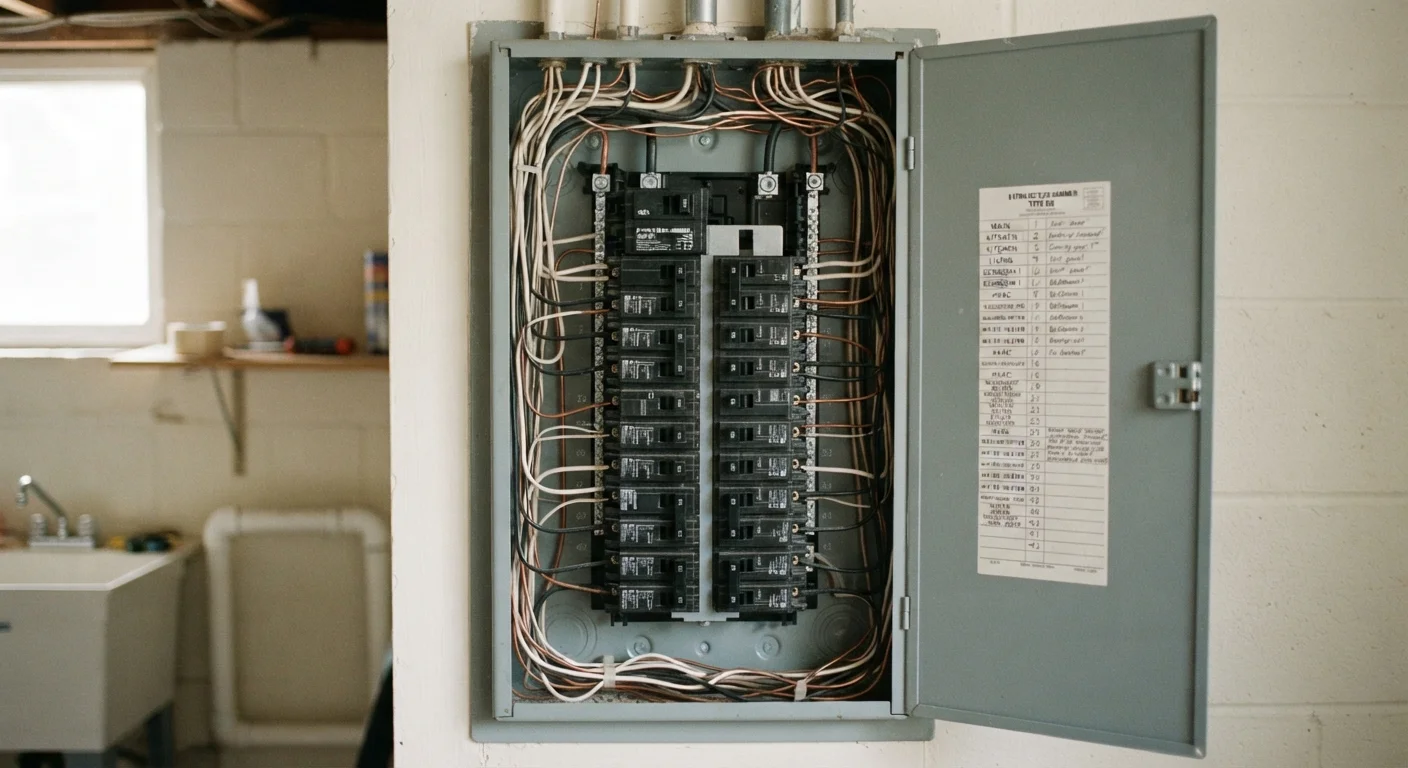
Key Takeaways
- A circuit breaker automatically shuts off power to prevent wiring damage or fire when current exceeds safe levels.
- Most trips are caused by overloaded circuits, a short circuit, or a ground fault.
- A breaker that trips repeatedly on the same circuit is a signal to investigate further, not just reset.
- Electrical panel work beyond resetting a tripped breaker should be handled by a licensed electrician.
- Knowing the layout of your panel before an emergency makes it easier to respond quickly and safely.
Circuit breaker
A circuit breaker is a safety switch inside your home's electrical panel that automatically cuts power to a circuit when it detects a fault or overload. Each breaker protects a specific section of your home's wiring from damage caused by too much current. When a breaker trips, it moves to a middle or off position and stops electricity from flowing until you reset it.
Breakers are rated in amperes (amps); common household branch circuits use 15-amp or 20-amp breakers, while large appliances may require 30-amp, 40-amp, or 50-amp dedicated circuits.
How a circuit breaker works
Your home's electrical panel, sometimes called a breaker box or load center, distributes power from the utility feed into individual circuits that supply outlets, lights, and appliances throughout the house. Each circuit runs through its own breaker, which monitors the flow of electrical current.
Inside the breaker, a bimetallic strip or electromagnet responds to current levels. When current stays within the rated limit, the breaker holds in the on position and power flows normally. When current exceeds that limit, the mechanism trips: an internal contact opens, the breaker handle moves to a middle or off position, and power to that circuit stops.
This response happens in fractions of a second for a severe fault, or over a short period for a sustained overload. That difference in timing is intentional. A gradual overload gives wiring a chance to shed heat; a dead short or ground fault needs to be cleared almost instantly to prevent damage or fire.
Common reasons a breaker trips
Understanding why a breaker trips helps you respond correctly rather than simply resetting and hoping the problem disappears.
Overloaded circuit
This is the most frequent cause. It happens when the total power demand of devices on one circuit exceeds the breaker's amp rating. Running a space heater, microwave, and hair dryer on the same circuit at the same time is a common example. Redistributing loads to other circuits usually solves the problem.
Short circuit
A short circuit occurs when a hot wire touches a neutral wire, either inside an outlet, a fixture, or an appliance. The resistance drops sharply, current spikes, and the breaker trips hard. A burning smell, a popping sound, or scorch marks around an outlet are warning signs. Short circuits in wiring (not just in a faulty appliance) need professional diagnosis.
Ground fault
A ground fault happens when a hot wire contacts a grounded surface, such as a metal box or a wet floor. GFCI breakers and GFCI outlets are designed specifically to catch this type of fault. If a GFCI trips and you cannot identify a clear cause, have an electrician inspect the circuit.
Faulty or aging breaker
Breakers wear out over time. A breaker that trips at normal load levels, feels warm to the touch, or will not stay reset after proper troubleshooting may have reached the end of its service life. Replacement is a job for a licensed electrician.
One appliance per high-draw circuit
Space heaters, window air conditioners, and microwave ovens draw close to a full 15-amp or 20-amp circuit on their own. Plugging them into a circuit that already supplies other loads is a straightforward path to a tripped breaker. Use a dedicated or lightly loaded circuit for these appliances whenever possible.
How to reset a tripped breaker safely
Before touching the panel, turn off or unplug the devices on the affected circuit. This prevents a sudden surge when power returns and makes it easier to identify what caused the trip.
- Open the panel door. Look for a breaker handle that has moved to the center position or is visibly out of line with the others.
- Push the handle firmly to the off position. You should feel or hear a click.
- Push the handle to the on position.
- Gradually reconnect devices one at a time to see whether a specific appliance triggers another trip.
If the breaker trips again immediately, do not keep resetting it. Repeated trips signal an ongoing fault that resetting will not fix. At that point, leave the breaker off and contact a licensed electrician. For guidance on deciding when a task is beyond a DIY approach, see our guide to DIY vs. professional repairs.
When to call an electrician
Any work inside the panel beyond resetting a breaker carries real risk of electric shock or fire. A licensed electrician should handle:
- Adding a new circuit or breaker
- Replacing a faulty breaker
- Upgrading panel capacity
- Investigating wiring faults behind walls
- Any work on the main breaker or service entrance
In many US jurisdictions, electrical work beyond minor repairs requires a permit and inspection. Check with your local building department before starting any project that involves your panel or home wiring.
Keeping your electrical system in good shape connects directly to other safety systems in your home. Reliable wiring supports the smoke and carbon monoxide detectors that give early warnings in an emergency. Our smoke and carbon monoxide detector maintenance guide covers how to keep those devices working properly.
Knowing your panel before a problem arises
A labeled panel directory saves time when you need to cut power quickly. Walk through the house and confirm that each breaker label matches the circuit it actually controls. Note any double-pole breakers (which occupy two slots and serve 240-volt appliances such as dryers or water heaters) and any AFCI or GFCI breakers, which have test buttons on their faces.
~51,000
Home electrical fires per year in the US
According to the U.S. Fire Administration, electrical fires cause thousands of injuries and billions in property damage annually.
15 or 20 A
Typical branch circuit breaker rating
Most general-purpose household circuits use 15-amp or 20-amp breakers; kitchen and bathroom circuits often require 20 amps under current electrical codes.
If your panel has blank spaces where breakers could be added, leave them alone. Those slots are energized even without a breaker installed, and contact with internal bus bars can be fatal. Panel interiors are not a DIY workspace.