

Key Takeaways
- A documented service history gives buyers and appraisers objective evidence of a vehicle's condition.
- Missing records do not automatically lower a car's value, but gaps create uncertainty that often leads to lower offers.
- Oil changes, tire rotations, brake work, and major repairs are the records that carry the most weight at resale.
- Both dealer-performed and independent shop work count, as long as you have dated paperwork to support it.
- Digital storage apps and cloud folders make it practical to keep records without a physical filing system.
Vehicle maintenance records
Vehicle maintenance records are documents that prove a car has received scheduled or necessary service over its lifetime. They can include receipts from repair shops, dealer service printouts, oil change stickers, inspection reports, and notes from DIY work. Buyers and appraisers use these records to assess how well a vehicle has been cared for.
A vehicle history report (such as those generated from a VIN lookup) captures some service events, but it does not replace physical receipts or shop invoices, which often contain more detail.
Why documentation changes what a used car is worth
When someone buys a used vehicle, they are taking on an unknown. They cannot observe how the previous owner drove, whether oil changes happened on schedule, or how long a warning light went ignored. Maintenance records convert some of that unknown into verifiable fact.
Appraisers and private buyers factor condition into their offers. Condition includes both what they can see and what they cannot. A car with 80,000 miles on a documented schedule of timely oil changes and brake inspections presents a different risk profile than the same car with no paperwork at all. The documented car gives the buyer a basis for confidence; the undocumented one leaves them guessing.
That uncertainty typically costs the seller. Buyers who cannot verify care often assume the worst and negotiate accordingly, or they walk away. Depreciation already works against every vehicle, and incomplete records accelerate that loss at the point of sale.
Start a record folder today, even mid-ownership
You do not need records going back to the original purchase to benefit from documentation. Contact your current shop for a printout of your service history with them, then begin saving every receipt from this point forward. A partial history is more useful than none.
Which records carry the most weight
Not all service documents are equal at resale. Buyers and appraisers tend to focus on work that directly relates to reliability and safety.
- Oil and filter changes, with mileage noted at each service
- Tire rotations and replacements, including the brand and type if noted
- Brake inspections and pad or rotor replacements
- Transmission service, coolant flushes, and other fluid work
- Timing belt or chain replacements where the manufacturer requires them
- Any recall repairs completed through a dealership
- Major repairs such as engine work, suspension components, or electrical diagnostics
Routine consumable work proves consistency. Major repair records prove that known problems were actually fixed rather than sold around. Both matter, for different reasons.
Many service items that owners overlook are also the ones a buyer will ask about first, so gaps in those areas draw more scrutiny.
77%
Used car buyers who consider service history important
According to a CarFax consumer survey, a large majority of used vehicle buyers say a documented service history influences their purchasing decision.
Up to 10%
Potential value difference with full service records
Automotive valuation guides generally note that well-documented vehicles can command a measurable premium over comparable vehicles with no service history.
How to build and maintain a usable record system
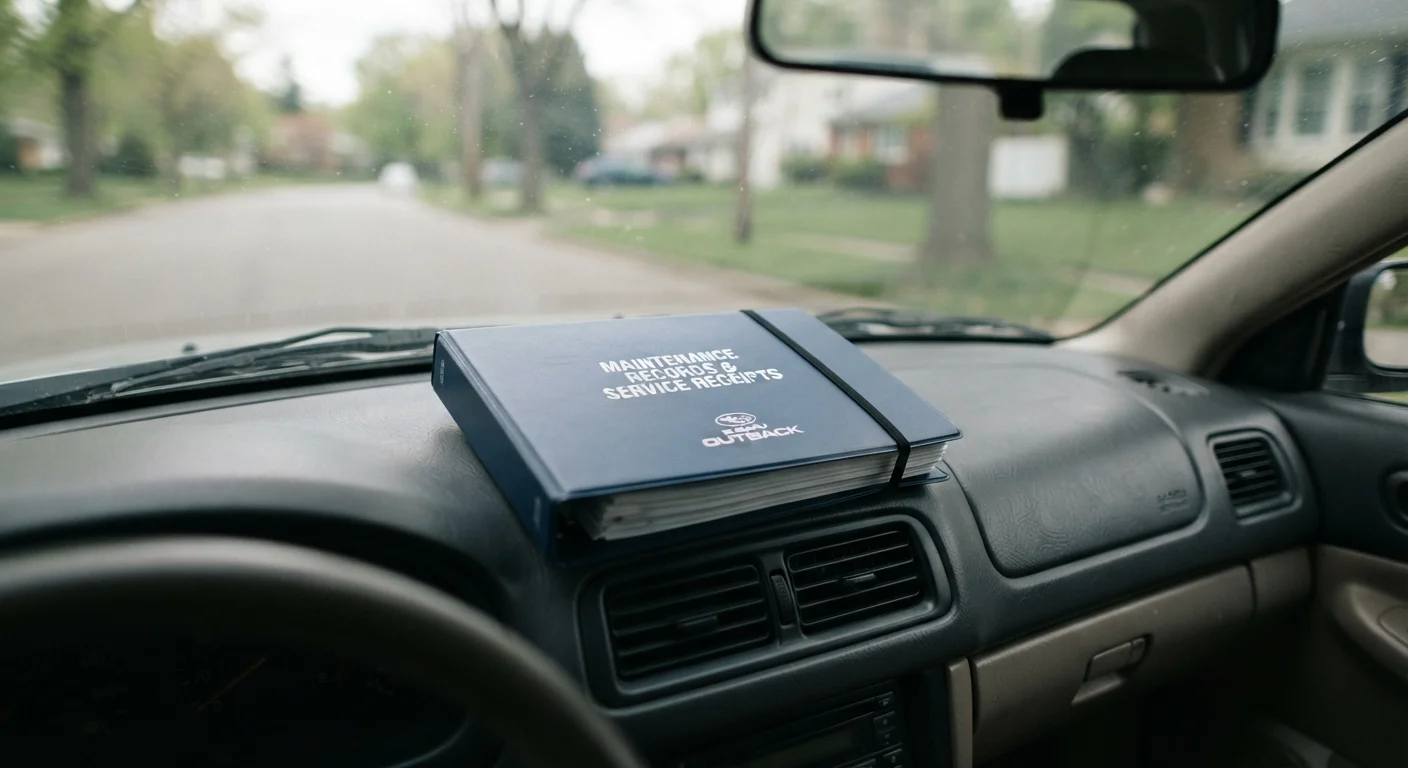
The barrier to keeping records is lower than most drivers expect. A dedicated folder in the glove box handles physical receipts. A labeled folder in cloud storage handles digital ones. The habit that matters is adding to it every time service is completed, whether at a shop or at home.
For each service entry, the useful details are: the date, the odometer reading, what work was performed, who performed it, and the cost. A receipt from a shop usually contains all of this automatically. For DIY work, a short handwritten or typed note with parts receipts attached is enough to establish a record.
Mileage at the time of service is one detail worth paying attention to, because it lets a buyer verify that intervals were reasonable rather than stretched. A pattern of oil changes every 12,000 miles on a vehicle whose manufacturer specifies 5,000 is a flag that paperwork alone cannot hide.
Drivers managing older vehicles can find more guidance on which systems deserve closer documentation in the high-mileage vehicle care guide. For a broader look at how service history fits into overall ownership costs, the car ownership cost strategies guide covers the financial picture in more depth.
What buyers and appraisers actually look for
A buyer reviewing your records is looking for two things: consistency and honesty. Consistency means services appear at regular, reasonable intervals. Honesty means the records align with the vehicle's current condition. A car with pristine oil change records but worn brake pads and a noisy suspension raises questions rather than settling them.
Appraisers at dealerships or inspection services often cross-reference physical condition with documented history. When the two align, the appraisal process moves faster and the offer is less likely to include a large deduction for assumed deferred maintenance.
Private buyers without mechanical knowledge rely on records more heavily than experienced buyers do. For that segment of the market, a well-organized folder of receipts can be the deciding factor between a sale at asking price and a prolonged negotiation.
The car ownership basics hub has additional context on registration, insurance, and the financial realities that affect vehicle value over time.