

Key Takeaways
- Fiber uses light signals through glass strands; cable uses electrical signals through coaxial copper lines.
- Fiber typically offers symmetrical upload and download speeds; cable upload speeds are usually much slower.
- Cable internet is available in far more US homes than fiber, though fiber coverage continues to expand.
- Network congestion affects cable more than fiber because cable lines are shared among neighborhood users.
- Both technologies can support multiple devices and 4K streaming under normal household conditions.
Option A
Fiber Internet
The newer technology built for symmetrical, high-capacity speeds.
Best for: Households that upload large files, video conference frequently, or have many devices running simultaneously.
Option B
Cable Internet
The widely available option built on existing coaxial cable networks.
Best for: Households in areas without fiber access who need reliable speeds for general browsing and streaming.
If you upload large files, back up data to the cloud, or video conference all day
Fiber Internet
Fiber's symmetrical speeds mean your upload bandwidth matches your download, which matters far more than most people expect until they start experiencing bottlenecks.
If fiber is not yet available at your address
Cable Internet
Cable reaches the vast majority of US homes and delivers download speeds more than adequate for streaming, gaming, and general use.
If you work from home and need a consistently stable connection
Fiber Internet
Fiber lines are not shared at the neighborhood level, so performance stays steadier during peak hours when cable networks can slow down.
If you share a connection across many simultaneous devices
Fiber Internet
Fiber's higher capacity and symmetrical bandwidth handles multiple active streams and downloads without the congestion risk present on shared cable networks.
If you are a light user who streams and browses on one or two devices
Cable Internet
A mid-tier cable plan delivers enough speed for typical home use, and cable's wide availability makes it the practical choice in most US markets.
How each technology actually works
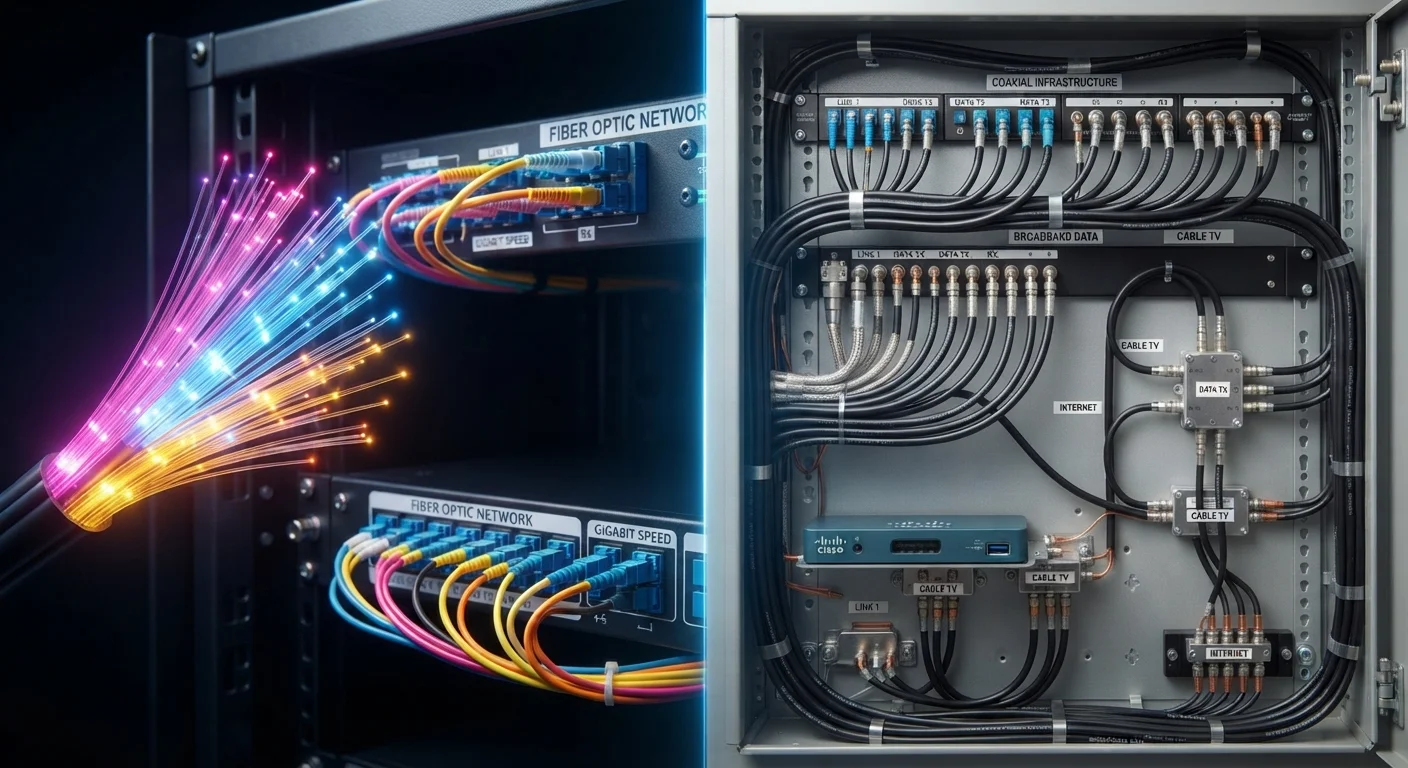
Fiber internet transmits data as pulses of light through thin strands of glass or plastic. Cable internet transmits data as electrical signals through coaxial cable, the same type of line that carries cable television. That physical difference has real consequences for speed, stability, and how the signal degrades over distance.
With fiber, light travels through the cable with very little signal loss, which is why fiber can maintain high speeds over longer distances without degrading. Coaxial cable, by contrast, experiences more interference and loss as distance from the provider's node increases, which can drag down speeds for homes at the far end of the line.
Cable networks also use a shared architecture in most deployments. That means several homes in a neighborhood share bandwidth on the same segment. Fiber networks are more commonly built as dedicated lines all the way to each home, a design sometimes called FTTH (fiber to the home). The distinction matters most during peak hours when many users are online at once. For a fuller look at how these and other technologies stack up, see this side-by-side comparison of home internet technologies.
Speed: download, upload, and what the numbers mean
Most cable plans advertise download speeds anywhere from 100 Mbps (megabits per second) to over 1 Gbps (gigabit per second). But cable upload speeds lag well behind: a plan advertising 500 Mbps download might offer only 20 to 35 Mbps upload. Fiber plans are far more likely to be symmetrical, meaning the upload speed matches the download speed.
That asymmetry matters more than it used to. Video calls, cloud backups, and sharing large files all consume upload bandwidth. If you are uploading constantly throughout a workday, a cable connection's limited upload capacity becomes a genuine constraint. Remote workers in particular often discover that advertised download speed is not the number that was holding them back.
If you want to understand what Mbps and Gbps actually translate to in daily use, this plain-language breakdown of internet plan terms covers the basics clearly.
| Criterion | Fiber Internet | Cable Internet |
|---|---|---|
| Signal medium | Light through glass strands | Electrical signal through coaxial cable |
| Typical download speeds | 200 Mbps to 5 Gbps | 100 Mbps to 1.2 Gbps |
| Typical upload speeds | Matches download (symmetrical) | Much lower than download |
| Network sharing | Dedicated line to home (common) | Shared neighborhood segment |
| Congestion sensitivity | Lower | Higher during peak hours |
| US household availability | Growing but limited | Widely available |
| Signal degradation over distance | Minimal | More noticeable |
Reliability and congestion
Fiber connections tend to be more consistent throughout the day because they are not subject to the neighborhood-sharing model that affects cable. On cable networks, speeds during evening hours, when many households are online simultaneously, can drop noticeably below what a provider advertises. This is not a flaw in any particular provider's service; it is a structural property of how shared cable networks are built.
Fiber is not immune to outages, but its signals are not affected by electrical interference or the radio frequency noise that can degrade coaxial cable performance. Physical damage to the line remains a risk for any wired technology. In general, fiber infrastructure requires less active maintenance over time than legacy coaxial networks, though cable operators have continued updating their systems with newer standards that improve capacity.
One point that often gets overlooked: the connection type coming into your home is only part of the reliability picture. How you distribute that connection inside your home matters too. A wired Ethernet connection from your router to a device can eliminate Wi-Fi variability regardless of whether you have fiber or cable.
Availability and what to check before deciding
Cable internet is available to a large majority of US households. Fiber availability is growing but still reaches a much smaller share of addresses, concentrated in urban areas and newer suburban developments. In many parts of the country, fiber is not yet an option, which makes the comparison moot for those households.
Before assuming either technology is available at your address, check with providers directly or use the FCC's broadband map (available at fcc.gov), which lists reported coverage by address. Advertised coverage areas do not always match what is actually serviceable at a specific address. Common misconceptions about internet speeds often start with what providers advertise versus what a household actually receives at the wall.
If both fiber and cable are available where you live, comparing the actual plan terms, including any data caps or contract requirements, gives you a clearer picture than speed numbers alone. Pricing varies considerably by market and plan tier, so no single figure applies broadly.