

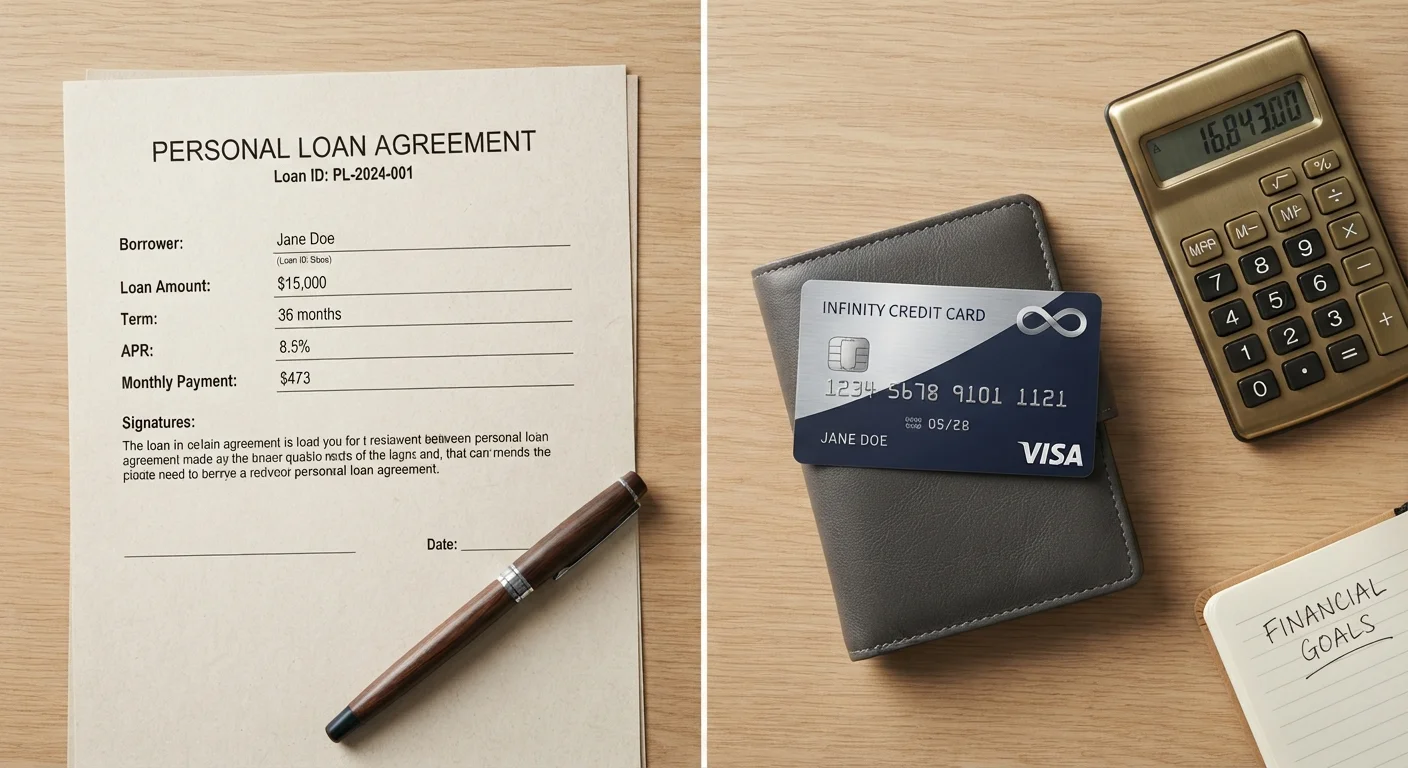
Key Takeaways
- Personal loans typically carry lower interest rates than credit cards for large expenses.
- Credit cards offer flexibility and rewards but can cost more if balances carry over months.
- Your credit score, repayment timeline, and spending discipline all affect which option costs less.
- Introductory 0% APR credit card offers can beat personal loans if you can repay within the promo period.
- A fixed monthly payment from a personal loan can help with budgeting predictability.
Our Verdict
Personal loans generally cost less for large expenses repaid over a year or more, because fixed rates stay lower than typical credit card APRs. Credit cards with promotional 0% periods can win on cost when the balance can realistically be cleared before interest begins. The right choice depends on the amount, your repayment timeline, and how reliably you can stick to a payoff plan.
| Best for | Recommended |
|---|---|
| Those financing a large expense over 12 months or longer | Personal loan |
| Those who can repay within a 0% APR promotional window | Credit card with intro APR offer |
| Those who want predictable monthly payments and a clear payoff date | Personal loan |
| Those making a purchase that qualifies for card rewards or purchase protection | Credit card, paid in full quickly |
How each option works
A personal loan gives you a lump sum upfront, which you repay in fixed monthly installments over a set term, typically 12 to 60 months. The interest rate is usually fixed, so your payment does not change. A credit card is a revolving line of credit: you can charge up to your limit, pay any amount above the minimum each month, and borrow again as you pay down the balance.
For a large expense, that structural difference matters. A personal loan locks in a repayment schedule and a single interest rate from the start. A credit card leaves repayment open-ended, which can work in your favor or against you depending on how you manage it. Understanding how payment method affects financial behavior is worth considering. See how payment method affects spending for context on the psychology involved.
Interest rate comparison
This is where the numbers often favor personal loans. Personal loan APRs for borrowers with good credit commonly fall in the range of 8% to 20%, depending on the lender and term. Credit card APRs average above 20%, with many cards charging 24% to 29% for standard purchases.
However, many credit cards offer 0% introductory APR periods, typically 12 to 21 months on purchases or balance transfers. If you can clear the full balance before that period ends, you pay no interest at all, which is cheaper than any personal loan. The risk is that any remaining balance at the end of the promo period begins accruing interest at the card's standard rate, often retroactively depending on the card's terms. Read the fine print before counting on a promotional offer.
| Personal loan | Credit card | |
|---|---|---|
| Typical APR range | 8% to 20% (fixed) | 20% to 29%+ (variable) |
| Repayment structure | Fixed monthly installments | Flexible, minimum required |
| 0% interest option | Not available | Promotional periods available |
| Origination or setup fees | Often 1% to 8% of loan | Annual fee on some cards |
| Credit utilization impact | None (installment debt) | Can raise utilization ratio |
| Rewards or protections | None | Cash back, purchase protection |
| Best payoff timeline | 12 to 60 months | Before promo period ends |
Fees and total cost
Personal loans sometimes include origination fees, typically 1% to 8% of the loan amount, deducted upfront or added to the balance. That fee effectively raises your cost of borrowing, so it is worth including in any comparison. Some lenders also charge prepayment penalties if you pay off early, though many do not.
Credit cards can carry annual fees, late fees, and foreign transaction fees. If you miss a payment, a penalty APR can kick in, which may be 29.99% or higher. Neither option is inherently fee-free; the total cost calculation requires accounting for both the interest rate and any fees attached.
If you are weighing how to allocate money between debt repayment and other financial goals, the guide on saving vs. paying down debt covers that trade-off in more depth.
How each affects your credit
Both options affect your credit report, but in different ways. A personal loan adds an installment account to your credit file, which can improve your credit mix. Making on-time payments builds a positive payment history, which is the largest factor in most credit scores.
A credit card is a revolving account. Using a large portion of your credit limit raises your credit utilization ratio, which can lower your score in the short term. If the expense is close to or exceeds your available credit, a personal loan may cause less immediate score impact. On the other hand, how credit cards are structured varies, and some cards carry higher limits that keep utilization low even on large charges.
When a personal loan makes more sense
A personal loan is generally the stronger option when the expense is large enough that repayment will take more than a year, when you want a fixed payment for budgeting purposes, or when your credit card limit cannot cover the full amount. The fixed rate protects you from rate increases, and the defined end date gives you a clear payoff timeline.
It is also worth considering how borrowing decisions fit into your broader financial picture, including any existing debt. The article on paying down debt vs. building an emergency fund can help frame that bigger picture.
When a credit card makes more sense
A credit card can be the better choice when you qualify for a 0% APR promotional offer and can realistically pay the balance in full before it expires. It also makes sense when the purchase qualifies for rewards, cash back, or purchase protection benefits that a personal loan cannot provide.
Spending discipline is the central factor here. If there is a realistic chance the balance will linger past the promo period, the eventual interest charges can exceed what a personal loan would have cost. Budgeting for a fixed payoff amount each month, rather than just meeting the minimum, is what makes the card option work. For general frameworks on tracking spending around a plan like this, budgeting basics provides useful structure.
This article is for general informational purposes only and does not constitute personalized financial or legal advice. Consult a licensed financial professional before making borrowing decisions based on your individual circumstances.