

Key Takeaways
- A budget is a plan made before spending; a spending tracker records what already happened.
- Trackers reveal patterns that make budgets more realistic and easier to stick to.
- Using both together closes the gap between what you intend to spend and what you actually spend.
- Neither tool guarantees financial outcomes; they are aids to decision-making, not solutions on their own.
- You can start with a tracker if you have no sense of your baseline spending habits.
Option A
Budget
A forward-looking plan that tells your money where to go before you spend it.
Best for: Anyone who wants to set spending limits and align monthly expenses with financial goals.
Option B
Spending tracker
A backward-looking record of what you actually spent and where.
Best for: Anyone who wants to understand their real spending patterns before or alongside building a plan.
If you have never tracked your spending before
Spending tracker
Without a baseline of actual spending, any budget you write is a guess. A tracker gives you the data to set realistic limits.
If you know your spending patterns and want to work toward a goal
Budget
A budget puts your income and expenses into a structured plan, so each dollar has a purpose before the month begins.
If you frequently overspend categories you thought you had under control
Both
A budget sets the target; a tracker shows where the gap opens up so you can adjust before the same problem repeats next month.
What each tool actually does
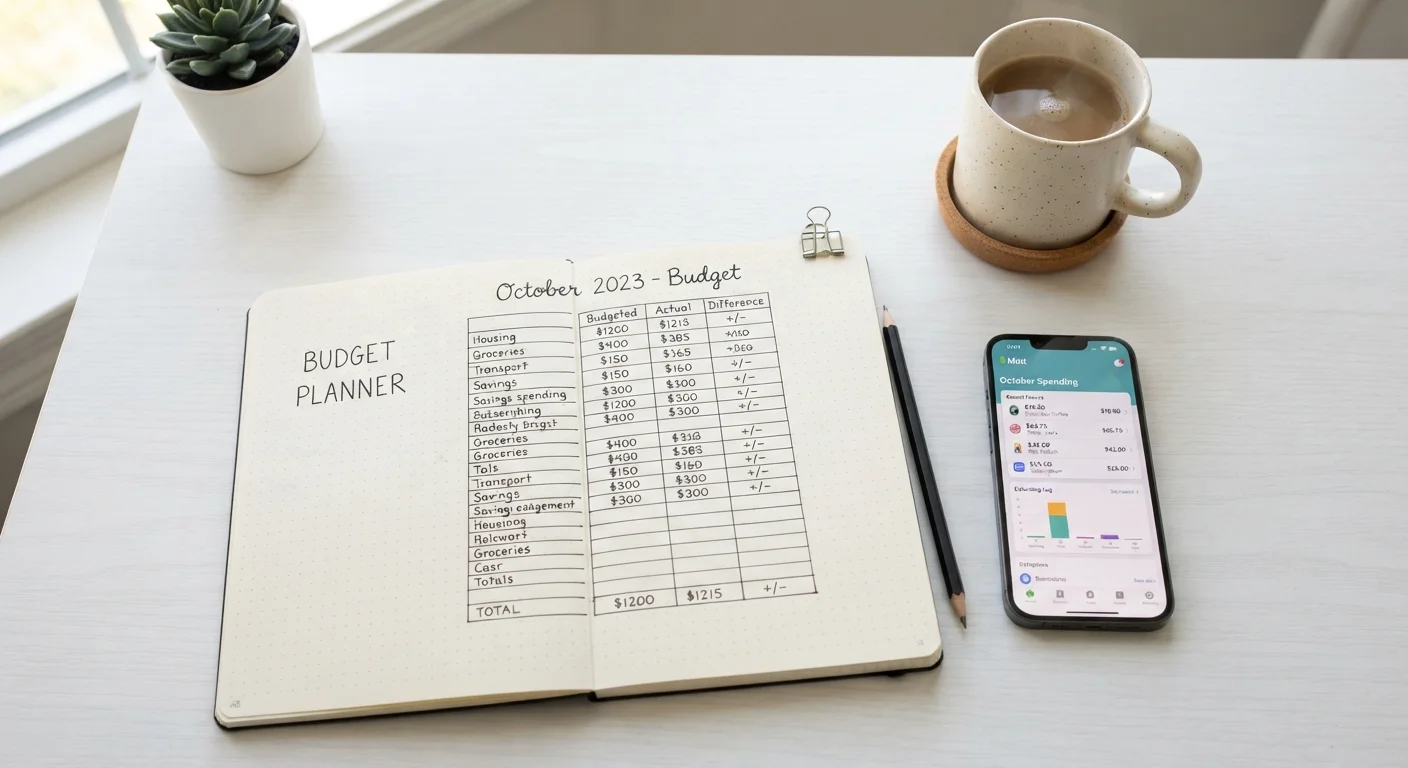
A budget is a plan. You write it before the month starts, assigning portions of your income to categories: rent, groceries, transportation, savings, and so on. The goal is to make deliberate decisions about money before it moves.
A spending tracker is a record. You log each transaction after it happens, either manually or by connecting a bank account to an app. Over days and weeks, the log builds into a picture of your real habits.
The two tools answer different questions. A budget answers: "Where do I intend my money to go?" A tracker answers: "Where did my money actually go?" Both questions matter, and neither answer substitutes for the other.
Understanding fixed and variable expenses is a useful starting point, because the two categories behave differently inside both tools. Fixed costs are predictable and easy to budget in advance; variable costs are where a tracker tends to surface surprises.
Why a budget alone can mislead you
A budget built from estimates rather than real data tends to be optimistic. Most people underestimate how much they spend on food, subscriptions, and small purchases. When actual spending consistently exceeds the budgeted amount, the budget stops functioning as a guide and becomes a source of frustration instead.
Discretionary spending is the category where this gap shows up most often. Without tracked data, it is easy to set a number that sounds reasonable but bears little relation to habit.
Starting with three months of data
If you are building a budget for the first time, track your spending for two to three months before setting category limits. This sample period accounts for irregular expenses and gives you averages that are far more accurate than estimates made from memory. The time invested upfront reduces the likelihood that your budget will need constant revision in the first few months.
A spending tracker fills this gap by giving you several months of real numbers to work from. Once you can see that you spend a consistent amount on dining out each month, you can budget that category with confidence rather than wishful thinking.
Why a tracker alone is not enough
Tracking without a plan produces awareness, but awareness by itself does not change behavior. You might know you spent more than expected last month and still have no framework for deciding what to do differently this month.
A budget gives tracked data a purpose. It sets the limit against which you measure each week's spending. Without that limit, a tracker is a ledger, not a decision tool.
Your bank statement can serve as a low-effort starting point for tracking, since it already contains a chronological record of transactions. But reading that record strategically, and then using it to build or refine a budget, is what turns observation into action.
How the two tools work together
The most practical approach treats the tracker as the input and the budget as the output. Spend one to three months tracking actual expenses across categories. Then use those numbers to write a budget grounded in reality.
Once a budget is in place, continue tracking to measure performance against it. If grocery spending runs over budget three months in a row, that is a signal to adjust the budget figure, not to feel defeated. The tracker makes the budget a living document rather than a static wish list.
Everyday money habits tend to improve when both tools are in use, because the combination creates a feedback loop: plan, observe, adjust, repeat.
For households managing shared finances, the same principle applies. Budgeting as a couple works better when both partners can see tracked data, since disagreements about spending are easier to resolve with a shared record than with competing memories. Digital tools for everyday finance can automate much of the tracking side, reducing the friction of maintaining both systems at once.
This article is for general informational purposes only and does not constitute personalized financial advice. For guidance on your specific situation, consider speaking with a qualified financial adviser.