

Key Takeaways
- Every vehicle has blind spots that mirrors cannot cover, regardless of how well the mirrors are adjusted.
- Incorrectly adjusted side mirrors are one of the most common causes of avoidable lane-change collisions.
- A brief head check over the appropriate shoulder before changing lanes catches what mirrors miss.
- Larger vehicles such as SUVs and trucks have wider blind spots than sedans.
- Blind spot monitoring systems help but are not a substitute for physical checks.
What you will need
Why blind spots form in every vehicle
A blind spot is any area around a vehicle that the driver cannot see through the mirrors or windshield from a normal seated position. Every production vehicle has them because the physical structure of the car, the A-pillars (the posts framing the windshield), B-pillars, headrests, and roof lines, blocks portions of the surrounding space.
The size of a vehicle's blind zones depends on body style. A low-slung sedan typically has narrower side blind zones than a full-size SUV or pickup truck, which sit higher and have longer rear overhangs. The rear blind zone, the area directly behind the vehicle at low speed, is covered in most vehicles made after May 2018 by a federally required backup camera. Side blind zones are not federally mandated to have camera coverage, which is why the skill of correctly adjusting mirrors and performing head checks still matters.
Good visibility habits connect to other safety fundamentals. Night driving shrinks your available reaction window further, making blind spots harder to manage at speed.
Side mirrors
Cover the rear flanks of the vehicle and reduce, but not eliminate, the blind zone along each side.
Rearview mirror
Covers the directly behind the vehicle through the rear window.
Blind spot monitoring system (if equipped)
Uses radar or cameras to alert the driver when a vehicle enters the side blind zone.
How to check and eliminate blind spots
Follow the steps below from your parked vehicle before driving. Mirror adjustments take two to three minutes and only need to be redone if someone else drives the vehicle or you change your seating position.
Set the rearview mirror first
Sit in your normal driving position before touching any mirror. Adjust the rearview mirror so the entire rear window is visible with minimal head movement. The top edge of the mirror should roughly align with the top of the rear window, and the view should be centered left to right.
Adjust the driver-side mirror outward
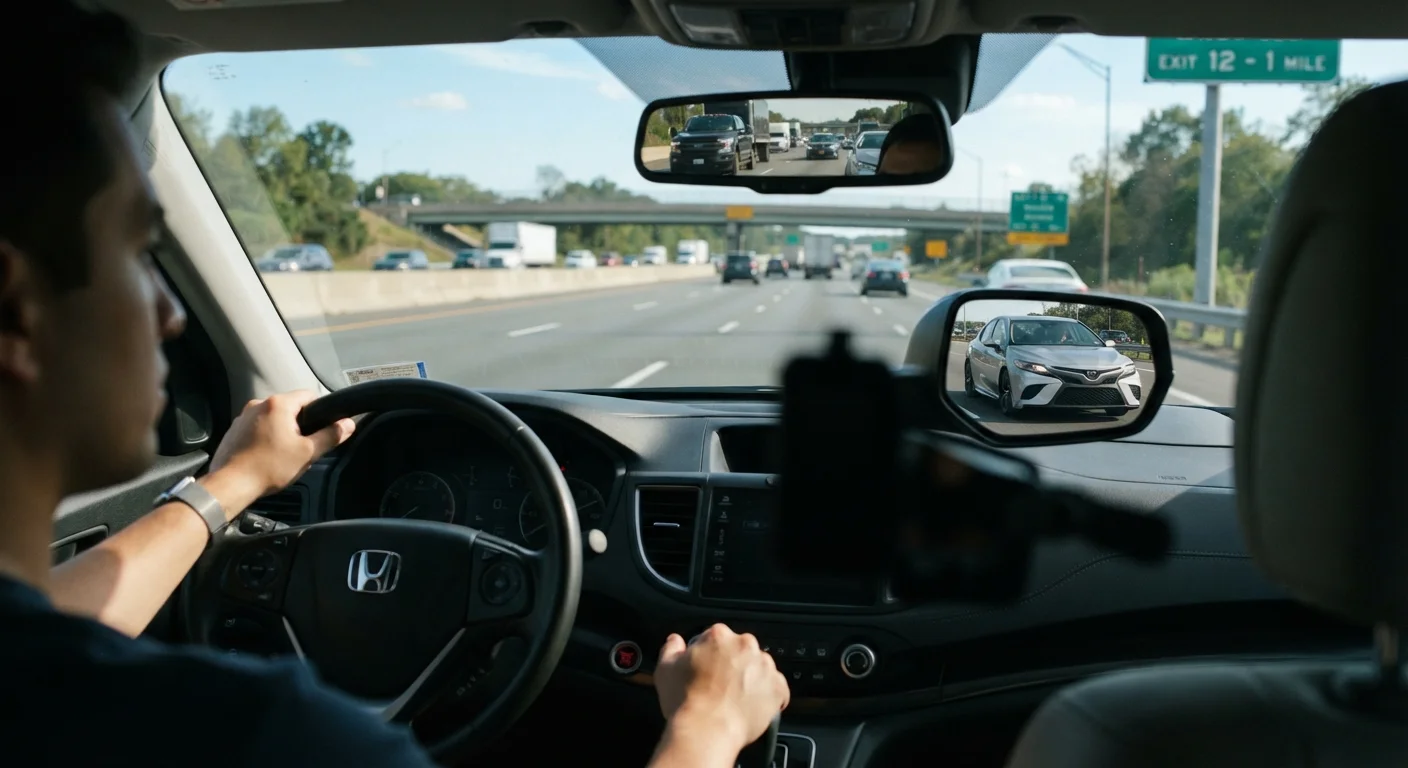
Most drivers position the side mirrors too far inward, which duplicates the rearview mirror's coverage instead of extending it. Move the driver-side mirror outward until your own vehicle's body just disappears from the left edge of the mirror frame. You should see mostly the lane to your left, not the side of your car.
Adjust the passenger-side mirror outward
Apply the same logic to the passenger side. Angle it until your vehicle's body barely disappears from the right edge. Because the passenger side is farther away, you may need to lean slightly toward the center console to set it, then check the view from your normal seat position afterward.
Identify where your blind zones still exist
Even with mirrors set correctly, two zones remain uncovered. On a standard sedan, the left blind zone sits roughly from the B-pillar (the post between the front and rear doors) rearward to where the side mirror's view begins. The right blind zone is wider because the passenger side is farther from the driver. Trucks, SUVs, and vans have larger blind zones due to their height and length.
A simple way to locate your specific blind zone: in a parking lot, watch a parked car as you walk from in front of the vehicle toward the driver's seat. Note at what point the car disappears from the side mirror but has not yet appeared in your forward peripheral vision. That gap is your blind zone.
Perform a head check before changing lanes
Before any lane change, check your mirrors, signal, and then quickly turn your head to look over the appropriate shoulder into the blind zone. A head check takes under a second and covers the gap the mirrors leave. Look for motorcycles and cyclists in particular, since they are narrow enough to disappear in blind zones even with well-adjusted mirrors.
Use blind spot monitoring systems correctly
If your vehicle has a blind spot monitoring (BSM) system, it will typically flash a warning light in the side mirror housing when a vehicle is detected in the adjacent zone. Treat this as one additional input, not a replacement for mirror checks and head checks. BSM systems can miss motorcycles at high relative speeds, and sensor coverage varies by vehicle. Always perform a physical head check even when no warning light is active.
Keeping your mirrors set correctly supports other routine checks. When you already have a habit of scanning your surroundings carefully, tasks like the checks described in this fluid inspection guide become easier to fit into your pre-drive routine.
Common mistakes that leave blind zones larger than necessary
The most widespread error is keeping side mirrors pointed too far inward. When the mirrors show mostly the side of the car, the driver has a false sense of coverage while the actual adjacent lane goes unmonitored. Correctly angled mirrors reduce the side blind zone significantly without eliminating it entirely.
A second common mistake is relying entirely on technology. Blind spot monitoring, lane-departure warnings, and rearview cameras are supplements, not substitutes, for mirror discipline and physical head checks. Sensors can be obstructed, and their detection ranges vary by manufacturer. No current production system covers every possible scenario.
Passengers and cargo can also worsen blind zones. A headrest in the rear center position, luggage stacked in the cargo area, or items hanging from the rearview mirror all reduce sightlines. Remove or reposition anything that cuts into your mirror views. For drivers who regularly haul loads, it is worth reviewing tire safety fundamentals as well, since improperly loaded vehicles handle differently, and that affects how quickly you can respond after identifying a hazard in a blind zone.