

Key Takeaways
- Misalignment often develops gradually, so drivers may not notice it until tire wear becomes severe.
- Hitting a pothole, curb, or road debris is one of the most common causes of alignment shift.
- Uneven tire wear is the clearest sign that alignment should be inspected.
- Correcting alignment early costs significantly less than replacing prematurely worn tires.
- Alignment should be checked at least once a year or after any significant impact.
Wheel alignment
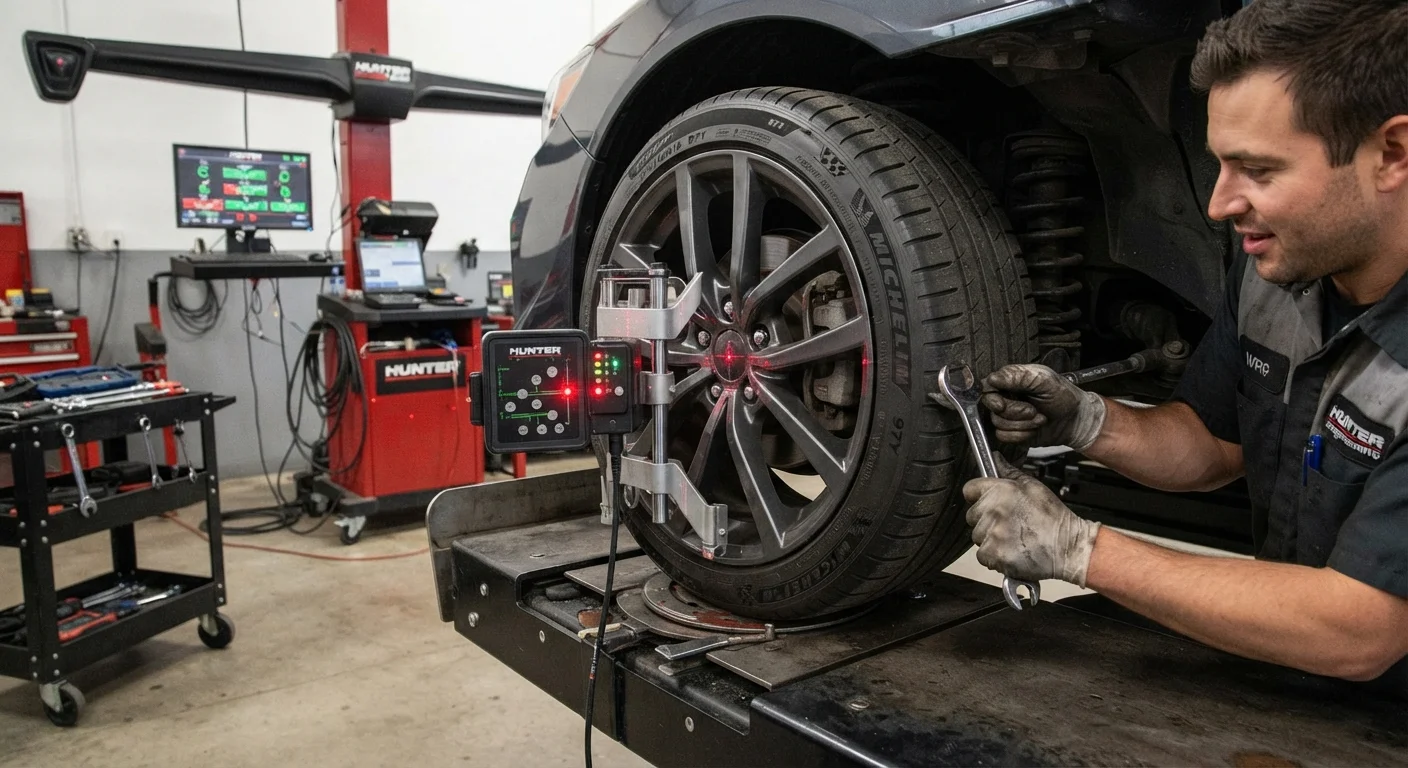
Wheel alignment refers to the angle at which your tires meet the road, relative to each other and to the vehicle's frame. When alignment is correct, all four tires point in the intended direction and share the load evenly. Misalignment means one or more wheels sit at the wrong angle, which causes uneven wear, handling problems, and added stress on suspension components.
Alignment is measured across three angles: camber (inward or outward tilt of the wheel), toe (whether wheels point inward or outward), and caster (the forward or backward tilt of the steering axis). Most modern vehicles require four-wheel alignment checks.
What alignment actually controls
Three angles determine how a wheel sits and moves: camber, toe, and caster.
Camber is the vertical tilt of the wheel when viewed from the front of the car. A wheel that tilts inward at the top has negative camber; outward tilt is positive camber. Most passenger vehicles are set to slight negative camber for stability. When camber is off, one edge of the tire wears faster than the other.
Toe describes whether the fronts of the tires point inward (toe-in) or outward (toe-out) when viewed from above. This is the angle that shifts most easily after an impact, and it causes feathering or saw-toothed wear across the tread.
Caster affects steering feel and straight-line stability. It is the angle of the steering axis relative to vertical, visible from the side of the vehicle. Caster problems are less common but can make the car feel unstable or cause it to pull to one side.
An alignment machine measures all three angles using sensors attached to each wheel, then compares those readings to the manufacturer's specified range for that vehicle. Technicians adjust the angles using the suspension geometry built into the car, typically through adjustable bolts or cam plates.
How alignment shifts without warning
Alignment does not require a collision to go wrong. The most frequent causes include hitting a pothole, rolling over a curb, or striking road debris at speed. Even a moderate impact that produces no visible damage can move suspension components enough to pull measurements out of spec.
Gradual drift is also real. Worn suspension bushings, ball joints, or tie-rod ends allow components to shift position over time, changing the effective alignment angles even without any single impact event. Vehicles with higher mileage are more susceptible for this reason.
Certain road conditions accelerate the process. Poorly maintained roads with frequent potholes, high-crown surfaces, or heavy rutting put repeated lateral stress on suspension geometry. Vehicles used for towing or frequently loaded near maximum payload also tend to develop alignment issues faster.
Check alignment when installing new tires
New tires installed on a misaligned vehicle will begin wearing unevenly from the first drive. Scheduling an alignment check at the same time as tire installation protects the new investment from day one. Many shops offer a discounted combined service for this reason.
For a broader look at maintenance items that are easy to postpone but expensive to ignore, see annual vehicle maintenance tasks most owners overlook.
What misalignment does to your tires and suspension
Tires are the first place misalignment becomes visible. A toe problem produces feathered tread wear, where each tread block is rounded on one side and sharp on the other. Camber issues produce one-sided shoulder wear. In either case, a tire that should last 50,000 miles may be unsafe at 25,000 miles.
~$1,000+
Cost of replacing a set of prematurely worn tires
Tire replacement costs vary by vehicle and tire type, but a full set of mid-range passenger tires commonly runs between $400 and $1,200 installed, making a $100 alignment check a meaningful preventive measure.
15-25%
Estimated reduction in tire lifespan from sustained misalignment
Industry-standard tire care guidance consistently notes that misalignment is one of the leading causes of premature and uneven tread wear across all vehicle types.
1x/year
Recommended minimum alignment check frequency
Most vehicle manufacturers and tire industry guidelines recommend at least an annual alignment inspection, with additional checks after significant road impacts.
Beyond tires, misalignment puts steady side-load stress on steering and suspension components. Tie rods, which connect the steering rack to the wheel hubs, experience lateral stress they were not designed to absorb continuously. Ball joints and wheel bearings also take on added load. Failures in any of these parts cost substantially more to repair than an alignment service.
Braking is affected as well. When wheels do not track straight, braking force is applied unevenly across the axle. In a hard stop, this can cause the vehicle to pull to one side, which reduces stopping effectiveness and may surprise a driver who is not expecting it.
Fuel economy takes a modest hit because misaligned tires generate rolling resistance, as the tread scrubs slightly sideways rather than rolling cleanly. This is similar in effect to driving with underinflated tires. See how tire pressure influences fuel economy and wear for more on related tire dynamics.
Recognizing the signs and deciding when to act
The steering wheel is one of the most reliable indicators. A wheel that sits rotated a few degrees to one side when the car tracks straight suggests the alignment is off, often at the front axle. This is different from a pull, which is a sustained lateral drift when hands are off the wheel on a flat road.
Tire wear inspection does not require a mechanic. Running a hand across each tire from shoulder to shoulder reveals uneven wear patterns that a visual check from a standing position may miss. A tread that feels sharp or sawtoothed on one side but smooth on the other is a reliable sign of a toe problem.
Vibration is a less precise indicator because it can also reflect wheel balance issues, worn tires, or worn wheel bearings. When vibration appears alongside uneven wear or a pull, alignment is a reasonable first step to investigate.
Alignment should be checked after any significant impact, when new tires are installed, and as part of annual maintenance. Keeping alignment in spec is one of the more cost-efficient protective measures in routine car ownership. For broader strategies on managing those costs, financial strategies for keeping car ownership costs under control covers the full picture.