

Key Takeaways
- Underinflated tires increase rolling resistance, which causes the engine to consume more fuel.
- The U.S. Department of Energy estimates that tires underinflated by 1 PSI can reduce fuel economy by about 0.2 percent.
- Correct tire pressure is listed on the driver-side door jamb sticker, not on the tire sidewall.
- Tires lose roughly 1 PSI per month naturally, and cold weather accelerates that loss.
- Overinflation also creates problems, including reduced traction and uneven tread wear in the center of the tire.
Tire pressure and fuel economy
Tire pressure is the amount of air inside a tire, measured in pounds per square inch (PSI). When a tire is underinflated, it deforms more as it rolls, creating extra friction against the road. That friction forces the engine to work harder, which burns more fuel. Keeping tires at the manufacturer-recommended PSI reduces rolling resistance and helps the vehicle move more efficiently.
Rolling resistance is the force a tire must overcome to maintain forward motion. Even a small drop in PSI increases the tire's contact patch and raises rolling resistance measurably.
Why tire pressure affects how much fuel you burn
A tire is not a rigid wheel. It flexes slightly with every rotation, and the amount it flexes depends directly on how much air is inside it. A properly inflated tire holds its shape well, rolls with minimal deformation, and transfers the engine's power to the road efficiently.
An underinflated tire flattens out more where it contacts the road. That wider, softer contact patch generates more friction, and the engine must work harder to push the vehicle forward at the same speed. The extra work comes from extra fuel. The U.S. Department of Energy has reported that tires underinflated by 1 PSI reduce fuel economy by approximately 0.2 percent, and that keeping tires at the correct pressure can improve efficiency by up to 3 percent compared to significantly underinflated tires.
For a driver covering 15,000 miles per year in a vehicle that gets 30 mpg, a 3 percent improvement means roughly 15 additional gallons of fuel over the course of a year. The math scales with mileage and gas prices, but the principle is consistent: soft tires cost money at the pump.
This connects directly to broader cost management. See financial strategies for managing car ownership costs for a wider view of where routine upkeep pays off.
Check pressure when tires are cold
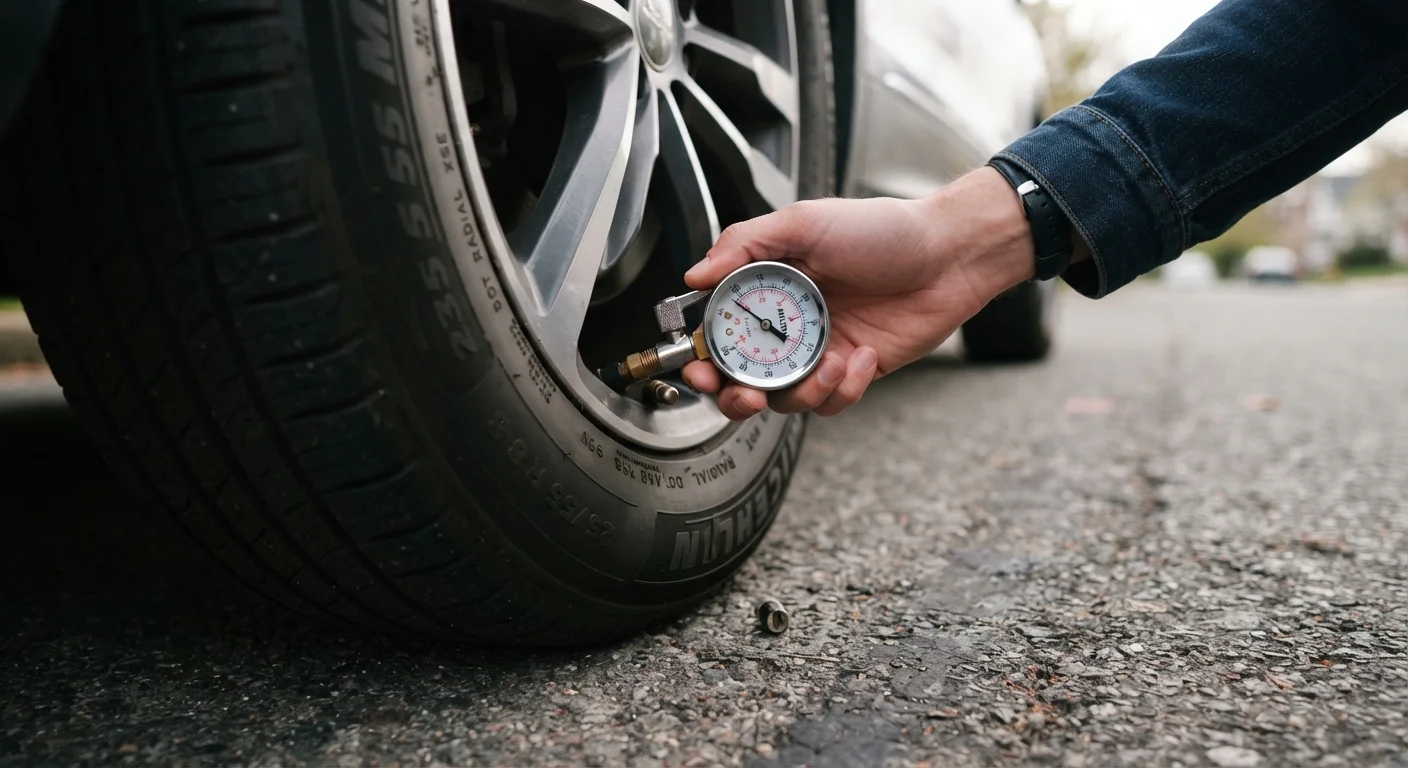
Tire pressure readings are most accurate when the vehicle has been parked for at least three hours or driven fewer than a mile. Driving heats the air inside the tire, temporarily raising the PSI reading and masking underinflation. Check in the morning before your first trip for the most reliable result.
Overinflation: the opposite problem
Drivers who know that low pressure hurts efficiency sometimes add extra air, assuming more is better. It is not. An overinflated tire has a smaller contact patch, which reduces the grip available for braking and cornering. It also causes the center of the tread to wear faster than the edges, shortening the tire's usable life.
The efficiency gain from overinflation is marginal and does not offset the safety and wear costs. The goal is the manufacturer's recommended PSI, which is printed on the driver-side door jamb sticker. That number accounts for load, handling, and efficiency together. The maximum PSI molded into the tire sidewall is a structural limit, not a target.
Temperature, time, and pressure loss
Tires lose air even without a puncture. A typical tire loses about 1 PSI per month through normal permeation of air through the rubber and valve stem. Cold weather accelerates this: for every 10-degree Fahrenheit drop in ambient temperature, tire pressure falls by roughly 1 to 2 PSI. A tire that was correct in September may be 4 to 6 PSI low by January without a single mile driven.
This seasonal drop is why monthly pressure checks matter, particularly in climates with cold winters. Most drivers underestimate how much pressure their tires have lost simply through time and temperature.
Vehicles manufactured after September 2007 are required by federal regulation to include a Tire Pressure Monitoring System (TPMS), which lights a dashboard warning when a tire drops to 25 percent below recommended pressure. That threshold is already a meaningful shortfall. Monthly manual checks with an inexpensive gauge catch smaller drops before they affect fuel economy or handling.
For a full picture of what to inspect and when, tire safety basics every driver should know covers pressure, tread depth, and load ratings together.
Tire pressure in the context of overall maintenance
Tire pressure does not operate in isolation. A vehicle with correct tire pressure but misaligned wheels still experiences uneven wear and handling pull. Wheel alignment and its effects on your car is a related maintenance item that affects tire life and, indirectly, fuel economy through the same rolling resistance mechanism.
Tire pressure is one of the lower-effort, higher-return maintenance habits available to any driver. It requires a gauge, two minutes, and a monthly reminder. The annual maintenance tasks most owners overlook article places tire pressure in a broader schedule of upkeep that protects both safety and long-term costs.
~0.2%
Fuel economy lost per 1 PSI underinflation
Reported by the U.S. Department of Energy as an estimated average across vehicle types.
1-2 PSI
Pressure drop per 10 degrees Fahrenheit temperature drop
A standard approximation used by automotive safety organizations to explain seasonal pressure loss.
25%
Underinflation threshold that triggers TPMS warning
Federal regulation requires TPMS to alert drivers when any tire reaches 25 percent below the vehicle's recommended cold inflation pressure.