

Key Takeaways
- Fat is a required macronutrient; the body cannot absorb vitamins A, D, E, and K without it.
- Unsaturated fats (monounsaturated and polyunsaturated) are associated with favorable cardiovascular outcomes in research.
- Artificial trans fats have been largely removed from the US food supply following regulatory action.
- Saturated fat and cardiovascular risk is an active area of research; current dietary guidelines still recommend limiting it.
- Total dietary pattern matters more than focusing on any single fat type in isolation.
- Always consult a qualified healthcare provider or registered dietitian for personal dietary guidance.
Dietary fat
Dietary fat is one of the three macronutrients the body requires, alongside protein and carbohydrates. It supplies energy, helps absorb fat-soluble vitamins (A, D, E, and K), and provides structural material for cell membranes. Fat is not a single substance: it is a category of molecules called fatty acids, grouped by their chemical structure into saturated, monounsaturated, polyunsaturated, and trans varieties.
Fatty acids differ by the number of carbon-carbon double bonds in their chains; these structural differences determine how each type behaves in the body and at cooking temperatures.
Why fat is not optional
Decades of low-fat dietary messaging left many people with the impression that fat is something to minimize. Nutrition science tells a more accurate story. Fat is a structural and functional necessity, not an optional fuel source you can simply subtract from your diet.
The body uses fatty acids to build and maintain cell membranes throughout every tissue. The brain is roughly 60 percent fat by dry weight, and myelin, the insulating sheath around nerve fibers, depends on fat for its integrity. Fat also acts as the transport medium for the fat-soluble vitamins: without adequate dietary fat, the body absorbs far less vitamin D, vitamin A, vitamin E, and vitamin K, regardless of how much of these nutrients you consume.
Fat also provides 9 calories per gram, more than twice the caloric density of carbohydrates or protein. This makes it an efficient energy store, but it also means that calorie intake can rise quickly when fat-dense foods dominate a diet. Understanding which types of fat do what helps put that energy density into context. For a parallel look at another often-misunderstood macronutrient, see our guide to dietary carbohydrates.
The four main types of dietary fat
Saturated fatty acids have no double bonds between carbon atoms. They are solid at room temperature and found mainly in animal products such as butter, whole-milk dairy, beef, and pork, as well as in coconut and palm oils. Current US dietary guidelines recommend keeping saturated fat below 10 percent of daily calories, based on evidence linking high intake to elevated LDL cholesterol levels. Some researchers argue the picture is more complex, and the science remains active. What is established is that replacing saturated fat with refined carbohydrates does not appear to improve cardiovascular risk; replacing it with unsaturated fat does, according to large observational studies.
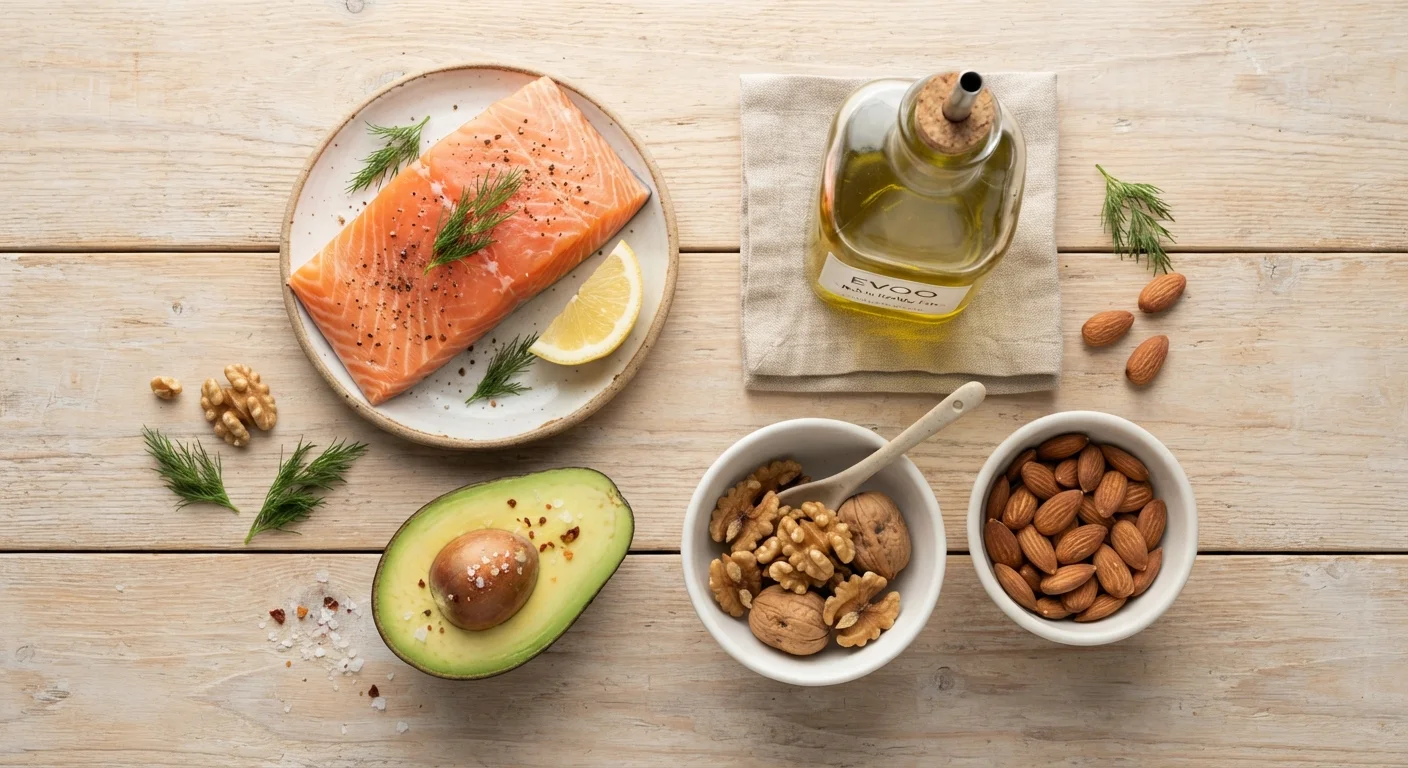
Monounsaturated fatty acids (MUFAs) have one double bond. Olive oil, avocados, and most tree nuts are rich sources. MUFAs are associated with favorable LDL and HDL cholesterol patterns in multiple studies, and they are a central feature of the Mediterranean dietary pattern, which has a substantial body of research behind it.
Polyunsaturated fatty acids (PUFAs) have two or more double bonds. This category includes two families the body cannot synthesize: omega-3s (found in fatty fish, flaxseed, and walnuts) and omega-6s (found in soybean, corn, and sunflower oils). Both are considered essential fatty acids. Omega-3s, particularly EPA and DHA from marine sources, have been studied extensively for their role in inflammation regulation and cardiovascular function.
Trans fatty acids come in two forms. Artificial trans fats, created by partially hydrogenating vegetable oils, were associated with increased cardiovascular risk and were phased out of the US food supply following FDA action completed in 2020. Naturally occurring trans fats, found in small amounts in ruminant dairy and meat, behave differently and have not shown the same adverse associations in research.
9 kcal/g
Calories per gram of fat
Fat provides more than twice the energy per gram compared to carbohydrates or protein, which each supply 4 calories per gram.
20-35%
Recommended fat share of daily calories
The 2020-2025 Dietary Guidelines for Americans recommend this range for total fat intake in adults.
Under 10%
Saturated fat ceiling in US dietary guidance
Current federal dietary guidelines advise limiting saturated fat to less than 10 percent of total daily calories.
What the research actually shows
Nutrition research is genuinely hard to conduct. Long-term randomized controlled trials on dietary patterns are expensive, difficult to keep participants on, and often rely on self-reported food intake. Most large-scale evidence comes from observational cohort studies, which can identify associations but cannot definitively establish cause and effect. Keeping that limitation in mind helps interpret nutrition headlines more accurately.
That said, some signals in the fat research are consistent and well-replicated. Replacing saturated fat with polyunsaturated fat is linked in multiple large cohort studies to lower rates of cardiovascular events. The Mediterranean-style diet, high in MUFAs and omega-3-rich fish, has shown protective associations in both observational and some trial data. Artificial trans fats are the clearest case: the evidence against them was strong enough to trigger regulatory removal from the food supply.
The saturated fat question remains contested. A 2020 analysis in the Journal of the American College of Cardiology argued that saturated fat subtypes and food sources matter, not just total intake. Dairy saturated fat, for instance, behaves differently in studies than processed-meat saturated fat. This does not overturn current guidance, but it illustrates why sweeping rules about any single nutrient can be an oversimplification.
Overall dietary pattern consistently outperforms any single nutrient as a predictor of long-term health outcomes in the research literature. Isolated fat type is one factor among many.
Practical context for everyday eating
General nutrition guidance from major health organizations, including the American Heart Association and the 2020-2025 Dietary Guidelines for Americans, supports a diet where most fat comes from unsaturated sources, saturated fat is limited, and artificial trans fat is avoided. These are population-level recommendations based on accumulated evidence, not personal prescriptions.
Whole food sources of fat tend to come packaged with other nutrients. Walnuts provide polyunsaturated fat alongside fiber and magnesium. Salmon provides DHA and EPA alongside high-quality protein. Olive oil provides MUFAs alongside polyphenols. Processing, cooking method, and the rest of the dietary context all affect how fat functions in practice.
Anyone managing a specific health condition, taking medications that interact with dietary fat absorption, or trying to make meaningful changes to their eating pattern should work with a registered dietitian or physician rather than relying on general articles.
This article is for general informational purposes only and does not constitute medical or dietary advice. Consult a qualified healthcare professional or registered dietitian before making changes to your diet, especially if you have an existing health condition.