

Key Takeaways
- Compound interest accelerates growth by adding earned interest back to the principal before the next calculation.
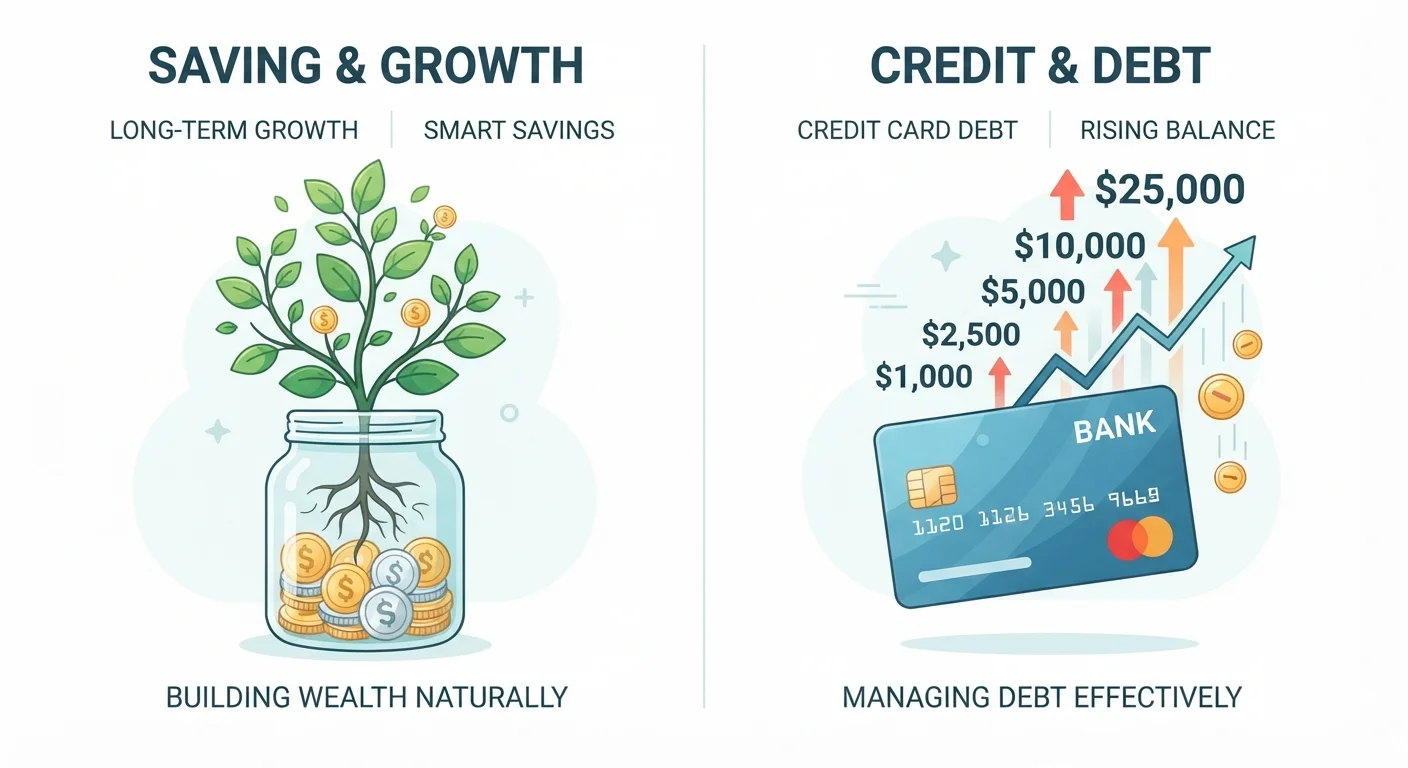
- High-rate debts such as credit cards compound against you, often daily, making balances grow quickly.
- The longer money stays invested or debt stays unpaid, the larger the compounding effect becomes.
- Annual percentage yield (APY) reflects compounding and is a more accurate measure than the stated interest rate.
- Paying more than the minimum on debt reduces the principal faster and limits the compounding effect.
Compound interest
Compound interest is interest calculated on both the original amount of money (the principal) and any interest already earned or owed. This means the balance grows faster over time because each period's interest becomes part of the base for the next calculation. It applies whether you are saving money or carrying a debt.
The compounding frequency, daily, monthly, or annually, affects how quickly balances grow. More frequent compounding produces a higher effective annual rate (EAR) than the stated nominal rate.
The basic mechanics of compounding
Interest becomes compound when it is added to the balance it was calculated on. The next interest calculation then uses that larger balance, producing a slightly larger interest amount, which is again added to the balance. This cycle repeats every compounding period.
A straightforward example: $1,000 earning 5% annual interest, compounded annually, becomes $1,050 after year one. In year two, interest is calculated on $1,050, not $1,000, producing $52.50 rather than $50. By year ten, the balance reaches roughly $1,629 without any additional deposits. The extra $129 beyond simple-interest growth comes purely from interest earning interest.
The key variables are the interest rate, the compounding frequency, and time. A higher rate and more frequent compounding both increase the speed of growth. Time is the variable most within a saver's control, and it has the largest long-run effect.
Check APY, not just the interest rate
When comparing savings accounts, use the APY rather than the nominal interest rate. APY already accounts for how often interest compounds, so it reflects what you will actually earn over a year. Two accounts with the same stated rate but different compounding frequencies will have different APYs.
For a broader look at how financial terminology works in practice, see common personal finance terms explained.
How compounding builds savings
On the savings side, compounding turns patience into a financial advantage. Money left in an account that compounds generates returns on prior returns without any additional action by the account holder.
US savings accounts typically compound daily and credit interest monthly. The figure banks advertise is the APY (annual percentage yield), which already incorporates the compounding frequency. An account with a 4.5% APY will produce more than an account with a 4.5% APR compounded annually, because the APY version reflects more frequent compounding cycles.
The effect is more pronounced over longer periods. Someone who deposits money at age 25 and leaves it untouched will accumulate considerably more than someone who deposits the same amount at age 40, even if both earn the same rate. This is because the 25-year-old's early interest payments have decades to generate their own interest.
22%+
Average credit card APR in the US
According to Federal Reserve data, average credit card interest rates have exceeded 20% APR in recent years, making daily compounding on carried balances a significant cost.
Daily
How often most credit cards compound interest
Most US credit card agreements compound interest daily on the average daily balance, producing a higher effective rate than the stated APR implies.
2x+
Balance growth from compounding over 20 years at 5%
At a 5% annual rate compounded annually, a principal balance more than doubles in 20 years due to compounding alone, without any additional contributions.
Certificates of deposit (CDs) and money market accounts use the same compounding principle but with different rules around access and rate structures. How savings accounts, money market accounts, and CDs differ covers those distinctions in detail.
How compounding builds debt
The same mechanism that favors savers works against borrowers, and it is most aggressive on revolving debt like credit cards. Most US credit card issuers apply interest daily based on the average daily balance. The daily rate is the card's APR divided by 365. At a 22% APR, that is roughly 0.060% per day, charged on whatever balance exists that day.
When interest charges are added to the balance and no payment covers them fully, the new higher balance becomes the base for the next day's calculation. A $3,000 balance at 22% APR, left untouched with only minimum payments, can take over a decade to repay and cost more in interest than the original purchases.
Minimum payments are structured to keep accounts current while leaving most of the principal intact. Paying only the minimum slows the reduction of the principal, which means the compounding base stays large and interest accumulates faster. Paying more than the minimum directly cuts the principal and reduces future interest charges.
For a related perspective on how small spending decisions interact with this dynamic, see why small daily purchases add up faster than most people expect.
Balancing savings growth and debt reduction
Compound interest creates a rate-of-return comparison between saving and paying down debt. If a credit card charges 22% interest compounded daily, paying $500 toward that balance produces a guaranteed 22% return equivalent, because future interest on that $500 is eliminated. A savings account returning 4.5% APY cannot match that, in pure mathematical terms.
This does not mean maintaining no savings. A cash reserve protects against unexpected expenses that would otherwise require borrowing at high rates. The general principle, though, is that high-interest debt warrants attention before building savings beyond a basic emergency buffer.
Lower-rate debt, such as a mortgage or federal student loan, changes the calculation. When the debt rate falls below what savings or investments might reasonably return, the trade-off is less clear-cut. That decision involves individual circumstances and risk tolerance, and a licensed financial adviser can help evaluate the options.
When to prioritize saving versus paying down debt examines that decision in more depth.
This article is for general informational purposes only and does not constitute personalized financial advice. Consult a qualified financial professional for guidance specific to your situation.