

Key Takeaways
- Two seconds is the minimum following gap under ideal conditions, not a universal safe distance.
- Most drivers chronically underestimate how long two seconds actually is when counting in motion.
- Wet roads, poor visibility, heavy loads, and fatigue all require a longer gap.
- Tailgating is a leading factor in rear-end crashes, which account for a large share of US collisions each year.
- Tire condition directly affects stopping distance, so a worn-tire vehicle needs even more space to stop safely.
The two-second rule
The two-second rule is a method for estimating a minimum safe following distance between your vehicle and the one ahead of you. When the vehicle in front passes a fixed point, at least two full seconds should pass before your vehicle reaches that same point. It works at any speed because the gap automatically scales with how fast you are traveling.
Two seconds is a baseline derived from average perception-reaction time, which traffic safety research generally places between 1.5 and 2.5 seconds for an alert driver under normal conditions.
What the rule actually measures
The two-second rule does not measure feet or car lengths. It measures time, which means the physical gap it creates grows as your speed increases. At 30 mph, two seconds translates to roughly 88 feet. At 60 mph, that same two seconds becomes about 176 feet. This scaling is exactly why the rule is taught as a time interval rather than a fixed distance.
The reason two seconds matters comes down to perception-reaction time. From the moment a hazard appears to the moment your foot reaches the brake pedal, an alert driver typically needs between 1.5 and 2.5 seconds. Any gap shorter than your reaction time means you are already in contact before you have even begun to brake.
After your foot hits the brake, the vehicle still needs additional distance to stop. That stopping distance depends on your speed, the road surface, your brake condition, and your tire tread. Two seconds covers the reaction phase; it does not cover the full stopping distance. This is a detail many drivers miss when they assume the rule is a complete safety buffer.
Why drivers consistently misjudge it
The most common error is counting too fast. Saying 'one-two' takes roughly one second, not two. The correct mental count uses filler syllables: 'one-one-thousand, two-one-thousand.' Even then, many drivers start counting before the car ahead has fully passed the reference point.
Speed also distorts time perception. At highway speeds, a two-second gap looks enormous compared to what drivers see on congested urban roads, where gaps of a fraction of a second are common. Drivers normalize what they see around them, and when surrounding traffic is tight, even a legal gap can feel like you are leaving too much room.
Re-establish the gap after a merge
When another driver fills the space you left, ease off the accelerator to rebuild a two-second gap rather than accelerating to close in behind them. This takes a few seconds and costs nothing in terms of travel time over a typical commute.
A third factor is social pressure. Leaving adequate space invites other drivers to merge in front of you. Many drivers unconsciously close the gap to prevent this, without weighing the safety cost. The practical fix is to simply re-establish the gap after a merge rather than preventing one from happening.
When two seconds is not enough
Rain reduces tire grip and increases stopping distance significantly. On wet pavement, a following distance of at least four seconds is a more reasonable minimum. Ice and packed snow can multiply stopping distances by four to ten times compared to dry asphalt, which means the gap needs to reflect that reality, not a dry-weather baseline.
Vehicle type also matters. A loaded pickup truck, an SUV, or a vehicle towing a trailer has substantially more momentum than an empty sedan. Heavier vehicles take longer to stop. If you are driving a loaded vehicle, two seconds is not an adequate buffer at highway speeds.
Tire condition changes stopping distance in ways most drivers do not account for. Worn tread reduces wet-road grip considerably. If your tires are near or below the legal minimum tread depth, your actual stopping distance will be longer than what the two-second rule was designed around. The basics of tire safety cover what tread depth and tire pressure mean for stopping performance.
Fatigue and distraction both increase reaction time. A tired driver's perception-reaction time can exceed three seconds, meaning the two-second gap is already consumed before braking even starts.
Applying the rule in real traffic
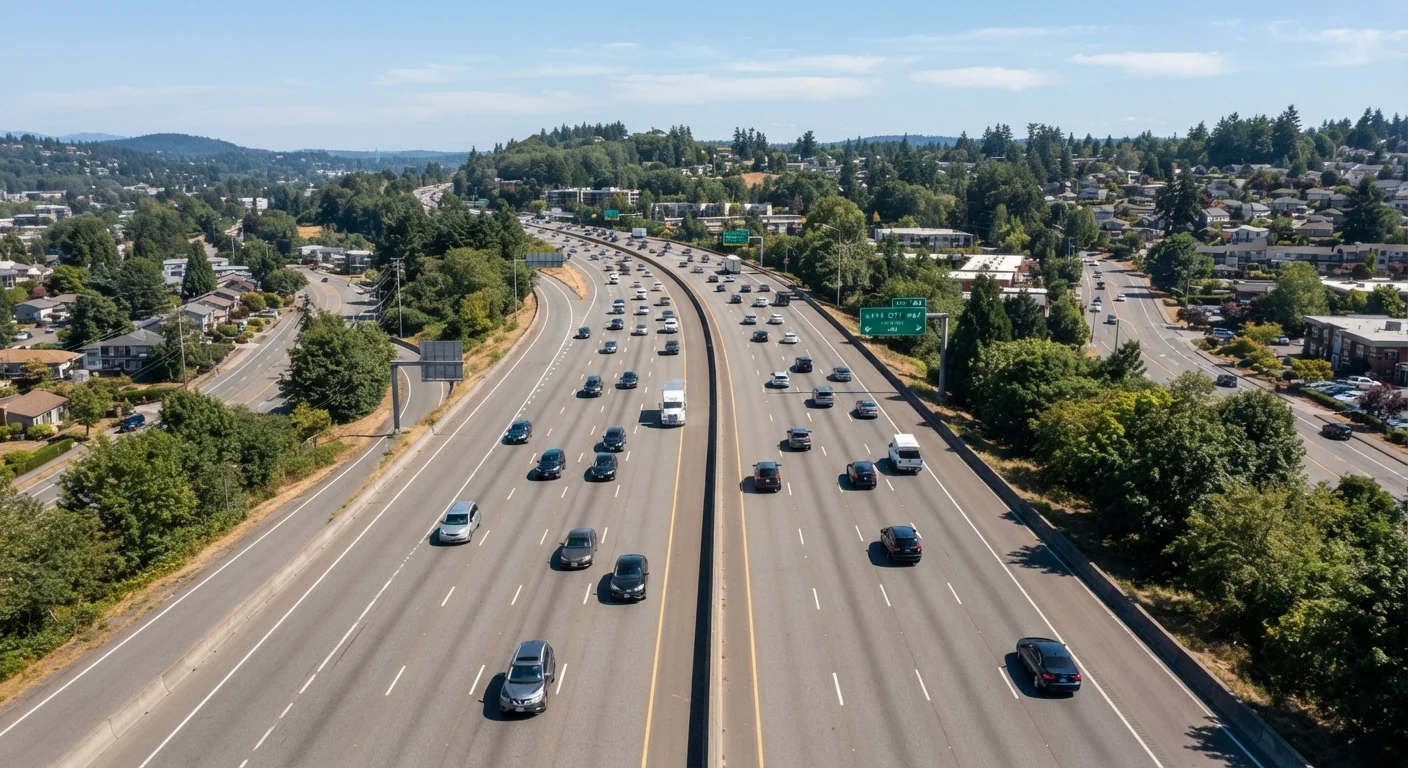
Choose a fixed reference point ahead: a highway sign, a painted road marking, or a bridge overpass. When the vehicle in front passes it, begin your count. If your front bumper reaches that same point before you finish 'one-one-thousand, two-one-thousand,' close the gap gradually by easing off the accelerator rather than braking.
On a congested highway, maintaining two seconds will result in other drivers filling the space. This is fine. The appropriate response is to re-establish the gap, not to match the tailgating behavior of surrounding traffic. Your stopping distance does not change because the car behind you is too close.
In parking lots and low-speed urban traffic, two seconds remains useful even though the speeds are lower. A pedestrian stepping into the road at 25 mph still requires a reaction gap before you can brake to a stop. The rule scales, but it never becomes irrelevant.