

Key Takeaways
- Every state requires at least liability coverage; full coverage is not legally mandated but is often required by lenders.
- Liability pays for damage or injuries you cause to others; it does not pay for repairs to your own vehicle.
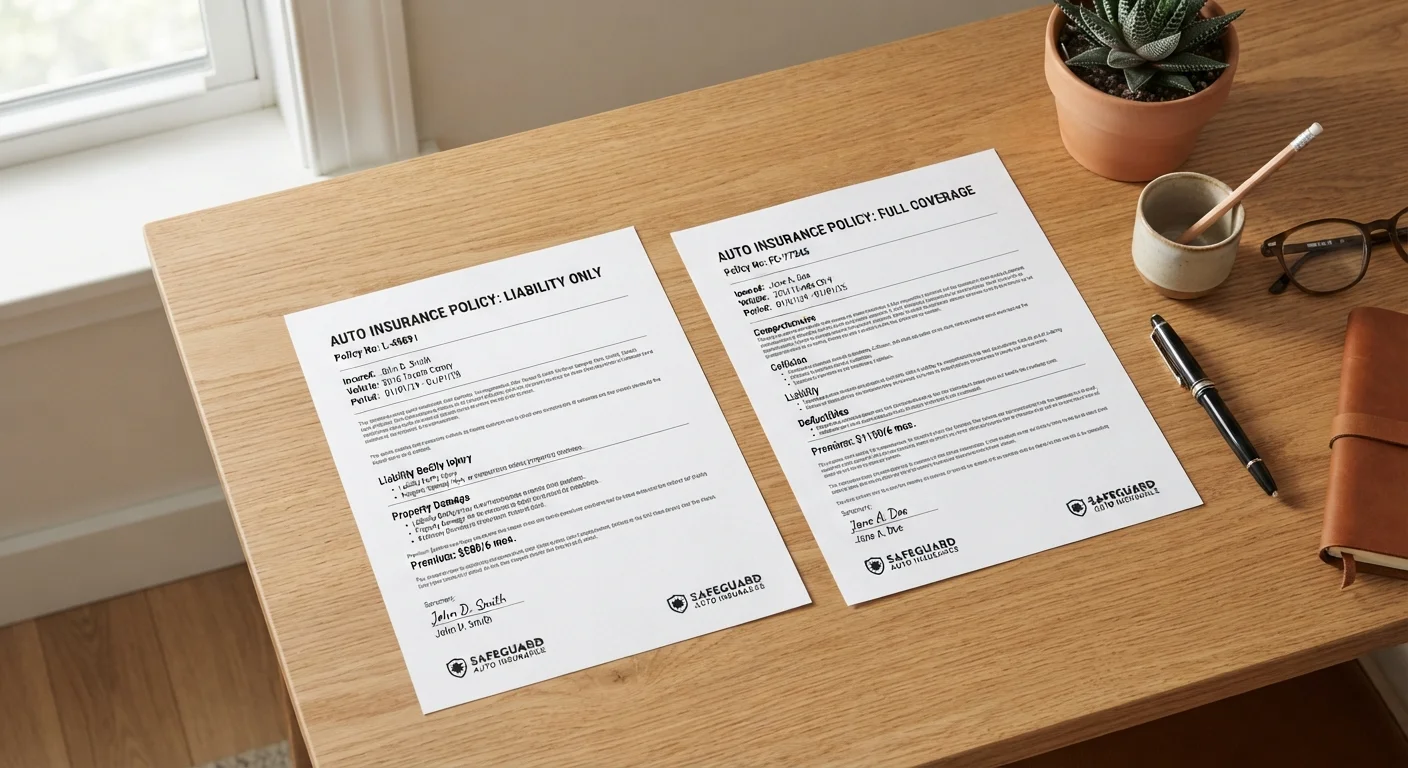
- Full coverage typically combines liability, collision, and comprehensive protection under one policy.
- The value of your vehicle relative to your annual premium cost is one of the clearest factors in this decision.
- Your deductible choice directly affects both your premium and your out-of-pocket exposure after a claim.
Option A
Liability-only coverage
The state-minimum option that protects others, not your vehicle.
Best for: Drivers with older, lower-value vehicles whose out-of-pocket repair cost would be manageable.
Option B
Full coverage
A broader policy that protects your vehicle on top of liability obligations.
Best for: Drivers with newer, financed, or high-value vehicles who want protection against physical damage to their own car.
If your car is financed or leased
Full coverage
Most lenders and leasing companies contractually require collision and comprehensive coverage for the duration of the loan or lease.
If your vehicle is older and low in market value
Liability-only coverage
When annual premiums for collision and comprehensive approach or exceed what the car is worth, the financial logic for full coverage weakens considerably.
If you drive frequently in high-traffic or weather-prone areas
Full coverage
Higher exposure to accidents, theft, and weather events increases the likelihood that comprehensive or collision coverage will pay out.
If you have savings to cover a total loss out of pocket
Liability-only coverage
Drivers with enough liquid savings to replace their vehicle without a claim may find liability-only premiums more cost-effective over time.
What each coverage type actually does
Liability coverage pays for bodily injury and property damage you cause to other people in an at-fault accident. It does not pay anything toward repairing or replacing your own car. Every state sets a minimum liability limit that drivers must carry, though those minimums vary considerably. Carrying only the state minimum is legal, but the limits are often low enough that a serious accident could leave you personally responsible for costs above the policy ceiling.
Full coverage is not a single product with a fixed definition. In practice, it refers to a policy that pairs liability with both collision and comprehensive coverage. Collision pays for damage to your vehicle from an accident with another car or object. Comprehensive covers losses from theft, fire, flooding, hail, and similar non-collision events. Together, they protect your vehicle's value, not just your legal obligation to others. For a plain-language breakdown of each coverage type, see auto insurance coverage types.
Collision vs. comprehensive: a quick distinction
Collision and comprehensive are the two physical-damage coverages that separate full coverage from liability-only. They protect against different events and carry separate deductibles. Collision vs. comprehensive coverage explains each in detail, which is worth reading before adjusting your policy.
The financial trade-off
The central question is whether the protection full coverage adds is worth its additional cost. A rough industry guideline suggests reconsidering collision and comprehensive when the combined annual premium for those coverages exceeds roughly 10 percent of the vehicle's current market value, though your own risk tolerance and financial situation matter just as much as any formula. This is general information, not personalized financial advice; a licensed insurance agent can help you evaluate your specific circumstances.
Deductibles are a significant variable. Choosing a higher deductible lowers your premium but raises the amount you pay before the insurer covers a claim. How deductibles work and what to consider covers this trade-off in detail. If you carry full coverage with a high deductible, you need enough savings on hand to actually meet that deductible after a loss.
If you financed your car and it is totaled, there is an additional gap to consider: the insurer pays actual cash value, which may be less than your remaining loan balance. Gap insurance is a separate product that covers that difference and is worth examining if you owe more than the car's current market value.
| Criterion | Liability-only | Full coverage |
|---|---|---|
| Covers damage to others | Yes | Yes |
| Covers your vehicle after a crash | No | Yes (collision) |
| Covers theft or weather damage | No | Yes (comprehensive) |
| State-required | Yes (minimum limits) | No (lender may require) |
| Monthly premium | Lower | Higher |
| Out-of-pocket after total loss | Full vehicle value | Deductible only |
When lender requirements settle the question
For many drivers, the choice is not entirely theirs. If you have an outstanding auto loan or a lease agreement, the lender or lessor almost always requires you to carry collision and comprehensive coverage and may specify minimum coverage limits and maximum deductibles. Dropping to liability-only while a loan is active would violate the loan terms and could trigger force-placed insurance, which protects the lender but typically costs more and covers less than a policy you choose yourself.
Once the loan is paid off, you regain full control over your coverage level. That is a natural point to reassess whether full coverage still makes sense relative to what your vehicle is now worth.
If you use your personal vehicle for business purposes, your coverage situation can become more complicated. Personal vs. commercial auto insurance explains where personal policies may not apply.
This article is for general informational purposes only and is not personalized insurance or financial advice. Coverage terms, exclusions, and state requirements vary. Consult a licensed insurance agent or adviser for guidance specific to your situation.