

Key Takeaways
- Collision coverage pays for damage your vehicle sustains when it hits another car or a stationary object.
- Comprehensive coverage pays for damage from events outside your control, such as theft, hail, floods, or animal strikes.
- Neither coverage is required by law, but lenders typically require both when you finance or lease a vehicle.
- Each coverage type has its own deductible, which you pay out of pocket before the insurer covers the rest.
- Dropping either coverage on an older, low-value vehicle may make financial sense, but the decision depends on your specific situation.
Option A
Collision Coverage
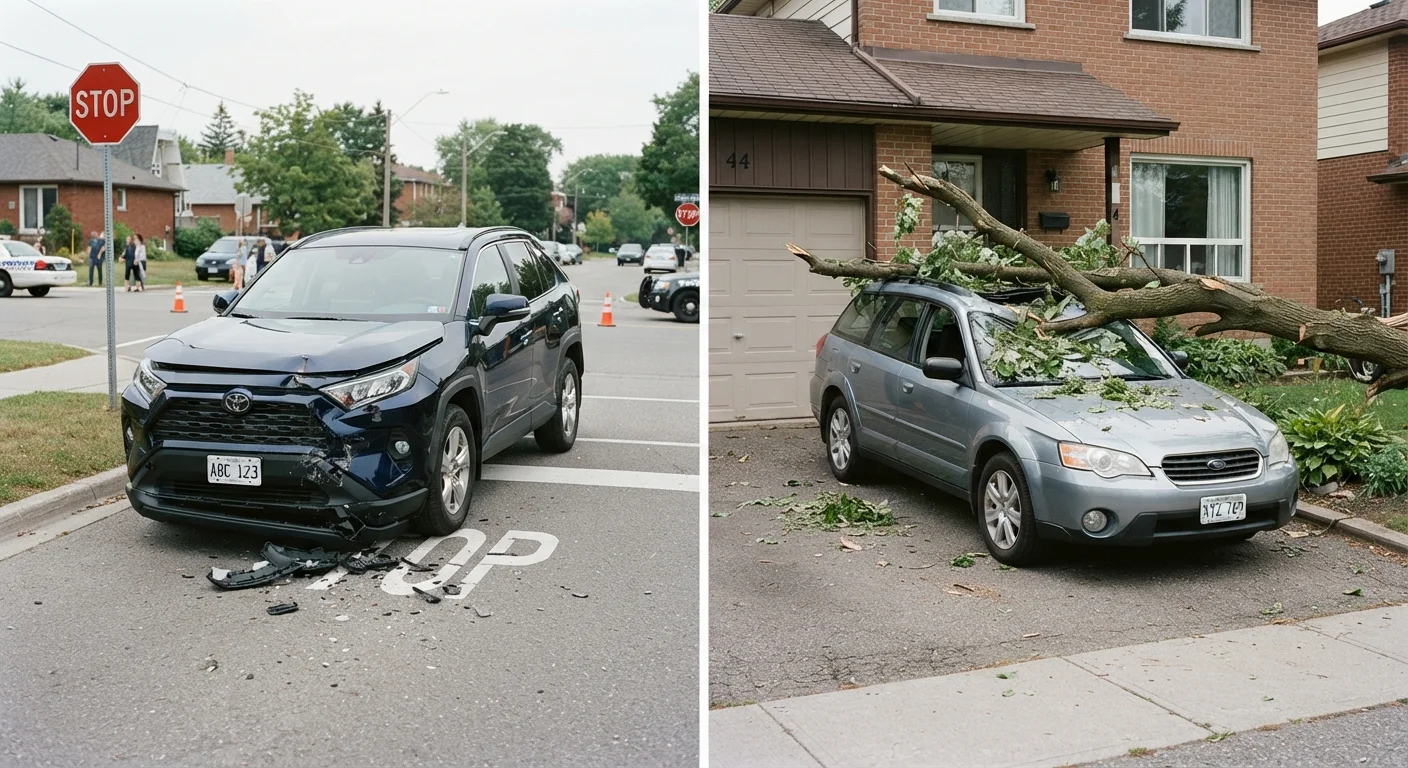
The coverage that pays when your car strikes something else.
Best for: Drivers who want protection when their vehicle is damaged in an accident with another car or object.
Option B
Comprehensive Coverage
The coverage that pays when something strikes your car.
Best for: Drivers who want protection against damage caused by weather, theft, animals, and other non-collision events.
If you finance or lease your vehicle
Both Collision and Comprehensive Coverage
Most lenders and leasing companies require both coverages as a condition of the loan or lease agreement.
If you own an older vehicle outright with low market value
Neither, potentially
If the vehicle's market value is close to or below your combined deductibles, the premium cost may outweigh any potential payout.
If you drive in areas prone to severe weather or wildlife
Comprehensive Coverage
Hailstorms, floods, and deer strikes are non-collision events that only comprehensive covers, and these risks are higher in certain regions.
If you drive frequently in heavy traffic or urban environments
Collision Coverage
Higher traffic density raises the statistical likelihood of a collision, making this coverage more likely to be used.
The core difference: what triggers each coverage
Both collision and comprehensive are optional physical damage coverages that pay to repair or replace your vehicle. The distinction between them is what causes the damage, not how severe it is.
Collision coverage responds when your vehicle makes physical contact with another vehicle or object. That includes rear-ending another car, hitting a guardrail, or backing into a concrete pillar in a parking garage. It also applies if another driver hits you and they are uninsured or their liability limit is too low to cover your repair costs, depending on your policy terms.
Comprehensive coverage responds to damage from events that are not vehicle-to-vehicle or vehicle-to-object contact. Common examples include a deer strike, a hailstorm that dents your hood, a flooded engine from rising water, a fire, vandalism, or a stolen vehicle. Comprehensive also covers broken windshields in most states, sometimes with no deductible applied, though policy terms vary.
For a broader overview of how these coverages fit into a full policy, see the auto insurance coverage types reference.
| Criterion | Collision Coverage | Comprehensive Coverage |
|---|---|---|
| What triggers it | Contact with another vehicle or object | Non-contact events (weather, theft, animals) |
| Common examples | Rear-end crash, hitting a guardrail | Hail damage, flood, deer strike, theft |
| Required by law | No | No |
| Required by lenders | Usually yes, when financing or leasing | Usually yes, when financing or leasing |
| Separate deductible | Yes | Yes (sometimes waived for glass) |
| Payout basis | Actual cash value minus deductible | Actual cash value minus deductible |
How deductibles and payouts work
Each coverage type carries its own deductible, the amount you pay before your insurer covers the remainder. If you choose a $500 deductible for collision and a $250 deductible for comprehensive, those apply independently depending on which event caused the damage.
When you file a claim, your insurer determines your vehicle's actual cash value (ACV), which accounts for depreciation. The payout is the ACV minus your deductible. If your car is worth $8,000 and your collision deductible is $1,000, the maximum payout for a total loss is $7,000.
Higher deductibles lower your monthly premium but increase what you pay at claim time. The right balance depends on your savings, how often you drive, and whether you could absorb a larger out-of-pocket cost without financial strain. For plain definitions of deductibles, premiums, and coverage limits, the insurance terms reference guide is a useful starting point.
This article is for general informational purposes only and is not insurance, financial, or legal advice. Coverage terms, exclusions, and requirements vary by insurer, policy, and state. Always review your actual policy documents and consult a licensed insurance professional for guidance specific to your situation.
When lenders require both
State law does not require collision or comprehensive coverage. Liability coverage, which pays for damage you cause to others, is the legally mandated minimum in most states. However, if you finance or lease a vehicle, the lender or leasing company almost always requires both collision and comprehensive as a condition of the agreement.
Their reasoning is straightforward: the lender has a financial interest in the vehicle until the loan is paid off. If the car is totaled or stolen and you carry no physical damage coverage, neither you nor the lender recovers the vehicle's value.
Some lenders also require gap coverage, which pays the difference between what you owe on the loan and the ACV if those figures diverge after a total loss. That is a separate coverage type, not part of collision or comprehensive, but it often appears alongside them in financed vehicle policies.
If your vehicle is used for any business purpose, coverage eligibility can get more complicated. The personal vs. commercial auto insurance guide explains where that line is typically drawn.
Deciding whether to keep, adjust, or drop coverage
For newer or higher-value vehicles, carrying both coverages generally makes financial sense. The potential repair or replacement cost is high enough that transferring the risk to an insurer is worth the premium.
For older vehicles with low market value, the math changes. If your car's ACV is $3,500 and your collision deductible is $1,000, the most you could collect from a collision claim is $2,500. If your annual collision premium is $600, you recover that breakeven point only if you file a claim within about four years. Whether that trade-off is worthwhile depends on your risk tolerance and financial position.
Adjusting your deductible is one way to manage cost without eliminating coverage entirely. Raising your deductible from $250 to $1,000 can reduce your premium noticeably, though the exact change depends on your insurer and driving profile.
~$290
Average annual comprehensive premium, US
According to the Insurance Information Institute, comprehensive coverage costs considerably less annually than collision on average.
~$590
Average annual collision premium, US
The Insurance Information Institute reports collision as the more expensive of the two physical damage coverages due to higher claim frequency.
1 in 8
Motorists uninsured in the US
The Insurance Research Council has estimated that roughly one in eight drivers on US roads carries no auto insurance at all.
Whatever you decide, verify that any changes to coverage align with your loan or lease terms before making them. Dropping required coverage can trigger a lender's right to purchase force-placed insurance on your behalf, which is typically more expensive and less comprehensive than a policy you choose yourself.